
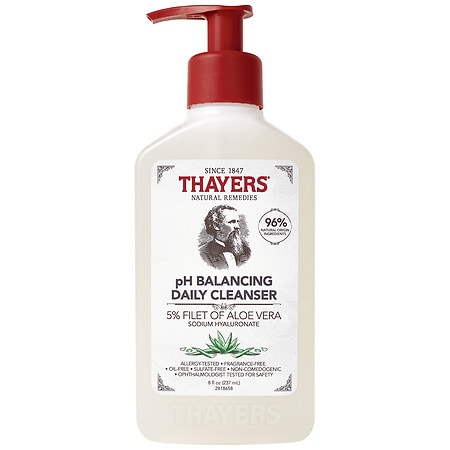
Thayers Remedies pH Balancing Gentle Face Wash with Aloe Vera - 8 fl oz: Liquid for Normal, Oily, Sensitive Skin, Paraben-Free
Analysis updated August 2026 · How Scout scores
At a glance
Summary
This face wash contains beneficial ingredients like aloe vera, glycerin, and sodium hyaluronate, which provide soothing and moisturizing benefits. However, the presence of alcohol, which can be drying and irritating, slightly detracts from its overall safety profile. The product is processed, which limits its maximum potential score, but it still maintains a relatively clean ingredient list with no parabens or synthetic fragrances.
Key ingredients 17
Aloe Barbadensis Leaf JuiceVery Good
Aloe vera is known for its soothing and moisturizing properties. It can help calm irritated skin and provide hydration. It is a natural ingredient with a long history of use in skincare.
Risks
Rarely, aloe vera can cause allergic reactions in sensitive individuals.
Benefits
Aloe vera provides soothing, anti-inflammatory, and moisturizing benefits to the skin.
GlycerinGood
Glycerin is a humectant that attracts moisture to the skin, helping to keep it hydrated. It is widely used in skincare for its moisturizing properties. It is generally well-tolerated and non-irritating.
Risks
Glycerin is generally safe, but in very high concentrations, it may cause irritation.
Benefits
Glycerin helps maintain skin hydration and improves skin barrier function.
Salicylic AcidGood
Salicylic Acid is a beta hydroxy acid known for its exfoliating and acne-fighting properties. It helps to unclog pores and reduce inflammation. It is widely used in skincare for its effectiveness in treating acne.
Risks
In high concentrations, it may cause dryness or irritation, especially in sensitive skin.
Benefits
Salicylic Acid helps exfoliate the skin, unclog pores, and reduce acne.
Sodium HyaluronateGood
Sodium Hyaluronate is a form of hyaluronic acid known for its excellent moisturizing properties. It helps retain moisture in the skin, making it plump and hydrated. It is a highly regarded ingredient in skincare for its hydrating benefits.
Risks
There are no significant risks associated with Sodium Hyaluronate.
Benefits
Sodium Hyaluronate provides deep hydration and improves skin elasticity.
Aqua/Water/EauNeutral
Water is a universal solvent used as a base in many cosmetic products. It helps dissolve other ingredients and provides hydration. It is generally considered safe and non-irritating.
Risks
There are no significant risks associated with water in cosmetics.
Benefits
Water helps to hydrate the skin and dissolve other beneficial ingredients.
PropanediolNeutral
Propanediol is used as a solvent and skin-conditioning agent. It helps improve the texture and feel of skincare products. It is considered safe for use in cosmetics.
Risks
Propanediol is generally safe, but it may cause irritation in sensitive skin types.
Benefits
Propanediol enhances the absorption of other ingredients and improves product texture.
Caprylyl/Capryl GlucosideNeutral
This ingredient is a mild surfactant derived from sugar and fatty alcohols. It helps to cleanse the skin by removing dirt and oil. It is considered gentle and suitable for sensitive skin.
Risks
There are minimal risks, but it may cause mild irritation in very sensitive individuals.
Benefits
Caprylyl/Capryl Glucoside provides gentle cleansing without stripping the skin's natural oils.
Coco-BetaineNeutral
Coco-Betaine is a mild surfactant derived from coconut oil. It helps to cleanse the skin and create foam in cleansing products. It is generally considered safe and non-irritating.
Risks
In rare cases, it may cause mild irritation or allergic reactions.
Benefits
Coco-Betaine provides gentle cleansing and helps maintain the skin's moisture balance.
Disodium Cocoyl GlutamateNeutral
This is a mild surfactant derived from coconut oil and glutamic acid. It is used for its gentle cleansing properties. It is considered safe and suitable for sensitive skin.
Risks
There are minimal risks, but it may cause mild irritation in very sensitive individuals.
Benefits
Disodium Cocoyl Glutamate provides gentle cleansing and is biodegradable.
Xanthan GumNeutral
Xanthan Gum is used as a thickening agent in cosmetics. It helps stabilize and improve the texture of products. It is generally considered safe and non-irritating.
Risks
There are no significant risks associated with Xanthan Gum in cosmetics.
Benefits
Xanthan Gum improves product texture and stability.
Citric AcidNeutral
Citric Acid is used to adjust the pH of cosmetic products. It can also act as a mild exfoliant. It is generally considered safe when used in appropriate concentrations.
Risks
In high concentrations, it may cause skin irritation or sensitivity.
Benefits
Citric Acid helps maintain product stability and can gently exfoliate the skin.
Sodium ChlorideNeutral
Sodium Chloride, or salt, is used to thicken and stabilize cosmetic formulations. It is generally considered safe and non-irritating. It is a common ingredient in many skincare products.
Risks
In high concentrations, it may cause dryness or irritation.
Benefits
Sodium Chloride helps improve product texture and stability.
Sodium Cocoyl GlutamateNeutral
This is a mild surfactant derived from coconut oil and glutamic acid. It is used for its gentle cleansing properties. It is considered safe and suitable for sensitive skin.
Risks
There are minimal risks, but it may cause mild irritation in very sensitive individuals.
Benefits
Sodium Cocoyl Glutamate provides gentle cleansing and is biodegradable.
Sodium PhytateNeutral
Sodium Phytate is used as a chelating agent in cosmetics. It helps stabilize formulations by binding metal ions. It is considered safe for use in skincare products.
Risks
There are no significant risks associated with Sodium Phytate.
Benefits
Sodium Phytate helps stabilize the product and improve its shelf life.
AlcoholNeutral
Standard formulation ingredient — neither beneficial nor harmful at typical use.
Risks
Alcohol can cause dryness, irritation, and compromise the skin barrier.
Benefits
In small amounts, alcohol can help dissolve other ingredients and improve product absorption.
Potassium SorbateBad
Synthetic preservative — flagged in daily-use products.
Risks
In rare cases, it may cause mild irritation or allergic reactions.
Benefits
Potassium Sorbate helps preserve the product and prevent microbial growth.
Sodium BenzoateBad
Synthetic preservative that can form benzene in the presence of vitamin C.
Risks
In rare cases, it may cause mild irritation or allergic reactions.
Benefits
Sodium Benzoate helps preserve the product and prevent microbial contamination.
Processing
Processed Foods
Get the full breakdown in the Scout appTake Scout shopping
Scan any product to see lab results, healthy alternatives, and your personalized analysis.
Download on theApp Store GET IT ONGoogle PlayAmazon pricing & content
Amazon price as of . Product prices and availability are accurate as of the date/time indicated and are subject to change. Any price and availability information displayed on Amazon.com at the time of purchase will apply to the purchase of this product.
CERTAIN CONTENT THAT APPEARS ON THIS SITE COMES FROM AMAZON. THIS CONTENT IS PROVIDED “AS IS” AND IS SUBJECT TO CHANGE OR REMOVAL AT ANY TIME.