
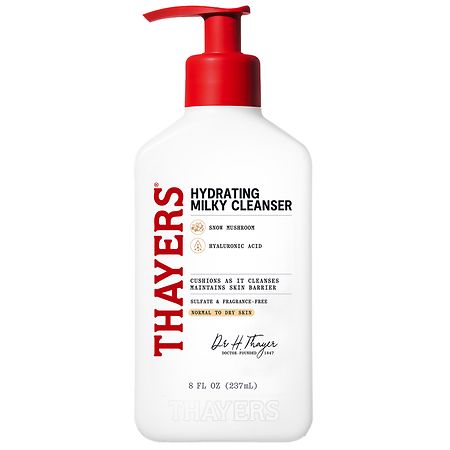
Thayers Remedies Hydrating Milky Face Wash - 8 fl oz: Paraben-Free, Sulfate-Free, Vegan, For Sensitive Skin
Analysis updated August 2026 · How Scout scores
At a glance
Summary
This face wash contains several beneficial ingredients like glycerin, sodium hyaluronate, and tocopherol, which provide hydration and antioxidant benefits. However, the presence of PEG-40 Stearate and phenoxyethanol, which can pose contamination and irritation risks, respectively, affects the overall safety profile. The product is free from parabens and sulfates, which is positive, but the inclusion of these potentially harmful ingredients results in a moderate score.
Key ingredients 21
Tremella Fuciformis PolysaccharideVery Good
Tremella Fuciformis Polysaccharide is a natural moisturizer that can hold water in the skin, similar to hyaluronic acid. It provides deep hydration and improves skin texture.
Benefits
Enhances skin hydration and texture.
GlycerinGood
Glycerin is a humectant that attracts moisture to the skin, helping to keep it hydrated. It is well-tolerated by most skin types and enhances skin barrier function.
Risks
Rarely, it may cause irritation in very sensitive skin.
Benefits
Improves skin hydration and barrier function.
Sambucus Nigra Flower WaterGood
Sambucus Nigra Flower Water is derived from elderflowers and is known for its soothing and anti-inflammatory properties. It can help calm irritated skin.
Risks
Rare allergic reactions may occur in sensitive individuals.
Benefits
Soothes and calms irritated skin.
Sodium HyaluronateGood
Sodium Hyaluronate is a form of hyaluronic acid that provides excellent hydration by attracting and holding water in the skin. It is beneficial for all skin types.
Benefits
Deeply hydrates and plumps the skin.
TocopherolGood
Tocopherol, or Vitamin E, is an antioxidant that helps to protect the skin from free radical damage. It also provides moisturizing benefits.
Risks
Rarely, it may cause allergic reactions in sensitive individuals.
Benefits
Protects skin from oxidative stress and moisturizes.
Aqua / Water / EauNeutral
Water is a common solvent used in cosmetics to dissolve other ingredients. It acts as a base for the formulation. It does not provide direct benefits or risks.
Benefits
Essential for dissolving and mixing other ingredients.
Cetearyl AlcoholNeutral
Standard formulation ingredient — neither beneficial nor harmful at typical use.
Risks
Generally safe, but may cause irritation in very sensitive individuals.
Benefits
Provides moisturizing and smoothing effects on the skin.
Stearyl AlcoholNeutral
Stearyl Alcohol is a fatty alcohol used as an emollient and thickener. It helps to stabilize and thicken formulations.
Risks
Generally considered safe, but may cause irritation in sensitive skin.
Benefits
Stabilizes and thickens cosmetic formulations.
Potassium PhosphateNeutral
Potassium Phosphate is used as a buffering agent to maintain the pH of the product. It ensures the stability of the formulation.
Benefits
Maintains product stability and pH balance.
Glyceryl StearateNeutral
Glyceryl Stearate is an emulsifier that helps to blend water and oils in formulations. It also acts as a skin conditioning agent.
Risks
Generally safe, but may cause mild irritation in sensitive skin.
Benefits
Improves texture and stability of the product.
Ammonium Polyacryloyldimethyl TaurateNeutral
Ammonium Polyacryloyldimethyl Taurate is a thickening agent that helps to stabilize emulsions. It provides a smooth texture to the product.
Risks
Generally considered safe with no significant risks.
Benefits
Improves texture and stability of the formulation.
Dipotassium PhosphateNeutral
Dipotassium Phosphate is used as a buffering agent to maintain the pH of the product. It ensures the stability of the formulation.
Benefits
Maintains product stability and pH balance.
Citric AcidNeutral
Citric Acid is used to adjust the pH of cosmetic products. It also acts as a mild exfoliant.
Risks
May cause irritation in sensitive skin if used in high concentrations.
Benefits
Helps to balance pH and provides mild exfoliation.
Trisodium Ethylenediamine DisuccinateNeutral
Trisodium Ethylenediamine Disuccinate is a chelating agent that helps to stabilize formulations by binding metal ions. It enhances the effectiveness of preservatives.
Benefits
Stabilizes formulations and enhances preservative efficacy.
EthylhexylglycerinNeutral
Ethylhexylglycerin is used as a skin conditioning agent and preservative enhancer. It helps to improve the efficacy of other preservatives.
Risks
Generally safe, but may cause mild irritation in sensitive skin.
Benefits
Enhances preservative efficacy and conditions the skin.
Polysorbate 20Neutral
Polysorbate 20 is an emulsifier that helps to mix oil and water-based ingredients. It is commonly used in cosmetics for its stabilizing properties.
Risks
May cause mild irritation in sensitive skin.
Benefits
Stabilizes and emulsifies formulations.
Cetyl AlcoholNeutral
Cetyl Alcohol is a fatty alcohol used as an emollient and thickener. It helps to soften and smooth the skin.
Risks
Generally safe, but may cause irritation in very sensitive individuals.
Benefits
Provides moisturizing and smoothing effects on the skin.
PEG-40 StearateBad
PEG-40 Stearate is an ethoxylated compound used as an emulsifier. It may contain trace amounts of 1,4-dioxane, a potential carcinogen.
Risks
Potential contamination with 1,4-dioxane, which is a concern for long-term exposure.
Benefits
Helps to emulsify and stabilize formulations.
Potassium SorbateBad
Synthetic preservative — flagged in daily-use products.
Risks
May cause mild irritation in sensitive skin.
Benefits
Prevents microbial growth and extends product shelf life.
Sodium BenzoateBad
Synthetic preservative that can form benzene in the presence of vitamin C.
Risks
May cause mild irritation in sensitive skin.
Benefits
Prevents microbial growth and extends product shelf life.
PhenoxyethanolBad
Phenoxyethanol is a preservative used to prevent bacterial growth. It can cause skin irritation and allergic reactions in some individuals.
Risks
Potential for skin irritation and allergic reactions.
Benefits
Effective preservative that extends product shelf life.
Processing
Processed Foods
Get the full breakdown in the Scout appTake Scout shopping
Scan any product to see lab results, healthy alternatives, and your personalized analysis.
Download on theApp Store GET IT ONGoogle PlayAmazon pricing & content
Amazon price as of . Product prices and availability are accurate as of the date/time indicated and are subject to change. Any price and availability information displayed on Amazon.com at the time of purchase will apply to the purchase of this product.
CERTAIN CONTENT THAT APPEARS ON THIS SITE COMES FROM AMAZON. THIS CONTENT IS PROVIDED “AS IS” AND IS SUBJECT TO CHANGE OR REMOVAL AT ANY TIME.