
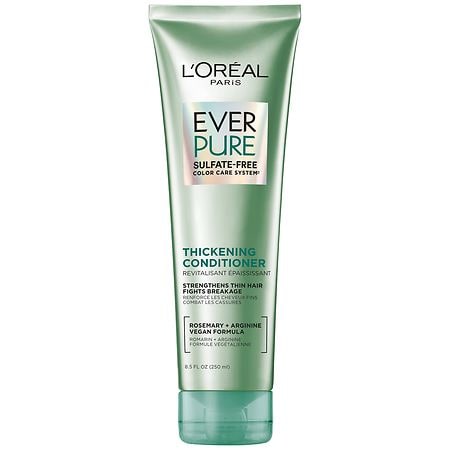

L'Oreal Paris Ever Strong Sulfate-Free Thickening Conditioner - 8.5 fl oz: For Dry, Fine Hair, Vegan, Lavender Scent
Analysis updated August 2026 · How Scout scores
At a glance
Summary
This conditioner contains beneficial ingredients like Behentrimonium Chloride, Arginine, and Tocopherol, which support hair health and conditioning. However, the presence of non-water-soluble silicones such as Dimethicone and Amodimethicone, along with potentially irritating fragrance and drying Isopropyl Alcohol, detracts from its overall safety and effectiveness. While it is sulfate-free, the inclusion of these ingredients limits its score due to potential buildup and irritation concerns.
Key ingredients 25
Behentrimonium ChlorideGood
Behentrimonium Chloride is a conditioning agent that helps to detangle and smooth hair. It is effective in reducing static and frizz. It is considered safe and beneficial for hair care.
Risks
In rare cases, it may cause mild irritation if it comes into contact with the eyes.
Benefits
It improves hair manageability and reduces frizz.
ArginineGood
Arginine is an amino acid that helps to strengthen and repair hair. It is beneficial for improving hair elasticity and reducing breakage. It is considered a positive ingredient for hair health.
Risks
There are no significant risks associated with Arginine in cosmetic formulations.
Benefits
It strengthens hair and improves elasticity.
TocopherolGood
Tocopherol, also known as Vitamin E, is an antioxidant that helps to protect hair from damage. It is beneficial for maintaining hair health and preventing oxidative stress. It is considered a positive ingredient for hair care.
Risks
There are no significant risks associated with Tocopherol in cosmetic formulations.
Benefits
It protects hair from damage and oxidative stress.
Helianthus Annuus Seed Oil / Sunflower Seed OilGood
Sunflower Seed Oil is a natural oil used as an emollient and moisturizer. It helps to nourish and condition the hair. It is considered a beneficial ingredient for hair care.
Risks
There are no significant risks associated with Sunflower Seed Oil in cosmetic formulations.
Benefits
It nourishes and conditions the hair.
Rosmarinus Officinalis Leaf Extract / Rosemary Leaf ExtractGood
Rosemary Leaf Extract is a natural ingredient with antioxidant and antimicrobial properties. It helps to protect hair from damage and promote scalp health. It is considered a beneficial ingredient for hair care.
Risks
There are no significant risks associated with Rosemary Leaf Extract in cosmetic formulations.
Benefits
It protects hair from damage and promotes scalp health.
Aqua / Water / EauNeutral
Water is a common solvent used in cosmetic formulations. It helps to dissolve other ingredients and provides a base for the product. It does not have any direct benefits or risks.
Risks
There are no known risks associated with water in cosmetic products.
Benefits
Water acts as a solvent and helps in the application of the product.
Cetearyl AlcoholNeutral
Standard formulation ingredient — neither beneficial nor harmful at typical use.
Risks
There are minimal risks associated with Cetearyl Alcohol as it is generally considered safe.
Benefits
It provides conditioning and softening effects to the hair.
Isopropyl MyristateNeutral
Isopropyl Myristate is used as an emollient and thickening agent. It helps to improve the texture and spreadability of the product. It does not have significant direct benefits or risks.
Risks
There are no significant risks associated with Isopropyl Myristate in cosmetic formulations.
Benefits
It enhances the texture and application of the conditioner.
Cetyl EstersNeutral
Cetyl Esters are used as emollients and thickeners in cosmetic products. They help to improve the texture and feel of the product. They do not have significant direct benefits or risks.
Risks
There are no known risks associated with Cetyl Esters in cosmetic products.
Benefits
They enhance the texture and feel of the conditioner.
Isopropyl AlcoholNeutral
Standard formulation ingredient — neither beneficial nor harmful at typical use.
Risks
It can cause dryness and brittleness in hair with prolonged use.
Benefits
It helps other ingredients penetrate the hair shaft.
Polyquaternium-37Neutral
Polyquaternium-37 is used as a conditioning agent to improve hair texture and manageability. It helps to reduce static and frizz. It is generally considered safe and effective for hair care.
Risks
There are no significant risks associated with Polyquaternium-37 in cosmetic formulations.
Benefits
It improves hair texture and reduces frizz.
Citric AcidNeutral
Citric Acid is used to adjust the pH of cosmetic products. It helps to maintain the stability and effectiveness of the formulation. It does not have significant direct benefits or risks.
Risks
In high concentrations, it can cause skin irritation.
Benefits
It helps to maintain the stability and pH balance of the product.
Chlorhexidine DihydrochlorideNeutral
Chlorhexidine Dihydrochloride is used as a preservative and antimicrobial agent in cosmetic products. It helps to prevent microbial growth and maintain product stability. It does not have significant direct benefits or risks.
Risks
In high concentrations, it can cause skin irritation.
Benefits
It helps to preserve the product and prevent microbial growth.
Ppg-1 Trideceth-6Neutral
PPG-1 Trideceth-6 is used as an emulsifier and surfactant in cosmetic formulations. It helps to stabilize the product and improve texture. It does not have significant direct benefits or risks.
Risks
There are no significant risks associated with PPG-1 Trideceth-6 in cosmetic formulations.
Benefits
It helps to stabilize the product and improve texture.
Sorbitan OleateNeutral
Sorbitan Oleate is used as an emulsifier in cosmetic formulations. It helps to stabilize the product and improve texture. It does not have significant direct benefits or risks.
Risks
There are no significant risks associated with Sorbitan Oleate in cosmetic formulations.
Benefits
It helps to stabilize the product and improve texture.
CitronellolNeutral
Citronellol is a fragrance component found in many essential oils. It provides a floral scent to the product. It does not have significant direct benefits or risks.
Risks
It can cause skin irritation or allergic reactions in sensitive individuals.
Benefits
It provides a pleasant floral scent to the product.
2-Oleamido-1,3-OctadecanediolNeutral
2-Oleamido-1,3-Octadecanediol is used as a conditioning agent in hair care products. It helps to improve hair texture and manageability. It does not have significant direct benefits or risks.
Risks
There are no significant risks associated with 2-Oleamido-1,3-Octadecanediol in cosmetic formulations.
Benefits
It improves hair texture and manageability.
DimethiconeBad
Dimethicone is a silicone used to provide smoothness and shine to hair. However, it is non-water-soluble and can lead to buildup on the hair over time. It is considered potentially damaging due to buildup.
Risks
It can cause buildup on the hair, leading to dullness and brittleness.
Benefits
It provides smoothness and shine to the hair.
PhenoxyethanolBad
Processed additive flagged under Scout's ingredient doctrine.
Risks
In high concentrations, it can cause skin irritation.
Benefits
It helps to preserve the product and prevent microbial growth.
Paraffinum Liquidum / Mineral Oil / Huile MineraleBad
Processed additive flagged under Scout's ingredient doctrine.
Risks
It can cause buildup on the hair if not washed out properly.
Benefits
It helps to lock in moisture and prevent dryness.
AmodimethiconeBad
Amodimethicone is a silicone used to provide smoothness and shine to hair. However, it is non-water-soluble and can lead to buildup on the hair over time. It is considered potentially damaging due to buildup.
Risks
It can cause buildup on the hair, leading to dullness and brittleness.
Benefits
It provides smoothness and shine to the hair.
LimoneneBad
Processed additive flagged under Scout's ingredient doctrine.
Risks
It can cause skin irritation or allergic reactions in sensitive individuals.
Benefits
It provides a pleasant citrus scent to the product.
Acrylates CopolymerBad
Processed additive flagged under Scout's ingredient doctrine.
Risks
There are no significant risks associated with Acrylates Copolymer in cosmetic formulations.
Benefits
It provides hold and texture to hair.
LinaloolBad
Processed additive flagged under Scout's ingredient doctrine.
Risks
It can cause skin irritation or allergic reactions in sensitive individuals.
Benefits
It provides a pleasant floral scent to the product.
Parfum / FragranceVery Bad
Fragrance is used to impart a pleasant scent to the product. However, it can cause allergic reactions or irritation in sensitive individuals. It is considered a potential irritant in cosmetic formulations.
Risks
Fragrance can cause skin irritation or allergic reactions in some individuals.
Benefits
It provides a pleasant scent to the product.
Processing
Processed Foods
Get the full breakdown in the Scout appTake Scout shopping
Scan any product to see lab results, healthy alternatives, and your personalized analysis.
Download on theApp Store GET IT ONGoogle PlayAmazon pricing & content
Amazon price as of . Product prices and availability are accurate as of the date/time indicated and are subject to change. Any price and availability information displayed on Amazon.com at the time of purchase will apply to the purchase of this product.
CERTAIN CONTENT THAT APPEARS ON THIS SITE COMES FROM AMAZON. THIS CONTENT IS PROVIDED “AS IS” AND IS SUBJECT TO CHANGE OR REMOVAL AT ANY TIME.