
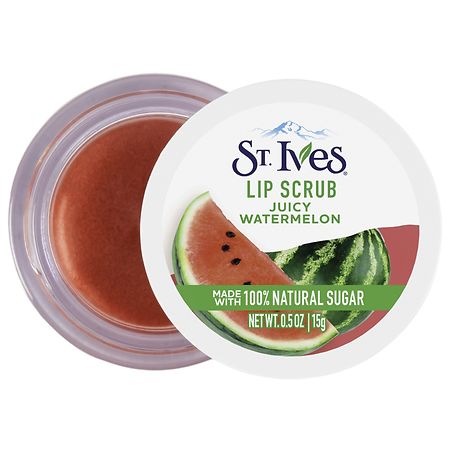

St. Ives Juicy Watermelon Lip Scrub - 0.5oz: Exfoliating, Smoothing, Lip Treatment
Analysis updated September 2026 · How Scout scores
At a glance
Summary
This lip scrub contains beneficial natural ingredients such as castor seed oil, coconut oil, sunflower seed oil, and shea butter, which are known for their moisturizing and nourishing properties. However, the presence of fragrance, which can be a mixture of various chemicals, poses a risk of skin irritation or allergic reactions. Additionally, the inclusion of microcrystalline wax and paraffin, while not as harmful as some other additives, contributes to a moderate level of processing.
Key ingredients 14
Ricinus Communis (Castor) Seed OilVery Good
Castor seed oil is a natural emollient that helps to moisturize and condition the skin. It is rich in fatty acids that are beneficial for maintaining skin health. It is well-tolerated and rarely causes allergic reactions.
Risks
Rarely, it may cause allergic reactions in sensitive individuals.
Benefits
Deeply moisturizes and conditions the lips, enhancing softness and smoothness.
Cocos Nucifera (Coconut) OilVery Good
Coconut oil is a natural moisturizer known for its hydrating properties. It contains medium-chain fatty acids that nourish and protect the skin. It is widely used in skincare for its soothing effects.
Risks
May cause breakouts in individuals with coconut allergies.
Benefits
Provides excellent hydration and has antimicrobial properties that protect the skin.
Helianthus Annuus (Sunflower) Seed OilVery Good
Sunflower seed oil is rich in vitamin E and fatty acids, which help to nourish and protect the skin. It is a lightweight oil that absorbs easily without leaving a greasy residue. It is beneficial for maintaining skin barrier function.
Risks
Generally safe, but may cause allergic reactions in some individuals.
Benefits
Nourishes and protects the skin, enhancing its natural barrier.
Butyrospermum Parkii (Shea) ButterVery Good
Shea butter is a natural fat extracted from the nuts of the shea tree. It is highly moisturizing and contains vitamins A and E, which are beneficial for skin health. It is known for its anti-inflammatory and healing properties.
Risks
Rarely, it may cause allergic reactions in individuals with nut allergies.
Benefits
Deeply moisturizes and soothes the skin, promoting healing and softness.
TocopherolVery Good
Tocopherol, or vitamin E, is a powerful antioxidant that helps to protect the skin from free radical damage. It also has moisturizing properties and supports skin health. It is well-tolerated and beneficial for all skin types.
Risks
Generally safe, but high concentrations may cause irritation.
Benefits
Protects the skin from oxidative stress and enhances moisture retention.
SucroseNeutral
Sucrose is a common sugar used as an exfoliant in lip scrubs. It helps to remove dead skin cells, leaving the lips smooth. However, it does not provide any additional nutritional benefits.
Risks
Over-exfoliation can lead to irritation if used excessively.
Benefits
Provides gentle exfoliation to improve lip texture.
Helianthus Annuus (Sunflower) Seed WaxNeutral
Sunflower seed wax is used as a thickening agent in cosmetic formulations. It helps to stabilize the product and improve texture. It does not provide significant nutritional benefits.
Benefits
Improves product texture and stability.
Microcrystalline WaxNeutral
Microcrystalline wax is used to provide structure and stability to cosmetic products. It helps to form a protective barrier on the skin. It does not offer any direct skin benefits.
Risks
Generally considered safe for topical use.
Benefits
Helps to stabilize the product and form a protective barrier.
Iron Oxides (CI 77491, CI 77492, CI 77499)Neutral
Iron oxides are used as colorants in cosmetics. They are stable and non-toxic, providing pigmentation without significant skin benefits. They are widely used in makeup products.
Risks
Generally considered safe for use in cosmetics.
Benefits
Provide color and pigmentation to the product.
Red 7 Lake (CI 15850)Neutral
Red 7 Lake is a synthetic dye used to impart color to cosmetic products. It is approved for use in lip products and provides vibrant pigmentation. It does not offer any skin benefits.
Risks
May cause irritation in sensitive individuals.
Benefits
Provides vibrant color to the product.
Yellow 5 Lake (CI 19140)Neutral
Yellow 5 Lake is a synthetic dye used to provide color in cosmetics. It is commonly used in lip products for its bright pigmentation. It does not provide any skin benefits.
Risks
May cause allergic reactions in some individuals.
Benefits
Adds bright color to the product.
ParaffinBad
Processed additive flagged under Scout's ingredient doctrine.
Risks
May cause irritation in sensitive individuals.
Benefits
Forms a protective barrier to lock in moisture.
LinaloolBad
Processed additive flagged under Scout's ingredient doctrine.
Risks
May cause allergic reactions in sensitive individuals.
Benefits
Contributes to the fragrance profile of the product.
Fragrance (Parfum)Very Bad
Fragrance is used to impart a pleasant scent to cosmetic products. However, it can be a mixture of various chemicals that may cause skin irritation or allergic reactions. It does not provide any skin benefits.
Risks
Potential to cause skin irritation or allergic reactions.
Benefits
Provides a pleasant scent to the product.
Get the full breakdown in the Scout appTake Scout shopping
Scan any product to see lab results, healthy alternatives, and your personalized analysis.
Download on theApp Store GET IT ONGoogle Play