
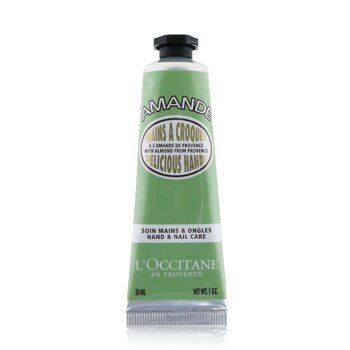

L'Occitane Almond Delicious Hands & Nail Cream, 1 Oz
Analysis updated August 2026 · How Scout scores
At a glance
Summary
This hand and nail cream contains several beneficial natural ingredients like shea butter, sunflower seed oil, and sweet almond oil, which are known for their moisturizing and nourishing properties. However, the presence of synthetic fragrance components such as parfum, limonene, linalool, and coumarin, which can be potential skin irritants, lowers its overall safety profile. The product is moderately processed, which also impacts its score.
Key ingredients 25
Helianthus Annuus (Sunflower) Seed OilVery Good
Sunflower Seed Oil is rich in vitamins and fatty acids that nourish and protect the skin. It is a natural emollient that helps to maintain the skin's barrier.
Risks
There are minimal risks; it is generally safe for most skin types.
Benefits
Sunflower Seed Oil provides antioxidant protection and helps to keep the skin soft and smooth.
Butyrospermum Parkii (Shea) ButterVery Good
Shea Butter is a natural fat extracted from the nuts of the shea tree. It is known for its moisturizing and anti-inflammatory properties.
Risks
It is generally safe, but those with nut allergies should perform a patch test.
Benefits
Shea Butter deeply moisturizes and soothes dry, irritated skin.
Prunus Amygdalus Dulcis (Sweet Almond) OilVery Good
Sweet Almond Oil is rich in vitamins and fatty acids that nourish and soften the skin. It is a natural emollient that helps to improve skin tone and texture.
Risks
Generally safe, but those with nut allergies should use with caution.
Benefits
Sweet Almond Oil provides deep hydration and helps to soothe irritated skin.
Cocos Nucifera (Coconut) OilVery Good
Coconut Oil is a natural emollient known for its moisturizing and antibacterial properties. It helps to nourish and protect the skin.
Risks
It may cause breakouts in acne-prone skin due to its comedogenic nature.
Benefits
Coconut Oil deeply moisturizes and provides a protective barrier for the skin.
TocopherolVery Good
Tocopherol, or Vitamin E, is an antioxidant that helps to protect the skin from free radical damage. It is widely used for its skin conditioning properties.
Risks
It is generally safe, but high concentrations may cause irritation in sensitive skin.
Benefits
Tocopherol provides antioxidant protection and helps to improve skin health.
GlycerinGood
Glycerin is a humectant that attracts moisture to the skin, helping to keep it hydrated. It is widely used in skincare for its moisturizing properties.
Risks
There are minimal risks associated with glycerin; it is generally safe for all skin types.
Benefits
Glycerin helps maintain skin hydration and improves skin barrier function.
Coco-Caprylate/CaprateGood
Coco-Caprylate/Caprate is an emollient derived from coconut oil and caprylic acid. It provides a silky feel and enhances skin hydration.
Risks
It is generally considered safe with low risk of irritation.
Benefits
This ingredient helps to improve skin texture and moisture retention.
Prunus Amygdalus Dulcis (Sweet Almond) ProteinGood
Sweet Almond Protein is used for its conditioning properties. It helps to strengthen and protect the skin barrier.
Risks
It is generally safe, but individuals with nut allergies should be cautious.
Benefits
This ingredient helps to improve skin elasticity and hydration.
Hydrogenated LecithinGood
Hydrogenated Lecithin is an emulsifier and skin conditioning agent. It helps to improve the texture and hydration of the skin.
Risks
It is generally safe, but may cause irritation in sensitive individuals.
Benefits
Hydrogenated Lecithin enhances skin hydration and improves product stability.
Aqua/WaterNeutral
Water is a common solvent used in cosmetics to dissolve other ingredients. It helps in the application and absorption of the product. It does not provide direct benefits or risks.
Risks
There are no significant risks associated with water in cosmetics.
Benefits
Water helps in the even distribution of other ingredients.
Cetearyl AlcoholNeutral
Standard formulation ingredient — neither beneficial nor harmful at typical use.
Risks
It is generally safe, but in rare cases, it may cause irritation in sensitive individuals.
Benefits
Cetearyl Alcohol provides a creamy texture and helps to lock in moisture.
Corn Starch ModifiedNeutral
Modified Corn Starch is used as a thickening agent in cosmetics. It helps to improve the texture and consistency of the product.
Risks
There are no significant risks associated with its use in cosmetics.
Benefits
It provides a smooth application and helps stabilize the formulation.
Hydroxyethyl Acrylate/Sodium Acryloyldimethyl Taurate CopolymerNeutral
This copolymer is used as a thickening and stabilizing agent in cosmetics. It helps to improve the texture and spreadability of the product.
Risks
There are no significant risks associated with its use in cosmetics.
Benefits
It provides a smooth application and enhances product stability.
Ceteareth-33Neutral
Ceteareth-33 is an emulsifier that helps to blend oil and water-based ingredients. It improves the texture and consistency of the product.
Risks
There is a potential risk of contamination with 1,4-dioxane, a byproduct of ethoxylation.
Benefits
It helps to create a stable and uniform formulation.
Caprylyl GlycolNeutral
Caprylyl Glycol is a skin conditioning agent and preservative. It helps to improve skin hydration and extend the shelf life of the product.
Risks
It is generally safe, but may cause irritation in sensitive skin.
Benefits
Caprylyl Glycol provides moisturizing benefits and enhances product preservation.
Cetyl AlcoholNeutral
Standard formulation ingredient — neither beneficial nor harmful at typical use.
Risks
It is generally safe, but may cause irritation in sensitive individuals.
Benefits
Cetyl Alcohol provides a creamy texture and helps to lock in moisture.
Xanthan GumNeutral
Xanthan Gum is a natural thickening agent used to stabilize cosmetic formulations. It helps to improve the texture and consistency of the product.
Risks
There are no significant risks associated with its use in cosmetics.
Benefits
It provides a smooth application and enhances product stability.
MannitolNeutral
Mannitol is a sugar alcohol used as a humectant and moisturizer in cosmetics. It helps to retain moisture in the skin.
Risks
There are no significant risks associated with its use in cosmetics.
Benefits
Mannitol helps to improve skin hydration and texture.
Sorbitan IsostearateNeutral
Sorbitan Isostearate is an emulsifier that helps to blend oil and water-based ingredients. It improves the texture and consistency of the product.
Risks
There are no significant risks associated with its use in cosmetics.
Benefits
It helps to create a stable and uniform formulation.
Citric AcidNeutral
Citric Acid is used to adjust the pH of cosmetic formulations. It helps to maintain the stability and effectiveness of the product.
Risks
In high concentrations, it may cause irritation in sensitive skin.
Benefits
Citric Acid helps to maintain the pH balance of the product.
Polysorbate 60Bad
Processed additive flagged under Scout's ingredient doctrine.
Risks
There is a potential risk of contamination with 1,4-dioxane, a byproduct of ethoxylation.
Benefits
It helps to create a stable and uniform formulation.
LimoneneBad
Limonene is a fragrance component that can oxidize and become a skin irritant. It is often used for its citrus scent.
Risks
Limonene can cause skin irritation and allergic reactions upon oxidation.
Benefits
It provides a fresh, citrus scent to the product.
LinaloolBad
Linalool is a fragrance component that can oxidize and become a skin irritant. It is commonly used for its floral scent.
Risks
Linalool can cause skin irritation and allergic reactions upon oxidation.
Benefits
It provides a pleasant floral scent to the product.
CoumarinBad
Coumarin is a fragrance component that can cause skin irritation and allergic reactions. It is used for its sweet scent.
Risks
Coumarin can cause allergic reactions and skin irritation in sensitive individuals.
Benefits
It provides a sweet, pleasant scent to the product.
Parfum/FragranceVery Bad
Fragrance is used to impart a pleasant scent to cosmetics. However, it can be a common irritant and allergen for sensitive skin.
Risks
Fragrance can cause allergic reactions and irritation, especially in sensitive individuals.
Benefits
It provides a pleasant scent to the product.
Get the full breakdown in the Scout appTake Scout shopping
Scan any product to see lab results, healthy alternatives, and your personalized analysis.
Download on theApp Store GET IT ONGoogle Play