
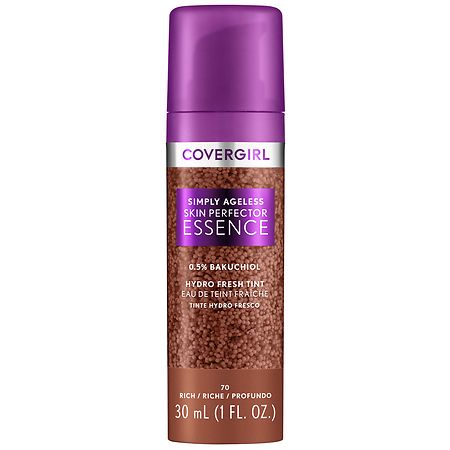
COVERGIRL Simply Ageless Skin Perfector Essence Vegan Foundation - 70 Rich - 1 fl oz: Liquid, Finish, Paraben-Free, Vegan
Analysis updated August 2026 · How Scout scores
At a glance
Summary
This foundation contains beneficial ingredients like glycerin and bakuchiol, which provide moisturizing and anti-aging benefits. However, it also includes acrylates, which are synthetic polymers that can be concerning for some users. The presence of aluminum hydroxide and synthetic polymers indicates a moderate level of processing, which affects the overall score.
Key ingredients 23
GLYCERINGood
Glycerin is a humectant that attracts moisture to the skin, helping to keep it hydrated. It is widely used in skincare products for its moisturizing properties. It is considered safe and beneficial for most skin types.
Risks
There are minimal risks associated with glycerin, though it may cause irritation in very sensitive skin.
Benefits
Glycerin helps maintain skin hydration and improves skin barrier function.
BAKUCHIOLGood
Bakuchiol is a plant-based compound known for its anti-aging properties. It is often used as a natural alternative to retinol. It is considered safe and beneficial for most skin types.
Risks
There are minimal risks associated with bakuchiol, though it may cause irritation in very sensitive skin.
Benefits
Bakuchiol helps reduce the appearance of fine lines and improves skin texture.
AQUA/WATER/EAUNeutral
Water is a common solvent used in cosmetics to dissolve other ingredients. It helps in the application and absorption of the product. It does not have any direct benefits or risks associated with its use in cosmetics.
Risks
There are no significant risks associated with water in cosmetics.
Benefits
Water helps in the even distribution of other ingredients.
HEXYL LAURATENeutral
Hexyl laurate is an ester used as an emollient and skin conditioning agent. It helps to soften and smooth the skin. It is generally considered safe for use in cosmetics.
Risks
There are no significant risks associated with hexyl laurate.
Benefits
It provides a smooth application and helps to condition the skin.
PROPANEDIOLNeutral
Propanediol is a glycol used as a solvent and skin-conditioning agent. It enhances the absorption of other ingredients. It is generally recognized as safe for use in cosmetics.
Risks
Propanediol may cause mild irritation in sensitive individuals.
Benefits
It improves the texture and feel of the product on the skin.
OCTYLDODECANOLNeutral
Octyldodecanol is a fatty alcohol used as an emollient and emulsifier. It helps to improve the texture and spreadability of the product. It is considered safe for use in cosmetics.
Risks
There are minimal risks associated with octyldodecanol.
Benefits
It provides a smooth application and helps to condition the skin.
PENTYLENE GLYCOLNeutral
Pentylene glycol is a synthetic humectant and solvent. It helps to retain moisture in the skin and improve the product's texture. It is generally considered safe for use in cosmetics.
Risks
Pentylene glycol may cause mild irritation in sensitive skin.
Benefits
It enhances skin hydration and improves product stability.
DISTEARDIMONIUM HECTORITENeutral
Disteardimonium hectorite is a clay-derived thickening agent used to stabilize emulsions. It helps to improve the texture and consistency of the product. It is generally considered safe for use in cosmetics.
Risks
There are no significant risks associated with disteardimonium hectorite.
Benefits
It enhances the stability and texture of the product.
ALUMINUM HYDROXIDENeutral
Aluminum hydroxide is used as a thickening agent and opacifier in cosmetics. It helps to improve the texture and appearance of the product. It is generally considered safe for use in cosmetics.
Risks
There are minimal risks associated with aluminum hydroxide.
Benefits
It improves the texture and opacity of the product.
CARBOMERNeutral
Carbomer is a synthetic polymer used as a thickening agent in cosmetics. It helps to stabilize and thicken formulations. It is generally considered safe for use in cosmetics.
Risks
Carbomer may cause mild irritation in sensitive skin.
Benefits
It enhances the texture and stability of the product.
PROPYLENE CARBONATENeutral
Propylene carbonate is a solvent used to dissolve other ingredients in cosmetics. It helps to improve the texture and spreadability of the product. It is generally considered safe for use in cosmetics.
Risks
There are minimal risks associated with propylene carbonate.
Benefits
It enhances the texture and application of the product.
TRISODIUM ETHYLENEDIAMINE DISUCCINATENeutral
Trisodium ethylenediamine disuccinate is a chelating agent used to stabilize formulations. It helps to prevent the degradation of the product. It is generally considered safe for use in cosmetics.
Risks
There are no significant risks associated with trisodium ethylenediamine disuccinate.
Benefits
It enhances the stability and shelf life of the product.
SODIUM LAUROYL GLUTAMATENeutral
Sodium lauroyl glutamate is a mild surfactant used for its cleansing properties. It is derived from natural sources and is considered gentle on the skin. It is generally considered safe for use in cosmetics.
Risks
There are minimal risks associated with sodium lauroyl glutamate.
Benefits
It provides gentle cleansing and is suitable for sensitive skin.
LYSINENeutral
Lysine is an amino acid used as a conditioning agent in cosmetics. It helps to improve the texture and feel of the product. It is generally considered safe for use in cosmetics.
Risks
There are no significant risks associated with lysine.
Benefits
It enhances the texture and feel of the product on the skin.
SODIUM HYDROXIDENeutral
Sodium hydroxide is used to adjust the pH of cosmetic formulations. It is used in very small amounts to ensure product stability. It is generally considered safe for use in cosmetics when properly formulated.
Risks
In high concentrations, sodium hydroxide can be irritating, but it is used in safe amounts in cosmetics.
Benefits
It helps to maintain the stability and effectiveness of the product.
ALCALIGENES POLYSACCHARIDESNeutral
Alcaligenes polysaccharides are used as thickening and stabilizing agents in cosmetics. They help to improve the texture and consistency of the product. They are generally considered safe for use in cosmetics.
Risks
There are no significant risks associated with alcaligenes polysaccharides.
Benefits
They enhance the texture and stability of the product.
MAGNESIUM CHLORIDENeutral
Magnesium chloride is used as a stabilizer and thickening agent in cosmetics. It helps to improve the texture and consistency of the product. It is generally considered safe for use in cosmetics.
Risks
There are no significant risks associated with magnesium chloride.
Benefits
It enhances the texture and stability of the product.
TRANEXAMIC ACIDNeutral
Tranexamic acid is used for its skin-brightening properties in cosmetics. It helps to reduce the appearance of dark spots and hyperpigmentation. It is generally considered safe for use in cosmetics.
Risks
There are minimal risks associated with tranexamic acid, though it may cause irritation in very sensitive skin.
Benefits
It helps to brighten the skin and reduce hyperpigmentation.
IRON OXIDES (CI 77491, CI 77492, CI 77499)Neutral
Iron oxides are used as colorants in cosmetics. They provide pigmentation and are considered safe for use in cosmetics. They are widely used in makeup products for their color properties.
Risks
There are no significant risks associated with iron oxides.
Benefits
They provide natural-looking pigmentation and are safe for use in cosmetics.
TITANIUM DIOXIDE (CI 77891)Neutral
Titanium dioxide is used as a pigment and UV filter in cosmetics. It provides coverage and sun protection. It is generally considered safe for use in cosmetics.
Risks
There are minimal risks associated with titanium dioxide, though inhalation of its powder form should be avoided.
Benefits
It provides coverage and helps protect the skin from UV radiation.
BENZYL ALCOHOLBad
Processed additive flagged under Scout's ingredient doctrine.
Risks
Benzyl alcohol can cause skin irritation and allergic reactions in sensitive individuals.
Benefits
It acts as a preservative, extending the shelf life of the product.
AMODIMETHICONEBad
Processed additive flagged under Scout's ingredient doctrine.
Risks
There are minimal risks associated with amodimethicone.
Benefits
It provides a smooth application and helps to condition the skin.
ACRYLATES/C10-30 ALKYL ACRYLATE CROSSPOLYMERBad
Processed additive flagged under Scout's ingredient doctrine.
Risks
There are minimal risks associated with this polymer.
Benefits
It enhances the texture and stability of the product.
Get the full breakdown in the Scout appTake Scout shopping
Scan any product to see lab results, healthy alternatives, and your personalized analysis.
Download on theApp Store GET IT ONGoogle PlayAmazon pricing & content
Amazon price as of . Product prices and availability are accurate as of the date/time indicated and are subject to change. Any price and availability information displayed on Amazon.com at the time of purchase will apply to the purchase of this product.
CERTAIN CONTENT THAT APPEARS ON THIS SITE COMES FROM AMAZON. THIS CONTENT IS PROVIDED “AS IS” AND IS SUBJECT TO CHANGE OR REMOVAL AT ANY TIME.