
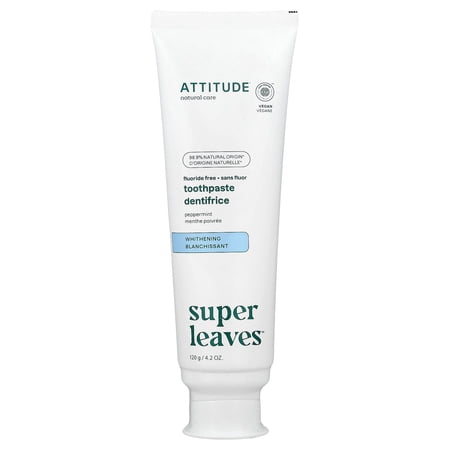
ATTITUDE Super Leaves™ Fluoride Free Whitening Toothpaste Peppermint 4.2 oz (120 g)
Analysis updated August 2026 · How Scout scores
At a glance
Summary
This toothpaste contains beneficial ingredients such as hydroxyapatite, which helps remineralize and strengthen tooth enamel, and peppermint oil, which provides natural antimicrobial properties and freshens breath. The product avoids harmful ingredients like fluoride and SLS, making it a safer choice for oral care. However, it is a processed product, which slightly limits its maximum potential score.
Key ingredients 15
HydroxyapatiteVery Good
Hydroxyapatite is a biomimetic mineral that helps to remineralize and strengthen tooth enamel. It is considered a highly beneficial ingredient in oral care for its ability to repair and protect teeth. It is safe and effective for daily use.
Risks
There are no significant risks associated with hydroxyapatite in toothpaste.
Benefits
Hydroxyapatite helps to remineralize enamel and strengthen teeth, protecting against cavities.
GlycerinGood
Beneficial ingredient — whole-food or functional value in this product class.
Risks
There are minimal risks associated with glycerin in toothpaste.
Benefits
Glycerin helps to maintain moisture and provides a smooth texture.
Mentha Piperita (peppermint) oilGood
Peppermint oil is used for its natural antimicrobial properties and its ability to freshen breath. It provides a pleasant flavor and can help reduce oral bacteria. It is generally considered beneficial in oral care products.
Risks
In rare cases, peppermint oil can cause irritation or allergic reactions.
Benefits
Peppermint oil helps to freshen breath and has natural antimicrobial properties.
Aqua / water / eauNeutral
Water is a common solvent used to dissolve other ingredients and create a paste consistency. It does not contribute to the active properties of the toothpaste. It is generally considered safe and inert.
Risks
There are no known risks associated with water in toothpaste.
Benefits
Water helps to dissolve and evenly distribute other ingredients in the formulation.
SorbitolNeutral
Sorbitol is a sugar alcohol used as a sweetener and humectant in toothpaste. It helps to retain moisture and improve texture. It is generally safe but can cause digestive issues if ingested in large amounts.
Risks
Excessive ingestion may lead to digestive discomfort or laxative effects.
Benefits
Sorbitol helps to maintain moisture and improve the taste of the toothpaste.
Hydrated SilicaNeutral
Hydrated silica is used as a mild abrasive to help remove plaque and surface stains from teeth. It is effective in polishing teeth without being overly abrasive. It is generally safe for use in toothpaste.
Risks
Excessive abrasiveness can potentially damage enamel over time, but hydrated silica is typically formulated to be gentle.
Benefits
Hydrated silica helps to clean and polish teeth, contributing to a whitening effect.
Sodium Methyl Cocoyl TaurateNeutral
Sodium methyl cocoyl taurate is a mild surfactant used to create foam and improve the spreadability of toothpaste. It is derived from coconut oil and is considered gentle on the mucous membranes. It is generally safe for use in oral care products.
Risks
There are minimal risks associated with this ingredient in toothpaste.
Benefits
It helps to create a foaming action that aids in the distribution of the toothpaste in the mouth.
Xanthan GumNeutral
Xanthan gum is used as a thickening agent to stabilize the toothpaste and improve its texture. It is a polysaccharide that is generally recognized as safe for use in food and oral care products. It does not have active oral health benefits.
Risks
There are minimal risks associated with xanthan gum in toothpaste.
Benefits
Xanthan gum helps to stabilize the formulation and improve texture.
Sodium ChlorideNeutral
Sodium chloride, or table salt, is used in toothpaste as a mild abrasive and to enhance flavor. It is generally safe and has been used traditionally for oral hygiene. It does not have significant active benefits in small amounts.
Risks
There are minimal risks associated with sodium chloride in toothpaste.
Benefits
Sodium chloride can help to clean teeth and enhance the flavor of the toothpaste.
Rebaudioside ANeutral
Rebaudioside A is a natural sweetener derived from the stevia plant. It is used to improve the taste of toothpaste without adding sugar. It is considered safe and does not contribute to tooth decay.
Risks
There are minimal risks associated with rebaudioside A in toothpaste.
Benefits
Rebaudioside A provides sweetness without contributing to cavities.
Citric AcidNeutral
Citric acid is used to adjust the pH of toothpaste and can help in stabilizing the formulation. It is generally safe but can be erosive to enamel if used in high concentrations. In toothpaste, it is typically used in safe amounts.
Risks
High concentrations can erode enamel, but it is used in safe amounts in toothpaste.
Benefits
Citric acid helps to stabilize the formulation and adjust pH.
Carica Papaya (papaya) leaf extractNeutral
Papaya leaf extract is included for its potential enzymatic properties that may aid in breaking down proteins. It is generally safe but lacks substantial evidence for significant oral health benefits. It is more commonly used for its potential skin benefits.
Risks
There are minimal risks associated with papaya leaf extract in toothpaste.
Benefits
Papaya leaf extract may provide mild enzymatic activity that could aid in oral hygiene.
Camellia Sinensis (tea) leaf extractNeutral
Tea leaf extract is known for its antioxidant properties and potential antimicrobial effects. It is generally safe and may contribute to oral health by reducing bacteria. However, its effectiveness in toothpaste is not well-documented.
Risks
There are minimal risks associated with tea leaf extract in toothpaste.
Benefits
Tea leaf extract may provide antioxidant and antimicrobial benefits.
Sodium BenzoateBad
Synthetic preservative that can form benzene in the presence of vitamin C.
Risks
There are minimal risks associated with sodium benzoate in toothpaste.
Benefits
Sodium benzoate helps to preserve the product by preventing microbial growth.
Potassium SorbateBad
Synthetic preservative — flagged in daily-use products.
Risks
There are minimal risks associated with potassium sorbate in toothpaste.
Benefits
Potassium sorbate helps to preserve the product by preventing mold and yeast growth.
Get the full breakdown in the Scout appTake Scout shopping
Scan any product to see lab results, healthy alternatives, and your personalized analysis.
Download on theApp Store GET IT ONGoogle PlayAmazon pricing & content
Amazon price as of . Product prices and availability are accurate as of the date/time indicated and are subject to change. Any price and availability information displayed on Amazon.com at the time of purchase will apply to the purchase of this product.
CERTAIN CONTENT THAT APPEARS ON THIS SITE COMES FROM AMAZON. THIS CONTENT IS PROVIDED “AS IS” AND IS SUBJECT TO CHANGE OR REMOVAL AT ANY TIME.