
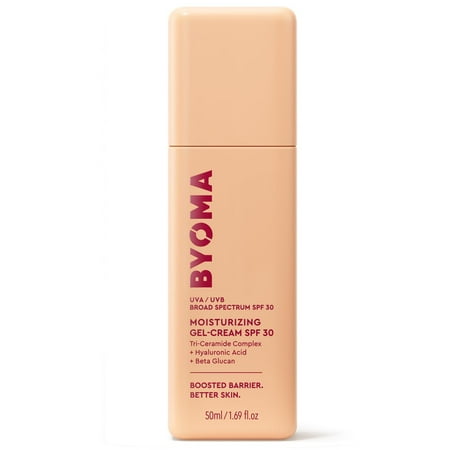

BYOMA Gel Face Moisturizer - SPF 30 - 1.69 fl oz
Analysis updated October 2026 · How Scout scores
At a glance
Summary
This moisturizer contains beneficial ingredients like glycerin, beta-glucan, and sodium hyaluronate, which are known for their hydrating and soothing properties. However, the presence of dimethicone and synthetic polymers indicates a moderate level of processing. While it lacks harsh chemicals or known endocrine disruptors, the inclusion of chemical UV filters and synthetic emulsifiers slightly lowers its overall safety profile.
Key ingredients 34
Beta-GlucanVery Good
Beta-Glucan is known for its skin-soothing and anti-aging properties. It helps to reduce redness and irritation while providing moisture. It is considered beneficial for sensitive and aging skin.
Risks
There are minimal risks associated with beta-glucan, though it may cause irritation in very sensitive skin.
Benefits
It soothes the skin and provides anti-aging benefits by reducing fine lines and wrinkles.
PanthenolVery Good
Panthenol, also known as provitamin B5, is used for its moisturizing and skin-soothing properties. It helps to improve skin hydration and reduce irritation. It is considered safe and beneficial for most skin types.
Risks
There are minimal risks associated with panthenol.
Benefits
It moisturizes and soothes the skin, reducing irritation and improving hydration.
TocopherolVery Good
Tocopherol, also known as vitamin E, is used for its antioxidant properties. It helps to protect the skin from free radical damage and improve skin health. It is considered safe and beneficial for most skin types.
Risks
There are minimal risks associated with tocopherol.
Benefits
It provides antioxidant protection and supports skin health.
GlycerinGood
Glycerin is a humectant that attracts moisture to the skin, helping to keep it hydrated. It is widely used in skincare for its moisturizing properties. It is considered safe and beneficial for most skin types.
Risks
There are minimal risks associated with glycerin, though it may cause irritation in very sensitive skin.
Benefits
Glycerin helps maintain skin hydration and improves skin barrier function.
Sodium HyaluronateGood
Sodium Hyaluronate is a form of hyaluronic acid that is highly effective in retaining moisture in the skin. It helps to plump and hydrate the skin, reducing the appearance of fine lines. It is considered safe and beneficial for all skin types.
Risks
There are minimal risks associated with sodium hyaluronate.
Benefits
It provides intense hydration and helps to maintain skin elasticity.
Caprylic/Capric TriglycerideGood
Caprylic/Capric Triglyceride is an emollient derived from coconut oil and glycerin. It helps to smooth and soften the skin. It is considered safe and beneficial for most skin types.
Risks
There are minimal risks associated with this ingredient.
Benefits
It provides a lightweight, non-greasy moisturizing effect.
Ceramide NPGood
Ceramide NP is a lipid that helps to restore the skin barrier and retain moisture. It is beneficial for dry and sensitive skin types. It is considered safe and effective in skincare formulations.
Risks
There are minimal risks associated with ceramide NP.
Benefits
It strengthens the skin barrier and improves hydration.
CholesterolGood
Cholesterol is a lipid that helps to maintain the skin's natural barrier and improve moisture retention. It is beneficial for dry and aging skin. It is considered safe and effective in skincare formulations.
Risks
There are minimal risks associated with cholesterol in cosmetics.
Benefits
It supports the skin barrier and enhances hydration.
PhytosphingosineGood
Phytosphingosine is a lipid that helps to restore the skin barrier and has anti-inflammatory properties. It is beneficial for acne-prone and sensitive skin. It is considered safe and effective in skincare formulations.
Risks
There are minimal risks associated with phytosphingosine.
Benefits
It reduces inflammation and supports the skin barrier.
WaterNeutral
Water is a common solvent used in cosmetics to dissolve other ingredients. It helps in the application and absorption of the product. It does not have any direct benefits or risks.
Risks
There are no significant risks associated with water in cosmetics.
Benefits
Water helps in hydrating the skin by providing moisture.
PropanediolNeutral
Propanediol is used as a solvent and skin-conditioning agent in cosmetics. It helps in improving the texture and feel of the product. It is generally considered safe for use in cosmetics.
Risks
Propanediol may cause mild irritation in sensitive individuals.
Benefits
It improves the texture and absorption of skincare products.
Caprylhydroxamic AcidNeutral
Caprylhydroxamic Acid is used as a preservative in cosmetics to prevent microbial growth. It is an alternative to parabens and is considered safe for use. It does not have direct skin benefits or risks.
Risks
There are no significant risks associated with this ingredient in the concentrations used in cosmetics.
Benefits
It helps to preserve the product by preventing microbial contamination.
Caprylyl GlycolNeutral
Caprylyl Glycol is used as a skin-conditioning agent and preservative in cosmetics. It helps to improve the texture and feel of the product. It is generally considered safe for use in cosmetics.
Risks
There are no significant risks associated with this ingredient in the concentrations used in cosmetics.
Benefits
It enhances the texture and stability of skincare products.
Dextrin PalmitateNeutral
Dextrin Palmitate is used as an emulsifier and thickening agent in cosmetics. It helps to stabilize formulations and improve texture. It is generally considered safe for use in cosmetics.
Risks
There are no significant risks associated with this ingredient in the concentrations used in cosmetics.
Benefits
It stabilizes formulations and improves product texture.
Dibutyl Ethylhexanoyl GlutamideNeutral
Dibutyl Ethylhexanoyl Glutamide is used as a thickening agent and texture enhancer in cosmetics. It helps to improve the spreadability and feel of the product. It is generally considered safe for use in cosmetics.
Risks
There are no significant risks associated with this ingredient in the concentrations used in cosmetics.
Benefits
It enhances the texture and application of skincare products.
Stearic AcidNeutral
Stearic Acid is a fatty acid used as an emulsifier and thickening agent in cosmetics. It helps to stabilize formulations and improve texture. It is generally considered safe for use in cosmetics.
Risks
There are no significant risks associated with this ingredient in the concentrations used in cosmetics.
Benefits
It stabilizes formulations and improves product texture.
Oleic AcidNeutral
Oleic Acid is a fatty acid used as an emulsifier and skin-conditioning agent in cosmetics. It helps to improve the texture and feel of the product. It is generally considered safe for use in cosmetics.
Risks
There are no significant risks associated with this ingredient in the concentrations used in cosmetics.
Benefits
It enhances the texture and moisturizing properties of skincare products.
Dibutyl Lauroyl GlutamideNeutral
Dibutyl Lauroyl Glutamide is used as a thickening agent and texture enhancer in cosmetics. It helps to improve the spreadability and feel of the product. It is generally considered safe for use in cosmetics.
Risks
There are no significant risks associated with this ingredient in the concentrations used in cosmetics.
Benefits
It enhances the texture and application of skincare products.
Hydrogenated LecithinNeutral
Hydrogenated Lecithin is used as an emulsifier and skin-conditioning agent in cosmetics. It helps to stabilize formulations and improve texture. It is generally considered safe for use in cosmetics.
Risks
There are no significant risks associated with this ingredient in the concentrations used in cosmetics.
Benefits
It stabilizes formulations and improves product texture.
Eugenia Caryophyllus Bud ExtractNeutral
Eugenia Caryophyllus Bud Extract, also known as clove extract, is used for its antioxidant and antimicrobial properties. It helps to protect the skin from environmental stressors. It is generally considered safe for use in cosmetics.
Risks
There are no significant risks associated with this ingredient in the concentrations used in cosmetics.
Benefits
It provides antioxidant protection and has antimicrobial properties.
HydroxyacetophenoneNeutral
Hydroxyacetophenone is used as an antioxidant and preservative booster in cosmetics. It helps to enhance the stability and efficacy of the product. It is generally considered safe for use in cosmetics.
Risks
There are no significant risks associated with this ingredient in the concentrations used in cosmetics.
Benefits
It boosts the antioxidant and preservative efficacy of skincare products.
Lactic AcidNeutral
Standard formulation ingredient — neither beneficial nor harmful at typical use.
Risks
Lactic Acid may cause irritation or sensitivity in some individuals, especially at higher concentrations.
Benefits
It exfoliates the skin, improving texture and promoting a more even skin tone.
OctyldodecanolNeutral
Octyldodecanol is used as an emollient and texture enhancer in cosmetics. It helps to improve the spreadability and feel of the product. It is generally considered safe for use in cosmetics.
Risks
There are no significant risks associated with this ingredient in the concentrations used in cosmetics.
Benefits
It enhances the texture and application of skincare products.
1,2-HexanediolNeutral
1,2-Hexanediol is used as a solvent and preservative in cosmetics. It helps to improve the texture and stability of the product. It is generally considered safe for use in cosmetics.
Risks
There are no significant risks associated with this ingredient in the concentrations used in cosmetics.
Benefits
It enhances the texture and stability of skincare products.
Poly C10-30 Alkyl AcrylateNeutral
Poly C10-30 Alkyl Acrylate is used as a thickening agent and emulsifier in cosmetics. It helps to stabilize formulations and improve texture. It is generally considered safe for use in cosmetics.
Risks
There are no significant risks associated with this ingredient in the concentrations used in cosmetics.
Benefits
It stabilizes formulations and improves product texture.
PullulanNeutral
Pullulan is used as a film-forming agent and texture enhancer in cosmetics. It helps to provide a smooth application and improve the feel of the product. It is generally considered safe for use in cosmetics.
Risks
There are no significant risks associated with this ingredient in the concentrations used in cosmetics.
Benefits
It provides a smooth, silky feel and enhances product texture.
Sclerotium GumNeutral
Sclerotium Gum is used as a thickening agent and stabilizer in cosmetics. It helps to improve the texture and stability of the product. It is generally considered safe for use in cosmetics.
Risks
There are no significant risks associated with this ingredient in the concentrations used in cosmetics.
Benefits
It stabilizes formulations and improves product texture.
Sodium Polyacryloyldimethyl TaurateNeutral
Sodium Polyacryloyldimethyl Taurate is used as a thickening agent and emulsifier in cosmetics. It helps to stabilize formulations and improve texture. It is generally considered safe for use in cosmetics.
Risks
There are no significant risks associated with this ingredient in the concentrations used in cosmetics.
Benefits
It stabilizes formulations and improves product texture.
Solidago Virgaurea ExtractNeutral
Solidago Virgaurea Extract, also known as goldenrod extract, is used for its antioxidant and anti-inflammatory properties. It helps to protect the skin from environmental stressors. It is generally considered safe for use in cosmetics.
Risks
There are no significant risks associated with this ingredient in the concentrations used in cosmetics.
Benefits
It provides antioxidant protection and has anti-inflammatory properties.
Xanthan GumNeutral
Xanthan Gum is used as a thickening agent and stabilizer in cosmetics. It helps to improve the texture and stability of the product. It is generally considered safe for use in cosmetics.
Risks
There are no significant risks associated with this ingredient in the concentrations used in cosmetics.
Benefits
It stabilizes formulations and improves product texture.
Butyloctyl SalicylateBad
Processed additive flagged under Scout's ingredient doctrine.
Risks
There are no significant risks associated with this ingredient in the concentrations used in cosmetics.
Benefits
It enhances the effectiveness of sunscreen products by improving their spreadability.
DimethiconeBad
Occlusive silicone film-former — flagged under clean-beauty doctrine.
Risks
Dimethicone can potentially clog pores in some individuals.
Benefits
It provides a smooth, silky feel and helps to lock in moisture.
Dimethicone/Vinyl Dimethicone CrosspolymerBad
Processed additive flagged under Scout's ingredient doctrine.
Risks
There are no significant risks associated with this ingredient in the concentrations used in cosmetics.
Benefits
It provides a smooth, silky feel and enhances product texture.
LecithinBad
Processed additive flagged under Scout's ingredient doctrine.
Risks
There are no significant risks associated with this ingredient in the concentrations used in cosmetics.
Benefits
It stabilizes formulations and improves product texture.
Get the full breakdown in the Scout appTake Scout shopping
Scan any product to see lab results, healthy alternatives, and your personalized analysis.
Download on theApp Store GET IT ONGoogle PlayAmazon pricing & content
Amazon price as of . Product prices and availability are accurate as of the date/time indicated and are subject to change. Any price and availability information displayed on Amazon.com at the time of purchase will apply to the purchase of this product.
CERTAIN CONTENT THAT APPEARS ON THIS SITE COMES FROM AMAZON. THIS CONTENT IS PROVIDED “AS IS” AND IS SUBJECT TO CHANGE OR REMOVAL AT ANY TIME.