
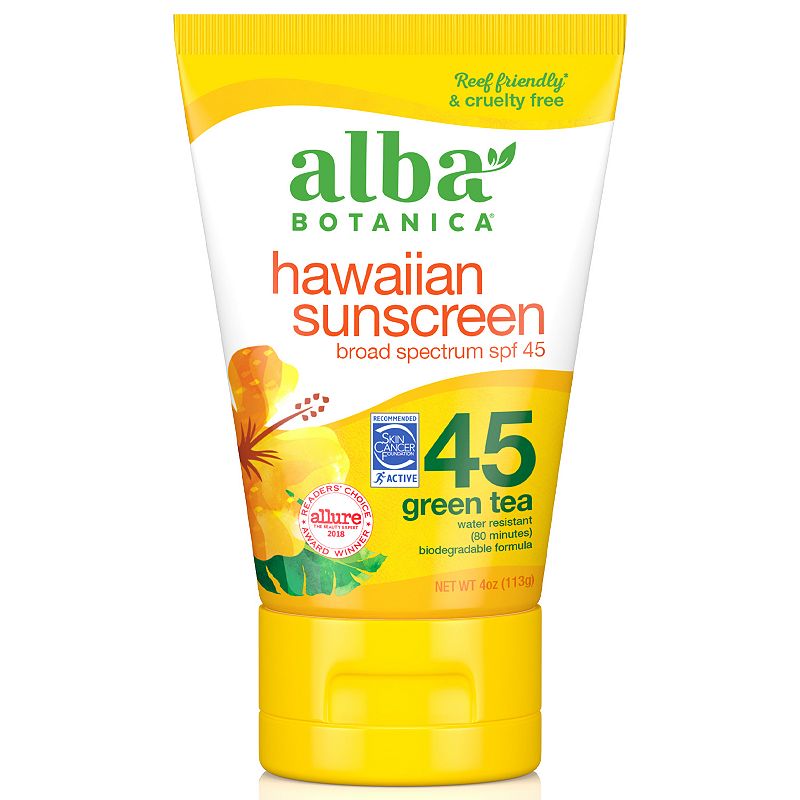


Alba Botanica HW Sunscreen Green Tea SPF45 / LOTION
Analysis updated October 2026 · How Scout scores
At a glance
Summary
This sunscreen contains beneficial ingredients like aloe vera, green tea extract, and chamomile, which provide soothing and antioxidant benefits. However, the presence of alcohol, which can be drying and irritating to the skin, slightly lowers its score. The product avoids harsh chemical UV filters and relies on a blend of natural extracts, contributing to a moderate processing level and a relatively clean label.
Key ingredients 28
Aloe Barbadensis Leaf JuiceVery Good
Aloe Barbadensis Leaf Juice is known for its soothing and moisturizing properties. It is widely used in skincare for its ability to calm irritated skin.
Risks
There are minimal risks, though it can cause allergic reactions in rare cases.
Benefits
Aloe vera soothes and moisturizes the skin, providing relief from irritation.
Camellia Sinensis Leaf ExtractVery Good
Camellia Sinensis Leaf Extract, or green tea extract, is rich in antioxidants and has anti-inflammatory properties. It helps to protect the skin from environmental damage.
Risks
There are minimal risks, though it can cause irritation in very sensitive skin.
Benefits
Green tea extract protects the skin from environmental damage and reduces inflammation.
Chamomilla Recutita (Matricaria) Flower ExtractVery Good
Chamomilla Recutita Flower Extract is known for its soothing and anti-inflammatory properties. It is beneficial for calming irritated skin.
Risks
There are minimal risks, though it can cause allergic reactions in rare cases.
Benefits
Chamomile extract soothes and calms irritated skin, reducing redness.
Calendula Officinalis Flower ExtractVery Good
Calendula Officinalis Flower Extract is known for its healing and anti-inflammatory properties. It is beneficial for soothing and repairing the skin.
Risks
There are minimal risks, though it can cause allergic reactions in rare cases.
Benefits
Calendula extract helps to soothe and repair the skin, promoting healing.
GlycerinGood
Glycerin is a humectant that attracts moisture to the skin, helping to keep it hydrated. It is widely used in skincare products for its moisturizing properties.
Risks
There are minimal risks associated with glycerin, though it can cause irritation in very sensitive skin.
Benefits
Glycerin helps to keep the skin hydrated and improves skin barrier function.
Glyceryl Stearate SEGood
Glyceryl Stearate SE is an emulsifier that helps to stabilize and thicken formulations. It also has moisturizing properties, making it beneficial for skin care.
Risks
There are minimal risks, though it can cause mild irritation in sensitive individuals.
Benefits
It helps to stabilize formulations and provides moisturizing benefits.
Caprylic/Capric TriglycerideGood
Caprylic/Capric Triglyceride is an emollient derived from coconut oil and glycerin. It helps to moisturize and replenish the skin.
Risks
There are minimal risks, though it can cause mild irritation in very sensitive skin.
Benefits
It helps to moisturize and replenish the skin, improving texture.
Ginkgo Biloba Leaf ExtractGood
Ginkgo Biloba Leaf Extract is rich in antioxidants and has anti-inflammatory properties. It helps to protect the skin from environmental damage.
Risks
There are minimal risks, though it can cause irritation in very sensitive skin.
Benefits
Ginkgo Biloba Extract protects the skin from environmental damage and reduces inflammation.
Cetearyl OlivateGood
Cetearyl Olivate is an emulsifier derived from olive oil. It helps to stabilize formulations and provides moisturizing benefits.
Risks
There are minimal risks associated with its use.
Benefits
It stabilizes formulations and provides moisturizing benefits.
Sorbitan OlivateGood
Sorbitan Olivate is an emulsifier derived from olive oil. It helps to stabilize formulations and provides moisturizing benefits.
Risks
There are minimal risks associated with its use.
Benefits
It stabilizes formulations and provides moisturizing benefits.
Tocopheryl AcetateGood
Tocopheryl Acetate is a form of Vitamin E, known for its antioxidant properties. It helps to protect the skin from environmental damage.
Risks
There are minimal risks, though it can cause irritation in very sensitive skin.
Benefits
Vitamin E protects the skin from environmental damage and supports skin health.
WaterNeutral
Water is a common solvent used in cosmetics to dissolve other ingredients. It helps in the application and absorption of the product. It does not have any direct benefits or risks associated with its use in cosmetics.
Risks
There are no significant risks associated with water in cosmetics.
Benefits
Water helps in the application and absorption of the product.
Cetyl AlcoholNeutral
Standard formulation ingredient — neither beneficial nor harmful at typical use.
Risks
It is generally safe, but can cause mild irritation in sensitive skin.
Benefits
Cetyl Alcohol helps to soften and smooth the skin, improving texture.
Cetearyl AlcoholNeutral
Standard formulation ingredient — neither beneficial nor harmful at typical use.
Risks
It is generally safe, but can cause mild irritation in sensitive skin.
Benefits
Cetearyl Alcohol helps to soften the skin and stabilize formulations.
VP/Hexadecene CopolymerNeutral
VP/Hexadecene Copolymer is a film-forming agent that helps to provide water resistance in formulations. It is commonly used in sunscreens for this purpose.
Risks
There are minimal risks associated with its use.
Benefits
It provides water resistance, enhancing the effectiveness of sunscreens.
Citrus Aurantium Dulcis (Orange) Peel OilNeutral
Orange Peel Oil is used for its fragrance and potential antioxidant properties. It can provide a pleasant scent to formulations.
Risks
It can cause photosensitivity and irritation in sensitive skin.
Benefits
Orange Peel Oil provides a pleasant scent and may offer antioxidant benefits.
Lavandula Angustifolia (Lavender) ExtractNeutral
Lavender Extract is used for its fragrance and potential calming properties. It is commonly used in cosmetics for its soothing scent.
Risks
It can cause irritation and allergic reactions in sensitive skin.
Benefits
Lavender Extract provides a calming scent and may have soothing properties.
Citric AcidNeutral
Citric Acid is used to adjust the pH of formulations. It can also provide mild exfoliation benefits.
Risks
It can cause irritation in sensitive skin if used in high concentrations.
Benefits
Citric Acid helps to adjust pH and can provide mild exfoliation.
Sodium ChlorideNeutral
Sodium Chloride is used as a thickening agent in cosmetics. It helps to improve the texture and consistency of formulations.
Risks
There are minimal risks associated with its use.
Benefits
Sodium Chloride improves the texture and consistency of formulations.
Sodium Stearoyl GlutamateNeutral
Sodium Stearoyl Glutamate is an emulsifier used to stabilize formulations. It helps to mix oil and water-based ingredients.
Risks
There are minimal risks associated with its use.
Benefits
It helps to stabilize formulations by mixing oil and water-based ingredients.
Triethyl CitrateNeutral
Triethyl Citrate is used as a fragrance ingredient and stabilizer in formulations. It helps to improve the scent and stability of products.
Risks
There are minimal risks associated with its use.
Benefits
It improves the scent and stability of formulations.
Xanthan GumNeutral
Xanthan Gum is used as a thickening agent in cosmetics. It helps to improve the texture and consistency of formulations.
Risks
There are minimal risks associated with its use.
Benefits
Xanthan Gum improves the texture and consistency of formulations.
AlcoholNeutral
Standard formulation ingredient — neither beneficial nor harmful at typical use.
Risks
Alcohol can cause dryness and irritation, particularly in sensitive skin.
Benefits
It helps in quick drying and acts as a solvent in formulations.
DimethiconeBad
Occlusive silicone film-former — flagged under clean-beauty doctrine.
Risks
It can potentially clog pores in acne-prone skin.
Benefits
Dimethicone provides a smooth application and helps to protect the skin.
Polysorbate 60Bad
Processed additive flagged under Scout's ingredient doctrine.
Risks
There are minimal risks associated with its use.
Benefits
It helps to stabilize formulations by mixing oil and water-based ingredients.
Benzyl AlcoholBad
Processed additive flagged under Scout's ingredient doctrine.
Risks
It can cause irritation and allergic reactions in sensitive skin.
Benefits
Benzyl Alcohol helps to preserve formulations by preventing microbial growth.
Potassium SorbateBad
Synthetic preservative — flagged in daily-use products.
Risks
It can cause irritation in sensitive skin.
Benefits
Potassium Sorbate helps to preserve formulations by preventing mold and yeast growth.
Sodium BenzoateBad
Synthetic preservative that can form benzene in the presence of vitamin C.
Risks
It can cause irritation in sensitive skin.
Benefits
Sodium Benzoate helps to preserve formulations by preventing microbial growth.
Get the full breakdown in the Scout appTake Scout shopping
Scan any product to see lab results, healthy alternatives, and your personalized analysis.
Download on theApp Store GET IT ONGoogle PlayAmazon pricing & content
CERTAIN CONTENT THAT APPEARS ON THIS SITE COMES FROM AMAZON. THIS CONTENT IS PROVIDED “AS IS” AND IS SUBJECT TO CHANGE OR REMOVAL AT ANY TIME.