
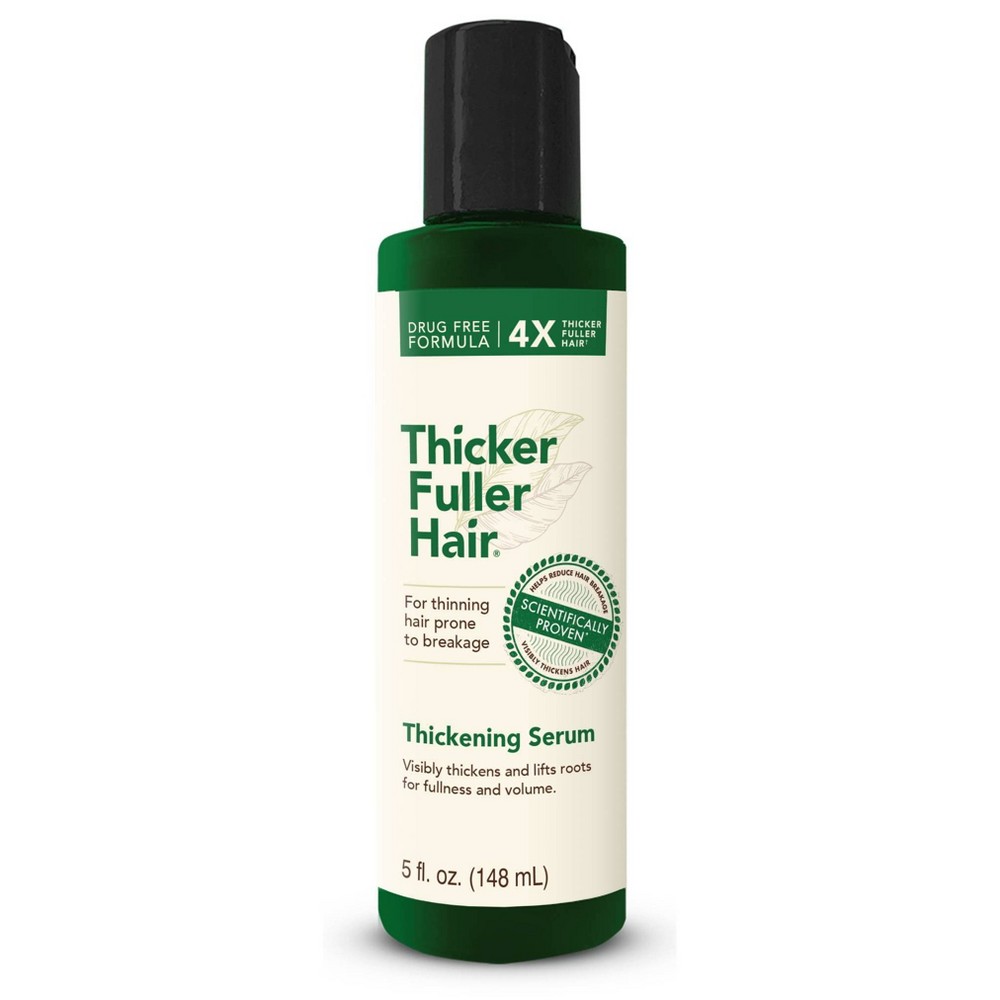

Thicker Fuller Hair Thickening Serum - 5 fl oz
Analysis updated August 2026 · How Scout scores
At a glance
Summary
This serum contains several beneficial ingredients such as aloe vera, glycerin, and various natural oils that provide hydration and nourishment to the hair. However, the presence of synthetic fragrance, which can cause skin irritation and allergic reactions, detracts from its overall safety profile. Additionally, the inclusion of PEG compounds and other synthetic additives indicates a moderate level of processing, which impacts the overall rating.
Key ingredients 31
Aloe Barbadensis Leaf JuiceVery Good
Aloe vera is known for its soothing and moisturizing properties. It can help calm irritated skin and provide hydration. It is a beneficial ingredient in skincare and haircare products.
Risks
Rare allergic reactions may occur in sensitive individuals.
Benefits
Provides soothing and hydrating effects, beneficial for skin and hair health.
GlycerinGood
Glycerin is a well-known humectant that attracts moisture to the skin. It helps maintain skin hydration and improve barrier function. It is widely used in skincare for its moisturizing properties.
Risks
Generally safe, but overuse can lead to a sticky feel.
Benefits
Excellent for maintaining skin hydration and improving texture.
Coffea Arabica (Coffee) Seed OilGood
Coffee seed oil is rich in antioxidants and can help protect the skin from environmental damage. It also has moisturizing properties. It is beneficial for skin and hair health.
Risks
Potential for allergic reactions in sensitive individuals.
Benefits
Provides antioxidant protection and moisturization.
Schinziophyton Rautanenii (Mongongo) Kernel OilGood
Mongongo oil is rich in fatty acids and vitamin E, providing nourishment and protection to the skin and hair. It helps improve moisture retention and elasticity. It is a beneficial natural oil in cosmetic formulations.
Risks
Rare allergic reactions may occur.
Benefits
Nourishes and protects skin and hair, enhancing moisture retention.
Pisum Sativum (Pea) Sprout ExtractGood
Pea sprout extract is known for its ability to stimulate hair growth and improve hair density. It contains phytonutrients that support hair health. It is a beneficial ingredient in haircare products.
Benefits
Promotes hair growth and improves hair density.
Rosmarinus Officinalis (Rosemary) Leaf ExtractGood
Rosemary extract is known for its antioxidant and antimicrobial properties. It helps protect the skin and hair from environmental damage. It is a beneficial botanical ingredient in cosmetics.
Risks
May cause irritation in sensitive individuals.
Benefits
Provides antioxidant protection and antimicrobial benefits.
Hydrolyzed QuinoaGood
Hydrolyzed quinoa is rich in amino acids and helps strengthen and protect hair. It improves hair elasticity and moisture retention. It is a beneficial ingredient in haircare products.
Benefits
Strengthens and protects hair, enhancing elasticity.
Caprylic/Capric TriglycerideGood
Caprylic/Capric Triglyceride is an emollient derived from coconut oil and glycerin. It helps moisturize and condition the skin and hair. It is a beneficial ingredient in cosmetic formulations.
Benefits
Moisturizes and conditions skin and hair.
Water (Aqua)Neutral
Water is a common solvent used in cosmetic formulations. It helps dissolve other ingredients and provides a base for the product. It does not have any direct benefits or risks.
Benefits
Provides a medium for other ingredients to be delivered effectively.
PEG-40 Hydrogenated Castor OilNeutral
PEG-40 Hydrogenated Castor Oil is used as an emulsifier and surfactant. It helps blend oil and water-based ingredients. It is generally considered safe in cosmetics.
Risks
May cause irritation in some individuals with sensitive skin.
Benefits
Helps stabilize formulations and improve texture.
PropanediolNeutral
Propanediol is a glycol used as a solvent and humectant. It helps retain moisture in the skin and improve product texture. It is generally well-tolerated in cosmetic formulations.
Risks
May cause mild irritation in sensitive skin types.
Benefits
Enhances moisture retention and improves product feel.
Soy Amino AcidsNeutral
Soy amino acids are used to strengthen and condition hair. They help improve hair texture and manageability. They are generally safe and beneficial in haircare formulations.
Risks
Potential for allergic reactions in soy-sensitive individuals.
Benefits
Strengthens and conditions hair, improving texture.
Wheat Amino AcidsNeutral
Wheat amino acids help improve hair strength and elasticity. They are used to condition and repair damaged hair. They are generally considered safe in haircare products.
Risks
May cause reactions in individuals with wheat allergies.
Benefits
Enhances hair strength and elasticity, aiding in repair.
Arginine HclNeutral
Arginine is an amino acid that can help improve blood circulation to the scalp. It supports hair health and growth. It is a common ingredient in haircare products.
Benefits
Supports scalp health and hair growth.
SerineNeutral
Serine is an amino acid that helps maintain skin hydration and elasticity. It is used in skincare and haircare products for its conditioning properties. It is generally safe and beneficial.
Benefits
Maintains hydration and elasticity in skin and hair.
ThreonineNeutral
Threonine is an amino acid that supports collagen production and skin health. It is used in cosmetic formulations for its conditioning benefits. It is generally considered safe.
Benefits
Supports collagen production and skin health.
Copper GluconateNeutral
Copper gluconate is used for its potential antioxidant properties and role in collagen synthesis. It supports skin health and elasticity. It is generally safe in cosmetic formulations.
Risks
Excessive use may lead to skin irritation.
Benefits
Provides antioxidant support and aids in collagen synthesis.
Zinc GluconateNeutral
Zinc gluconate is used for its anti-inflammatory and skin-soothing properties. It helps regulate oil production and supports skin health. It is generally safe in cosmetic formulations.
Risks
Excessive use may cause dryness or irritation.
Benefits
Regulates oil production and soothes skin.
Magnesium AspartateNeutral
Magnesium aspartate is used for its potential skin conditioning properties. It helps maintain skin health and hydration. It is generally safe in cosmetic formulations.
Benefits
Supports skin health and hydration.
Polysorbate 20Neutral
Polysorbate 20 is an emulsifier that helps blend oil and water-based ingredients. It is commonly used in cosmetics to stabilize formulations. It is generally considered safe.
Risks
May cause mild irritation in sensitive skin.
Benefits
Stabilizes formulations and improves texture.
HydroxyethylcelluloseNeutral
Hydroxyethylcellulose is a thickening agent used to improve product texture. It helps stabilize formulations and is generally considered safe. It does not have direct benefits or risks.
Benefits
Improves product texture and stability.
VP/VA CopolymerNeutral
VP/VA Copolymer is used as a film-forming agent in haircare products. It helps provide hold and style retention. It is generally considered safe in cosmetic formulations.
Risks
May cause build-up on hair with excessive use.
Benefits
Provides hold and style retention in hair products.
PVPNeutral
PVP is a film-forming agent used to provide hold and style retention in haircare products. It is commonly used in styling products for its fixative properties. It is generally considered safe.
Risks
May cause build-up on hair with excessive use.
Benefits
Provides hold and style retention in hair products.
Polyquaternium-11Neutral
Polyquaternium-11 is a conditioning agent that helps improve hair texture and manageability. It provides a smooth feel and reduces static. It is generally considered safe in haircare products.
Risks
May cause build-up on hair with excessive use.
Benefits
Improves hair texture and reduces static.
Polyquaternium-7Neutral
Polyquaternium-7 is a conditioning agent used to improve hair texture and manageability. It provides a smooth feel and reduces static. It is generally considered safe in haircare products.
Risks
May cause build-up on hair with excessive use.
Benefits
Improves hair texture and reduces static.
IsomaltNeutral
Isomalt is a sugar alcohol used as a humectant and texturizer in cosmetics. It helps retain moisture and improve product feel. It is generally considered safe.
Benefits
Retains moisture and improves product texture.
PhenoxyethanolBad
Processed additive flagged under Scout's ingredient doctrine.
Risks
May cause irritation in sensitive skin types.
Benefits
Prevents microbial growth, extending product shelf life.
Benzyl AlcoholBad
Processed additive flagged under Scout's ingredient doctrine.
Risks
May cause irritation in sensitive skin types.
Benefits
Prevents microbial growth and improves texture.
Potassium SorbateBad
Synthetic preservative — flagged in daily-use products.
Risks
May cause irritation in sensitive skin types.
Benefits
Inhibits mold and yeast growth, extending product shelf life.
Sodium BenzoateBad
Synthetic preservative that can form benzene in the presence of vitamin C.
Risks
May cause irritation in sensitive skin types.
Benefits
Prevents microbial growth, extending product shelf life.
FragranceVery Bad
Fragrance is often added to cosmetics for scent but can cause skin irritation and allergic reactions. It is a common sensitizer in personal care products. It is generally considered a negative ingredient due to potential irritation.
Risks
Can cause skin irritation and allergic reactions.
Benefits
Adds pleasant scent to products.
Get the full breakdown in the Scout appTake Scout shopping
Scan any product to see lab results, healthy alternatives, and your personalized analysis.
Download on theApp Store GET IT ONGoogle PlayAmazon pricing & content
Amazon price as of . Product prices and availability are accurate as of the date/time indicated and are subject to change. Any price and availability information displayed on Amazon.com at the time of purchase will apply to the purchase of this product.
CERTAIN CONTENT THAT APPEARS ON THIS SITE COMES FROM AMAZON. THIS CONTENT IS PROVIDED “AS IS” AND IS SUBJECT TO CHANGE OR REMOVAL AT ANY TIME.