
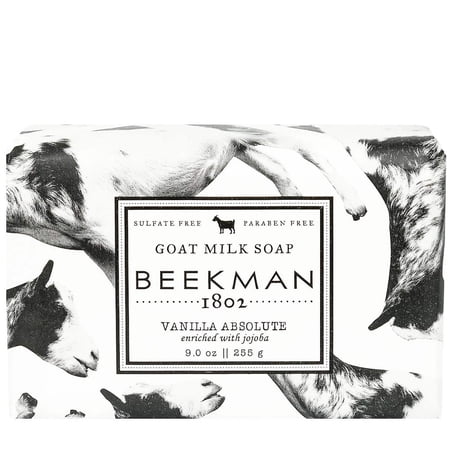

Beekman 1802 Goat Milk Bar Soap
Summary
The Beekman 1802 Goat Milk Bar Soap is a processed product with a moderate level of processing. It contains beneficial ingredients like goat milk, which is nourishing for the skin, but may also include some synthetic components typical of processed soaps. While it lacks harmful substances like parabens or synthetic fragrances, the presence of any synthetic additives prevents it from achieving a higher score.
At a glance
Key ingredients 11
Sodium Palmate
Sodium Palmate is a surfactant derived from palm oil used for its cleansing properties. It helps to remove dirt and oil from the skin effectively. It is generally considered safe for use in cosmetics.
Risks
There are environmental concerns related to palm oil production, which can lead to deforestation.
Benefits
It provides effective cleansing and is biodegradable.
Sodium Cocoate And/Or Palm Kernelate
Sodium Cocoate and Palm Kernelate are salts of fatty acids used as surfactants and cleansing agents. They are derived from coconut oil and palm kernel oil, respectively. These ingredients help to create a lather and cleanse the skin.
Risks
Similar to Sodium Palmate, there are environmental concerns with palm oil production.
Benefits
They are effective cleansing agents and are considered mild on the skin.
Water (Aqua)
Water is used as a solvent in cosmetic formulations. It helps to dissolve other ingredients and provides a base for the product. It is essential for the formulation of many personal care products.
Risks
There are no significant risks associated with water in cosmetics.
Benefits
It hydrates the skin and helps in the application of the product.
Glycerin
Glycerin is a humectant that attracts moisture to the skin. It is widely used in skincare products for its hydrating properties. It helps to maintain the skin's moisture balance.
Risks
There are no significant risks associated with glycerin in cosmetics.
Benefits
It is beneficial for dry skin as it helps to keep it hydrated and soft.
Caprae Lac (Goat Milk)
Goat Milk is rich in vitamins and minerals, making it a nourishing ingredient for the skin. It contains lactic acid, which can help to gently exfoliate and soften the skin. It is often used in skincare for its moisturizing properties.
Risks
There is a potential for allergic reactions in individuals sensitive to dairy products.
Benefits
It is beneficial for sensitive skin due to its soothing and moisturizing properties.
Disodium Cocoyl Glutamate
Disodium Cocoyl Glutamate is a mild surfactant derived from coconut oil and glutamic acid. It is used for its gentle cleansing properties. It is suitable for sensitive skin and helps to maintain the skin's natural barrier.
Risks
There are no significant risks associated with this ingredient.
Benefits
It is a gentle cleanser that is less likely to irritate the skin compared to harsher surfactants.
Sodium Cocoyl Glutamate
Sodium Cocoyl Glutamate is a mild surfactant similar to Disodium Cocoyl Glutamate. It is derived from coconut oil and glutamic acid and is used for its gentle cleansing properties. It is suitable for sensitive skin types.
Risks
There are no significant risks associated with this ingredient.
Benefits
It provides gentle cleansing without stripping the skin of its natural oils.
Sodium Cocoyl Threoninate
Sodium Cocoyl Threoninate is a surfactant used for its cleansing properties. It is derived from coconut oil and threonine, an amino acid. It helps to create a lather and cleanse the skin effectively.
Risks
There are no significant risks associated with this ingredient.
Benefits
It is a mild surfactant that is suitable for sensitive skin.
Sodium Chloride
Sodium Chloride, commonly known as salt, is used to thicken the aqueous phase of cosmetics. It helps to improve the texture and stability of the product. It is generally considered safe for use in cosmetics.
Risks
In high concentrations, it can be drying to the skin.
Benefits
It helps to improve the texture and consistency of the product.
Pentasodium Pentetate
Pentasodium Pentetate is a chelating agent used to bind metal ions in cosmetics. It helps to stabilize the formulation and improve the efficacy of preservatives. It is considered safe for use in cosmetics.
Risks
There are no significant risks associated with this ingredient.
Benefits
It enhances the stability and shelf-life of the product.
Tetrasodium Etidronate
Tetrasodium Etidronate is a chelating agent used to prevent the deterioration of cosmetic products. It binds metal ions that can cause instability in formulations. It is considered safe for use in cosmetics.
Risks
There are no significant risks associated with this ingredient.
Benefits
It helps to maintain the stability and effectiveness of the product.
Processing
Processed Foods
Get the full breakdown in the Scout app
Scan any product to see lab results, healthy alternatives, and your personalized analysis.
Download on theApp Store