
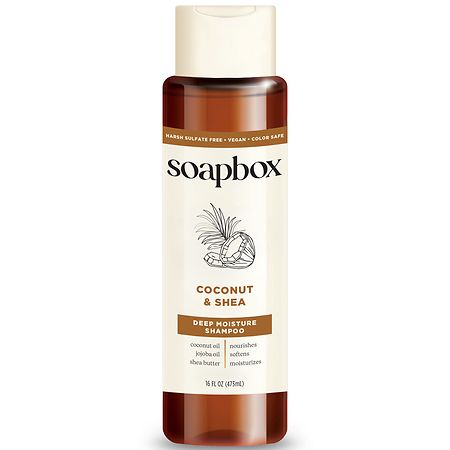
Soapbox Coconut & Shea Butter Deep Moisture Shampoo - 16 fl oz: Vegan, Paraben & Phthalate-Free, All Hair Types
Analysis updated August 2026 · How Scout scores
At a glance
Summary
This shampoo contains beneficial ingredients like coconut oil, shea butter, and aloe vera, which are known for their moisturizing and nourishing properties. However, the presence of sodium chloride, benzyl alcohol, and synthetic fragrance can potentially cause dryness and irritation, which slightly detracts from its overall safety and effectiveness. The product is free from parabens and phthalates, which is a positive aspect, but the inclusion of these less desirable ingredients prevents it from achieving a higher score.
Key ingredients 24
Cocos Nucifera (Coconut) OilVery Good
Coconut oil is known for its conditioning and moisturizing properties. It penetrates the hair shaft to provide deep nourishment. It is rich in fatty acids that help to strengthen and protect the hair.
Risks
Overuse may lead to buildup on the hair.
Benefits
It deeply conditions and adds shine to the hair.
Butyrospermum Parkii (Shea Butter)Very Good
Shea butter is a natural fat extracted from the nuts of the shea tree. It is highly moisturizing and helps to soften and smooth the hair. It is rich in vitamins and fatty acids.
Risks
There are minimal risks associated with shea butter in cosmetic products.
Benefits
It provides intense moisture and improves hair texture.
Simmondsia Chinensis (Jojoba) Seed OilVery Good
Jojoba oil is a liquid wax that closely resembles the natural oils of the scalp. It helps to balance oil production and moisturize the hair. It is non-comedogenic and suitable for all hair types.
Risks
There are minimal risks associated with jojoba oil in cosmetic products.
Benefits
It conditions the hair and helps to prevent dryness and frizz.
GlycerinGood
Glycerin is a humectant that attracts moisture to the hair and skin. It helps to maintain hydration and prevent dryness. It is widely used in moisturizing formulations.
Risks
There are minimal risks associated with glycerin in cosmetic products.
Benefits
It helps to keep the hair hydrated and soft.
Aloe Barbadensis (Aloe Vera) Leaf JuiceGood
Aloe vera is known for its soothing and hydrating properties. It helps to calm the scalp and reduce irritation. It is often used in products for sensitive skin.
Risks
There are minimal risks associated with aloe vera in cosmetic products.
Benefits
It hydrates and soothes the scalp, promoting healthy hair growth.
Ascorbic Acid (Vitamin C)Good
Vitamin C is an antioxidant that helps to protect the hair from environmental damage. It supports collagen production and promotes healthy hair growth. It is often used in anti-aging formulations.
Risks
There are minimal risks associated with vitamin C in cosmetic products.
Benefits
It protects the hair from oxidative stress and enhances shine.
Tocopheryl Acetate (Vitamin E)Good
Vitamin E is an antioxidant that helps to protect the hair from damage. It supports scalp health and improves hair elasticity. It is commonly used in moisturizing and anti-aging products.
Risks
There are minimal risks associated with vitamin E in cosmetic products.
Benefits
It nourishes the hair and promotes a healthy scalp.
Biotin (Vitamin B7)Good
Biotin is a B vitamin that is essential for healthy hair growth. It helps to strengthen the hair and prevent breakage. It is commonly used in hair care products for its nourishing properties.
Risks
There are minimal risks associated with biotin in cosmetic products.
Benefits
It strengthens the hair and supports healthy growth.
Panthenol (Vitamin B5)Good
Panthenol is a provitamin of B5 that helps to moisturize and strengthen the hair. It improves hair elasticity and reduces breakage. It is widely used in hair care products for its conditioning properties.
Risks
There are minimal risks associated with panthenol in cosmetic products.
Benefits
It moisturizes and strengthens the hair, reducing breakage.
WaterNeutral
Water is a common solvent used in cosmetic formulations. It helps to dissolve other ingredients and provides a base for the product. It is generally considered safe and non-reactive.
Risks
There are no significant risks associated with water in cosmetic products.
Benefits
Water helps to hydrate and distribute other ingredients evenly across the hair.
Cocamidopropyl BetaineNeutral
Standard formulation ingredient — neither beneficial nor harmful at typical use.
Risks
In rare cases, it may cause skin irritation or allergic reactions.
Benefits
It provides gentle cleansing and helps to create a rich lather.
Sodium C14-16 Olefin SulfonateNeutral
Sodium C14-16 Olefin Sulfonate is a surfactant used for its cleansing properties. It is effective at removing dirt and oil from the hair. It is considered a harsher surfactant compared to others.
Risks
It may cause dryness or irritation in sensitive scalps.
Benefits
It effectively cleanses the hair and scalp.
Folic Acid (Vitamin B9)Neutral
Standard formulation ingredient — neither beneficial nor harmful at typical use.
Risks
There are minimal risks associated with folic acid in cosmetic products.
Benefits
It strengthens the hair and promotes healthy growth.
Sodium ChlorideNeutral
Standard formulation ingredient — neither beneficial nor harmful at typical use.
Risks
It may cause dryness and irritation, especially in sensitive scalps.
Benefits
It helps to thicken the product and improve texture.
Sodium Lauryl SulfoacetateNeutral
Sodium Lauryl Sulfoacetate is a surfactant used for its cleansing properties. It is considered milder than traditional sulfates. It helps to create a rich lather and cleanse the hair effectively.
Risks
It may cause mild irritation in sensitive individuals.
Benefits
It provides effective cleansing with a rich lather.
Disodium Laureth SulfosuccinateNeutral
Disodium Laureth Sulfosuccinate is a mild surfactant used for its cleansing properties. It is considered less irritating than traditional sulfates. It helps to remove dirt and oil from the hair.
Risks
It may cause mild irritation in sensitive individuals.
Benefits
It provides gentle cleansing without stripping natural oils.
Citric AcidNeutral
Citric acid is used to adjust the pH of cosmetic formulations. It helps to maintain the stability and effectiveness of the product. It is generally considered safe and non-irritating.
Risks
There are minimal risks associated with citric acid in cosmetic products.
Benefits
It helps to maintain the pH balance of the product.
Guar Hydroxypropyltrimonium ChlorideNeutral
Guar Hydroxypropyltrimonium Chloride is a conditioning agent derived from guar gum. It helps to improve the texture and manageability of the hair. It is commonly used in hair care products for its conditioning properties.
Risks
There are minimal risks associated with this ingredient in cosmetic products.
Benefits
It conditions the hair and improves manageability.
Dehydroacetic AcidNeutral
Dehydroacetic Acid is a preservative used to prevent microbial growth in cosmetic products. It helps to extend the shelf life of the product. It is generally considered safe and non-irritating.
Risks
There are minimal risks associated with dehydroacetic acid in cosmetic products.
Benefits
It helps to preserve the product and prevent spoilage.
Polyquaternium-11Neutral
Polyquaternium-11 is a film-forming agent that helps to improve the texture and manageability of the hair. It provides a conditioning effect and reduces static. It is commonly used in hair care products for its styling properties.
Risks
There are minimal risks associated with polyquaternium-11 in cosmetic products.
Benefits
It conditions the hair and improves manageability.
Polyquaternium-7Neutral
Polyquaternium-7 is a conditioning agent that helps to improve the texture and manageability of the hair. It provides a conditioning effect and reduces static. It is commonly used in hair care products for its styling properties.
Risks
There are minimal risks associated with polyquaternium-7 in cosmetic products.
Benefits
It conditions the hair and improves manageability.
Benzyl AlcoholBad
Benzyl alcohol is used as a preservative and solvent in cosmetic products. It can be drying and irritating to the skin and scalp. It is generally considered a less desirable ingredient in hair care products.
Risks
It may cause dryness and irritation, especially in sensitive scalps.
Benefits
It helps to preserve the product and prevent microbial growth.
Cetrimonium ChlorideBad
Processed additive flagged under Scout's ingredient doctrine.
Risks
There are minimal risks associated with cetrimonium chloride in cosmetic products.
Benefits
It conditions the hair and reduces static and frizz.
Fragrance (Parfum)Very Bad
Fragrance is used to impart a pleasant scent to cosmetic products. It can be composed of many different chemicals, some of which may cause irritation or allergic reactions. It is generally considered a less desirable ingredient due to potential sensitivities.
Risks
It may cause irritation or allergic reactions in sensitive individuals.
Benefits
It provides a pleasant scent to the product.
Get the full breakdown in the Scout appTake Scout shopping
Scan any product to see lab results, healthy alternatives, and your personalized analysis.
Download on theApp Store GET IT ONGoogle PlayAmazon pricing & content
CERTAIN CONTENT THAT APPEARS ON THIS SITE COMES FROM AMAZON. THIS CONTENT IS PROVIDED “AS IS” AND IS SUBJECT TO CHANGE OR REMOVAL AT ANY TIME.