
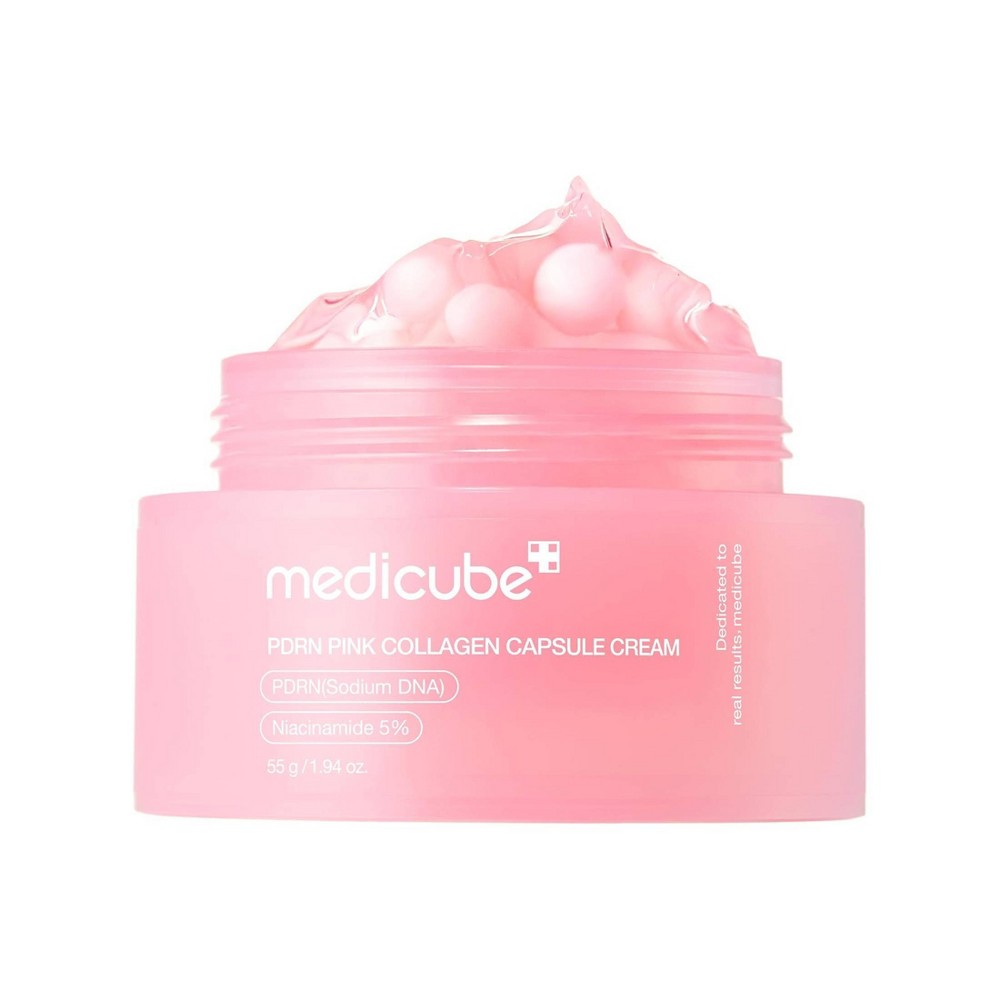
medicube PDRN Pink Collagen Capsule Cream Korean Skincare- 1.94oz: Skin Tone Improvement, Face Application, Normal/Sensitive Skin
Analysis updated August 2026 · How Scout scores
At a glance
Summary
This skincare product contains beneficial ingredients like glycerin, niacinamide, and moringa oleifera seed oil, which are known for their hydrating and anti-aging properties. However, the presence of synthetic polymers and emulsifiers, such as polyacrylate-13 and polysorbate 20, indicates a moderate level of processing. While the product includes several skin-friendly actives, the inclusion of these processed ingredients prevents it from achieving a higher score.
Key ingredients 52
Moringa Oleifera Seed OilVery Good
Moringa Oleifera Seed Oil is a natural oil with moisturizing and antioxidant properties. It helps nourish and protect the skin.
Risks
There are minimal risks; it is generally safe for all skin types.
Benefits
It provides deep hydration and protects against environmental damage.
GlutathioneVery Good
Glutathione is an antioxidant that helps protect the skin from oxidative stress. It also supports skin brightening and even tone.
Risks
There are minimal risks; it is generally safe for all skin types.
Benefits
It provides antioxidant protection and supports skin radiance.
Hydroxypropyltrimonium HyaluronateVery Good
Hydroxypropyltrimonium Hyaluronate is a modified form of hyaluronic acid that provides enhanced hydration. It helps improve skin texture and elasticity.
Risks
There are minimal risks; it is generally safe for all skin types.
Benefits
It provides long-lasting hydration and improves skin smoothness.
Hydrolyzed Hyaluronic AcidVery Good
Hydrolyzed Hyaluronic Acid is a smaller molecule form of hyaluronic acid that penetrates deeper into the skin. It provides intense hydration and plumping effects.
Risks
There are minimal risks; it is generally safe for all skin types.
Benefits
It provides deep hydration and improves skin elasticity.
Sodium Acetylated HyaluronateVery Good
Sodium Acetylated Hyaluronate is a modified form of hyaluronic acid that provides enhanced hydration. It helps improve skin texture and elasticity.
Risks
There are minimal risks; it is generally safe for all skin types.
Benefits
It provides long-lasting hydration and improves skin smoothness.
Copper Tripeptide-1Very Good
Copper Tripeptide-1 is a peptide that supports skin regeneration and repair. It helps improve skin elasticity and firmness.
Risks
There are minimal risks; it is generally safe for all skin types.
Benefits
It enhances skin repair and provides anti-aging benefits.
Hydrolyzed Sodium HyaluronateVery Good
Hydrolyzed Sodium Hyaluronate is a smaller molecule form of hyaluronic acid that penetrates deeper into the skin. It provides intense hydration and plumping effects.
Risks
There are minimal risks; it is generally safe for all skin types.
Benefits
It provides deep hydration and improves skin elasticity.
Sodium Hyaluronate CrosspolymerVery Good
Sodium Hyaluronate Crosspolymer is a form of hyaluronic acid that provides long-lasting hydration. It helps improve skin texture and elasticity.
Risks
There are minimal risks; it is generally safe for all skin types.
Benefits
It provides sustained hydration and improves skin smoothness.
Potassium HyaluronateVery Good
Potassium Hyaluronate is a form of hyaluronic acid that provides intense hydration. It helps plump the skin and reduce the appearance of fine lines.
Risks
There are minimal risks; it is generally safe for all skin types.
Benefits
It provides deep hydration and improves skin elasticity.
GlycerinGood
Glycerin is a humectant that attracts moisture to the skin. It helps maintain skin hydration and improves skin barrier function.
Risks
There are minimal risks associated with glycerin; it is generally safe for all skin types.
Benefits
Glycerin helps keep the skin moisturized and soft.
NiacinamideGood
Niacinamide is a form of Vitamin B3 that improves skin tone and texture. It reduces inflammation and hyperpigmentation.
Risks
Niacinamide is generally well-tolerated but can cause mild irritation in sensitive skin.
Benefits
It enhances skin barrier function and reduces signs of aging.
Caprylic/Capric TriglycerideGood
Caprylic/Capric Triglyceride is an emollient derived from coconut oil. It helps moisturize and soften the skin.
Risks
There are minimal risks; it is generally safe for all skin types.
Benefits
It provides a lightweight, non-greasy moisturizing effect.
ArginineGood
Arginine is an amino acid that helps improve skin hydration. It also supports collagen production.
Risks
There are minimal risks associated with arginine in skincare.
Benefits
It enhances skin elasticity and moisture retention.
Cetearyl OlivateGood
Cetearyl Olivate is an emulsifier derived from olive oil. It helps blend oil and water components in the product.
Risks
There are minimal risks; it is generally safe for all skin types.
Benefits
It provides a smooth, moisturizing effect and enhances product stability.
Sorbitan OlivateGood
Sorbitan Olivate is an emulsifier derived from olive oil. It helps blend oil and water components in the product.
Risks
There are minimal risks; it is generally safe for all skin types.
Benefits
It provides a smooth, moisturizing effect and enhances product stability.
Eclipta Prostrata ExtractGood
Eclipta Prostrata Extract is a botanical ingredient with antioxidant properties. It helps protect the skin from environmental damage.
Risks
There are minimal risks; it is generally safe for all skin types.
Benefits
It provides antioxidant benefits and supports skin health.
AdenosineGood
Adenosine is a skin-soothing and anti-aging ingredient. It helps reduce the appearance of wrinkles and fine lines.
Risks
There are minimal risks; it is generally safe for all skin types.
Benefits
It improves skin smoothness and reduces signs of aging.
Melia Azadirachta Leaf ExtractGood
Melia Azadirachta Leaf Extract is a botanical ingredient with antimicrobial properties. It helps protect the skin from environmental stressors.
Risks
There are minimal risks; it is generally safe for all skin types.
Benefits
It provides antimicrobial benefits and supports skin health.
Sodium HyaluronateGood
Sodium Hyaluronate is a form of hyaluronic acid that provides intense hydration. It helps plump the skin and reduce the appearance of fine lines.
Risks
There are minimal risks; it is generally safe for all skin types.
Benefits
It provides deep hydration and improves skin elasticity.
Salmon Egg ExtractGood
Salmon Egg Extract is rich in nutrients that support skin health. It helps nourish and rejuvenate the skin.
Risks
There are minimal risks; it is generally safe for all skin types.
Benefits
It provides nourishment and supports skin regeneration.
Ceramide NPGood
Ceramide NP is a lipid that helps restore the skin barrier. It improves skin hydration and reduces moisture loss.
Risks
There are minimal risks; it is generally safe for all skin types.
Benefits
It strengthens the skin barrier and enhances moisture retention.
Thioctic AcidGood
Thioctic Acid is an antioxidant that helps protect the skin from oxidative stress. It supports skin health and radiance.
Risks
There are minimal risks; it is generally safe for all skin types.
Benefits
It provides antioxidant protection and supports skin vitality.
Hydrolyzed Collagen ExtractGood
Hydrolyzed Collagen Extract helps improve skin elasticity and hydration. It supports skin firmness and reduces the appearance of fine lines.
Risks
There are minimal risks; it is generally safe for all skin types.
Benefits
It enhances skin elasticity and provides a plumping effect.
Acetyl Hexapeptide-8Good
Acetyl Hexapeptide-8 is a peptide that helps reduce the appearance of wrinkles. It supports skin firmness and elasticity.
Risks
There are minimal risks; it is generally safe for all skin types.
Benefits
It provides anti-aging benefits and improves skin texture.
Hyaluronic AcidGood
Hyaluronic Acid is a powerful humectant that provides intense hydration. It helps plump the skin and reduce the appearance of fine lines.
Risks
There are minimal risks; it is generally safe for all skin types.
Benefits
It provides deep hydration and improves skin elasticity.
Palmitoyl Pentapeptide-4Good
Palmitoyl Pentapeptide-4 is a peptide that helps reduce the appearance of wrinkles. It supports skin firmness and elasticity.
Risks
There are minimal risks; it is generally safe for all skin types.
Benefits
It provides anti-aging benefits and improves skin texture.
Palmitoyl Hexapeptide-12Good
Palmitoyl Hexapeptide-12 is a peptide that helps reduce the appearance of wrinkles. It supports skin firmness and elasticity.
Risks
There are minimal risks; it is generally safe for all skin types.
Benefits
It provides anti-aging benefits and improves skin texture.
WaterNeutral
Water is a common solvent used in skincare products. It helps dissolve other ingredients and provides a base for the formulation.
Risks
There are no significant risks associated with water in skincare.
Benefits
Water hydrates the skin and helps in the absorption of other ingredients.
MethylpropanediolNeutral
Methylpropanediol is a solvent that enhances the absorption of other ingredients. It also provides a smooth texture to the product.
Risks
It may cause mild irritation in very sensitive skin.
Benefits
It improves the efficacy of active ingredients by enhancing their penetration.
PropanediolNeutral
Propanediol is a glycol that acts as a solvent and humectant. It helps improve the texture and feel of the product.
Risks
Propanediol is generally safe but can cause irritation in sensitive individuals.
Benefits
It enhances skin hydration and improves the spreadability of the product.
1,2-HexanediolNeutral
1,2-Hexanediol is a preservative and humectant. It helps maintain the product's stability and moisture content.
Risks
It may cause mild irritation in sensitive skin.
Benefits
It helps preserve the product and maintain skin hydration.
Dipropylene GlycolNeutral
Dipropylene Glycol is a solvent that helps dissolve other ingredients. It also acts as a humectant to retain moisture.
Risks
It is generally safe but can cause irritation in sensitive skin.
Benefits
It enhances the texture and moisture retention of the product.
Glycereth-26Neutral
Glycereth-26 is a humectant that helps retain moisture in the skin. It also improves the texture of the product.
Risks
It is generally safe but can cause irritation in sensitive skin.
Benefits
It enhances skin hydration and product spreadability.
Butylene GlycolNeutral
Butylene Glycol is a solvent and humectant that helps retain moisture. It also improves the texture of the product.
Risks
It may cause mild irritation in sensitive skin.
Benefits
It enhances skin hydration and product spreadability.
Ethylhexyl PalmitateNeutral
Ethylhexyl Palmitate is an emollient that provides a smooth texture. It helps improve the spreadability of the product.
Risks
It may cause mild irritation in sensitive skin.
Benefits
It provides a silky feel and enhances product application.
Cetearyl AlcoholNeutral
Cetearyl Alcohol is a fatty alcohol that acts as an emollient and thickener. It helps stabilize and improve the texture of the product.
Risks
It is generally safe but can cause irritation in sensitive skin.
Benefits
It provides a creamy texture and enhances skin softness.
CarbomerNeutral
Carbomer is a thickening agent that helps stabilize emulsions. It provides a smooth texture to the product.
Risks
It is generally safe but can cause irritation in sensitive skin.
Benefits
It enhances the consistency and stability of the product.
Ammonium Acryloyldimethyltaurate/VP CopolymerNeutral
This copolymer is used as a thickening and stabilizing agent. It helps improve the texture and consistency of the product.
Risks
It is generally safe but can cause irritation in sensitive skin.
Benefits
It enhances the stability and spreadability of the product.
SimethiconeNeutral
Simethicone is an anti-foaming agent that helps reduce surface tension. It provides a smooth texture to the product.
Risks
It is generally safe with minimal risks.
Benefits
It enhances the texture and application of the product.
EthylhexylglycerinNeutral
Ethylhexylglycerin is a preservative and skin conditioning agent. It helps maintain product stability and enhances skin feel.
Risks
It is generally safe but can cause irritation in sensitive skin.
Benefits
It enhances product preservation and skin softness.
Polyacrylate-13Neutral
Polyacrylate-13 is a thickening agent that helps stabilize emulsions. It provides a smooth texture to the product.
Risks
It is generally safe but can cause irritation in sensitive skin.
Benefits
It enhances the consistency and stability of the product.
Sodium DNANeutral
Sodium DNA is a skin conditioning agent that helps improve skin texture. It supports skin regeneration and repair.
Risks
It is generally safe but can cause irritation in sensitive skin.
Benefits
It enhances skin health and supports repair processes.
PolyisobuteneNeutral
Polyisobutene is a synthetic polymer used as a thickening agent. It helps improve the texture and consistency of the product.
Risks
It is generally safe but can cause irritation in sensitive skin.
Benefits
It enhances the stability and spreadability of the product.
Hydrolyzed Sclerotium GumNeutral
Hydrolyzed Sclerotium Gum is a natural thickening agent. It helps stabilize emulsions and improve product texture.
Risks
It is generally safe but can cause irritation in sensitive skin.
Benefits
It enhances the consistency and stability of the product.
Glyceryl StearateNeutral
Glyceryl Stearate is an emulsifier that helps blend oil and water components. It provides a smooth texture to the product.
Risks
It is generally safe but can cause irritation in sensitive skin.
Benefits
It enhances product stability and application.
Polysorbate 20Neutral
Polysorbate 20 is an emulsifier that helps blend oil and water components. It improves the texture and stability of the product.
Risks
It is generally safe but can cause irritation in sensitive skin.
Benefits
It enhances product stability and application.
Sorbitan IsostearateNeutral
Sorbitan Isostearate is an emulsifier that helps blend oil and water components. It provides a smooth texture to the product.
Risks
It is generally safe but can cause irritation in sensitive skin.
Benefits
It enhances product stability and application.
OctyldodecanolNeutral
Octyldodecanol is an emollient that provides a smooth texture. It helps improve the spreadability of the product.
Risks
It is generally safe but can cause irritation in sensitive skin.
Benefits
It provides a silky feel and enhances product application.
Hydrogenated LecithinNeutral
Hydrogenated Lecithin is an emulsifier that helps blend oil and water components. It provides a smooth texture to the product.
Risks
It is generally safe but can cause irritation in sensitive skin.
Benefits
It enhances product stability and application.
CyanocobalaminNeutral
Cyanocobalamin is a form of Vitamin B12 that supports skin health. It helps improve skin texture and tone.
Risks
It is generally safe but can cause irritation in sensitive skin.
Benefits
It supports skin health and improves overall appearance.
Caprylyl GlycolNeutral
Caprylyl Glycol is a humectant and skin conditioning agent. It helps retain moisture and improve skin feel.
Risks
It is generally safe but can cause irritation in sensitive skin.
Benefits
It enhances skin hydration and product preservation.
Disodium EDTABad
Processed additive flagged under Scout's ingredient doctrine.
Risks
It is generally safe but can cause irritation in sensitive skin.
Benefits
It enhances product stability and shelf life.
Processing
Processed Foods
Get the full breakdown in the Scout appTake Scout shopping
Scan any product to see lab results, healthy alternatives, and your personalized analysis.
Download on theApp Store GET IT ONGoogle PlayAmazon pricing & content
Amazon price as of . Product prices and availability are accurate as of the date/time indicated and are subject to change. Any price and availability information displayed on Amazon.com at the time of purchase will apply to the purchase of this product.
CERTAIN CONTENT THAT APPEARS ON THIS SITE COMES FROM AMAZON. THIS CONTENT IS PROVIDED “AS IS” AND IS SUBJECT TO CHANGE OR REMOVAL AT ANY TIME.