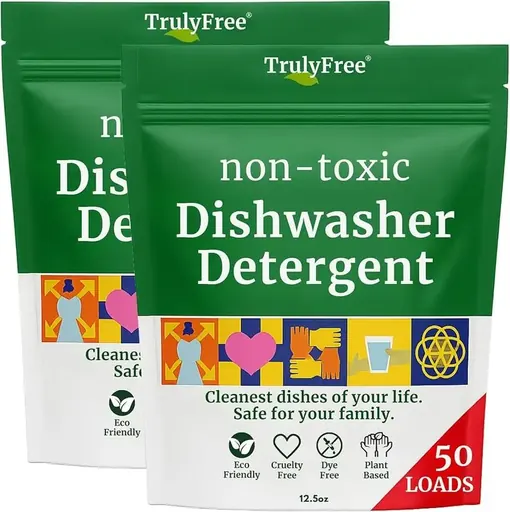
Truly Free Home Dishwasher Detergent Plastic Bag
At a glance
Summary
This dishwasher detergent contains beneficial enzymes like amylase and protease, which enhance cleaning efficiency and are biodegradable, contributing positively to its environmental impact. However, the presence of alkoxylated alcohol raises concerns due to potential contamination risks, and the use of acrylic acid homopolymer and sodium polyacrylate suggests a moderate level of processing. These factors prevent it from achieving a higher score despite its effective cleaning ingredients.
Key ingredients 12
AmylaseVery Good
Amylase is an enzyme that breaks down starches into sugars. It is commonly used in detergents to enhance cleaning efficiency. Being biodegradable, it is environmentally friendly.
Risks
There are minimal risks associated with its use in cleaning products.
Benefits
Amylase improves the removal of starch-based stains, enhancing cleaning performance.
ProteaseVery Good
Protease is an enzyme that breaks down proteins into smaller peptides or amino acids. It is commonly used in detergents to enhance cleaning efficiency. Being biodegradable, it is environmentally friendly.
Risks
There are minimal risks associated with its use in cleaning products.
Benefits
Protease improves the removal of protein-based stains, enhancing cleaning performance.
Sodium CitrateGood
Sodium Citrate is used as a water softener and pH regulator in cleaning products. It helps to enhance cleaning performance by preventing mineral deposits. It is considered safe and environmentally friendly.
Risks
There are minimal risks associated with its use in cleaning products.
Benefits
It softens water and regulates pH, improving the effectiveness of cleaning agents.
Acrylic Acid HomopolymerNeutral
Acrylic Acid Homopolymer is used as a dispersing agent in cleaning products. It helps to prevent redeposition of soil on surfaces. It is generally considered safe for use in cleaning applications.
Risks
There are minimal risks associated with its use in cleaning products.
Benefits
It effectively prevents soil redeposition, enhancing cleaning performance.
Alkoxylated AlcoholNeutral
Alkoxylated Alcohols are used as surfactants in cleaning products. They help to lower surface tension, allowing water to spread and wet surfaces more effectively. They are generally considered safe for use in cleaning applications.
Risks
There is a potential risk of skin irritation with prolonged exposure.
Benefits
They improve the wetting and spreading properties of cleaning solutions.
TAEDNeutral
TAED (Tetraacetylethylenediamine) is a bleach activator used in detergents. It enhances the effectiveness of bleach at lower temperatures. It is considered safe for use in cleaning products.
Risks
There are minimal risks associated with its use in cleaning products.
Benefits
TAED improves the bleaching performance of detergents, especially in cold water.
Precipitated SilicaNeutral
Precipitated Silica is used as an anti-caking agent in powdered detergents. It helps to maintain free-flowing properties. It is generally considered safe for use in cleaning applications.
Risks
There are minimal risks associated with its use in cleaning products.
Benefits
It prevents clumping, ensuring consistent performance of powdered detergents.
Sodium SulfateNeutral
Sodium Sulfate is used as a filler in powdered detergents. It helps to bulk up the product without affecting its cleaning performance. It is generally considered safe for use in cleaning applications.
Risks
There are minimal risks associated with its use in cleaning products.
Benefits
It acts as a filler, helping to maintain the consistency of powdered detergents.
Sodium PolyacrylateNeutral
Sodium Polyacrylate is used as a water-absorbing agent in cleaning products. It helps to maintain moisture balance. It is generally considered safe for use in cleaning applications.
Risks
There are minimal risks associated with its use in cleaning products.
Benefits
It helps to control moisture, enhancing the stability of cleaning products.
Sodium PercarbonateNeutral
Sodium Percarbonate is used as a bleaching agent in detergents. It releases hydrogen peroxide when dissolved in water. It is considered safe for use in cleaning products.
Risks
There are minimal risks associated with its use in cleaning products.
Benefits
It provides effective bleaching action, enhancing stain removal.
Sodium CarbonateNeutral
Sodium Carbonate, also known as washing soda, is used as a water softener in detergents. It helps to enhance cleaning performance by preventing mineral deposits. It is generally considered safe for use in cleaning applications.
Risks
There are minimal risks associated with its use in cleaning products.
Benefits
It softens water, improving the effectiveness of cleaning agents.
Sodium Carboxymethyl InulinNeutral
Sodium Carboxymethyl Inulin is used as a dispersing agent in cleaning products. It helps to prevent redeposition of soil on surfaces. It is generally considered safe for use in cleaning applications.
Risks
There are minimal risks associated with its use in cleaning products.
Benefits
It effectively prevents soil redeposition, enhancing cleaning performance.
Get the full breakdown in the Scout appTake Scout shopping
Scan any product to see lab results, healthy alternatives, and your personalized analysis.
Amazon pricing & content
Amazon price as of . Product prices and availability are accurate as of the date/time indicated and are subject to change. Any price and availability information displayed on Amazon.com at the time of purchase will apply to the purchase of this product.
CERTAIN CONTENT THAT APPEARS ON THIS SITE COMES FROM AMAZON. THIS CONTENT IS PROVIDED “AS IS” AND IS SUBJECT TO CHANGE OR REMOVAL AT ANY TIME.