
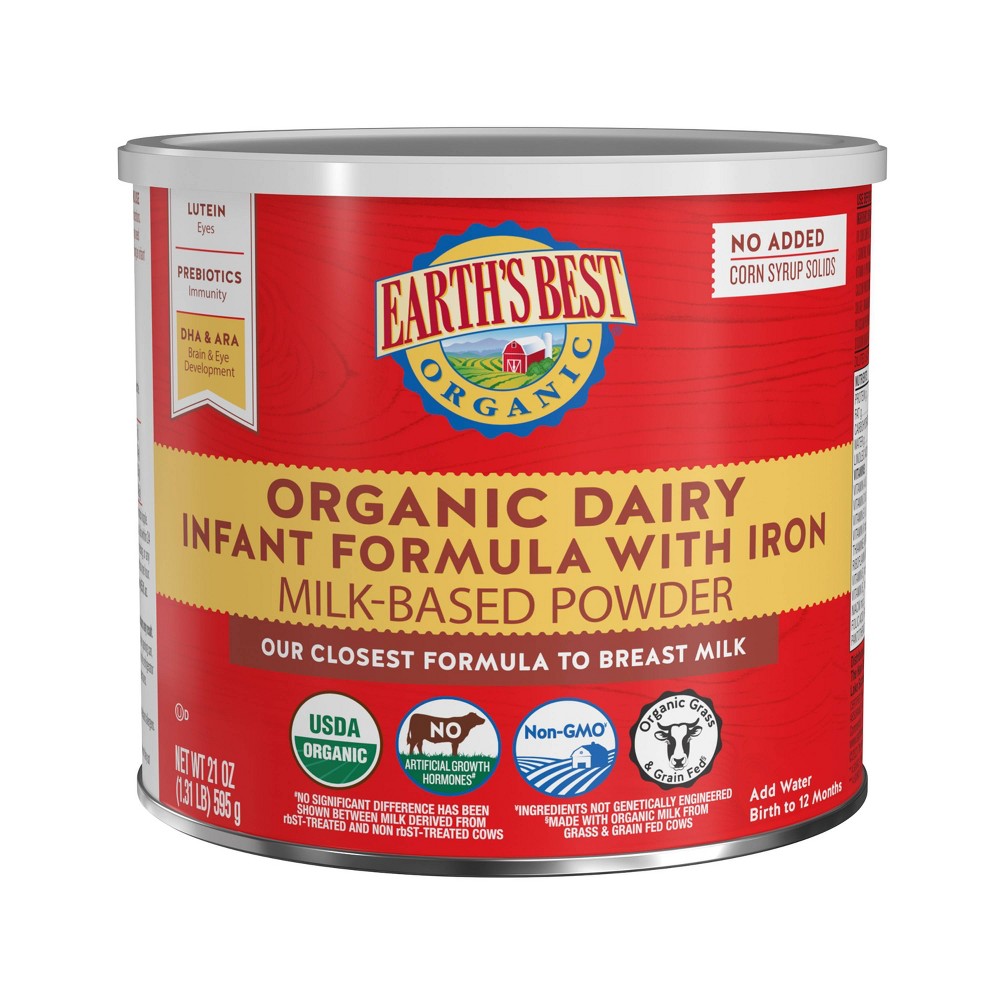


Earth's Best Organic Infant Dairy Baby Formula - 21oz: Brain Development, Immune System Support, Eye Development
Summary
This infant formula contains beneficial ingredients such as organic nonfat milk, organic lactose, and organic whey protein concentrate, which support infant growth and development. However, it is ultra-processed and includes a blend of oils with high omega-6 content, which may promote inflammation. The presence of organic soy lecithin as an emulsifier also contributes to its processed nature, limiting its score despite the organic certification.
At a glance
Key ingredients 42
Organic nonfat milkGood
Organic nonfat milk is a high-quality source of protein and calcium, essential for infant growth and development. Being organic, it is free from synthetic pesticides and hormones, ensuring a cleaner nutritional profile. It provides a base for the formula, supporting bone health and muscle development.
Benefits
Provides essential nutrients like protein and calcium, crucial for bone and muscle development in infants.
Organic lactoseGood
Organic lactose is a natural sugar found in milk, providing a source of energy for infants. As an organic ingredient, it is free from synthetic additives and pesticides. It aids in the absorption of calcium and supports the growth of beneficial gut bacteria.
Benefits
Supports energy needs and aids in calcium absorption, promoting healthy bone development.
Organic oilsBad
The inclusion of organic palm or palm olein, organic soy, organic coconut, and organic high oleic safflower or sunflower oil provides a blend of fats. While organic, the presence of palm and safflower oils raises concerns due to high omega-6 content, which may promote inflammation. Coconut oil offers medium-chain triglycerides beneficial for energy, but the overall blend is not ideal.
Risks
High omega-6 content in palm and safflower oils may promote inflammation when consumed in excess.
Benefits
Coconut oil provides medium-chain triglycerides that are easily metabolized for energy.
Organic glucose syrup solidsNeutral
Organic glucose syrup solids are used as a carbohydrate source, providing energy. Being organic, they are free from synthetic additives, but they are a refined sugar source. They offer quick energy but lack additional nutritional benefits.
Risks
Excessive consumption of refined sugars can lead to health issues like obesity and dental cavities.
Benefits
Provides a quick source of energy for infants.
Organic whey protein concentrateGood
Organic whey protein concentrate is a high-quality protein source, rich in essential amino acids necessary for growth and development. Being organic, it is free from synthetic hormones and additives. It supports muscle development and immune function in infants.
Benefits
Rich in essential amino acids, supporting muscle growth and immune function.
Mortierella alpina oilNeutral
Mortierella alpina oil is a source of arachidonic acid, an omega-6 fatty acid important for brain development. It is produced through microbial fermentation, ensuring a controlled and consistent quality. While beneficial for brain development, excessive omega-6 intake should be balanced with omega-3s.
Risks
Excessive omega-6 intake without adequate omega-3s may lead to an imbalance and promote inflammation.
Benefits
Provides arachidonic acid, supporting brain development in infants.
Crypthecodinium cohnii oilNeutral
Crypthecodinium cohnii oil is a source of DHA, an omega-3 fatty acid crucial for brain and eye development. It is derived from microalgae, offering a sustainable and vegetarian source of DHA. While beneficial, it should be part of a balanced intake of omega-3 and omega-6 fatty acids.
Benefits
Provides DHA, supporting brain and eye development in infants.
LuteinGood
Lutein is a carotenoid with antioxidant properties, supporting eye health and development. It is naturally found in leafy greens and is important for protecting the eyes from oxidative stress. Its inclusion in infant formula helps support visual development.
Benefits
Supports eye health and development with its antioxidant properties.
Vitamin A palmitateNeutral
Vitamin A palmitate is a synthetic form of vitamin A, essential for vision, immune function, and skin health. It is added to ensure adequate vitamin A intake in infants. While beneficial, excessive intake can lead to toxicity.
Risks
Excessive intake of vitamin A can lead to toxicity, affecting liver health and causing other adverse effects.
Benefits
Essential for vision, immune function, and skin health.
Beta-caroteneGood
Beta-carotene is a precursor to vitamin A and acts as an antioxidant, supporting immune function and eye health. It is naturally found in colorful fruits and vegetables. Its inclusion in the formula helps ensure adequate vitamin A levels without the risk of toxicity.
Benefits
Supports immune function and eye health as a precursor to vitamin A.
Vitamin D (cholecalciferol)Good
Vitamin D (cholecalciferol) is crucial for calcium absorption and bone health. It is often added to infant formulas to ensure adequate intake, especially in regions with limited sunlight exposure. It supports healthy bone development and immune function.
Risks
Excessive intake can lead to hypercalcemia, affecting bone and kidney health.
Benefits
Supports calcium absorption and bone health, crucial for infant development.
Vitamin E (dl-alpha tocopheryl acetate)Neutral
Vitamin E (dl-alpha tocopheryl acetate) is a synthetic form of vitamin E, providing antioxidant protection. It helps protect cells from oxidative damage and supports immune function. While beneficial, natural forms of vitamin E are generally preferred.
Benefits
Provides antioxidant protection, supporting immune function.
Mixed tocopherol concentrateNeutral
Mixed tocopherol concentrate is a blend of vitamin E compounds, providing antioxidant benefits. It helps stabilize the formula and protect fats from oxidation. While beneficial, it is often used in processed foods to extend shelf life.
Benefits
Provides antioxidant benefits, helping to stabilize the formula.
Vitamin K (phytonadione)Neutral
Vitamin K (phytonadione) is essential for blood clotting and bone health. It is added to infant formulas to ensure adequate intake, especially important for newborns. While beneficial, excessive intake can interfere with anticoagulant medications.
Risks
Excessive intake can interfere with anticoagulant medications.
Benefits
Essential for blood clotting and bone health.
Ascorbyl palmitateNeutral
Ascorbyl palmitate is a fat-soluble form of vitamin C, used as an antioxidant to preserve freshness. It helps protect the formula from oxidation, maintaining nutrient quality. While beneficial for preservation, it does not provide significant vitamin C benefits.
Benefits
Helps preserve freshness by protecting against oxidation.
Thiamin hydrochlorideNeutral
Thiamin hydrochloride is a synthetic form of vitamin B1, essential for energy metabolism and nerve function. It is added to ensure adequate intake in infants. While beneficial, it is typically obtained from a balanced diet.
Benefits
Supports energy metabolism and nerve function.
RiboflavinNeutral
Riboflavin, or vitamin B2, is essential for energy production and cellular function. It is added to infant formulas to ensure adequate intake. While beneficial, it is typically obtained from a balanced diet.
Benefits
Supports energy production and cellular function.
Pyridoxine hydrochlorideNeutral
Pyridoxine hydrochloride is a synthetic form of vitamin B6, important for protein metabolism and cognitive development. It is added to ensure adequate intake in infants. While beneficial, it is typically obtained from a balanced diet.
Benefits
Supports protein metabolism and cognitive development.
CyanocobalaminNeutral
Cyanocobalamin is a synthetic form of vitamin B12, essential for red blood cell formation and neurological function. It is added to ensure adequate intake in infants. While beneficial, it is typically obtained from animal-based foods.
Benefits
Supports red blood cell formation and neurological function.
NiacinamideNeutral
Niacinamide is a form of vitamin B3, important for energy metabolism and skin health. It is added to ensure adequate intake in infants. While beneficial, it is typically obtained from a balanced diet.
Benefits
Supports energy metabolism and skin health.
Folic acidNeutral
Folic acid is a synthetic form of vitamin B9, crucial for DNA synthesis and cell division. It is added to ensure adequate intake in infants. While beneficial, it is typically obtained from leafy greens and fortified foods.
Benefits
Supports DNA synthesis and cell division.
Calcium pantothenateNeutral
Calcium pantothenate is a form of vitamin B5, important for energy metabolism and hormone synthesis. It is added to ensure adequate intake in infants. While beneficial, it is typically obtained from a balanced diet.
Benefits
Supports energy metabolism and hormone synthesis.
BiotinNeutral
Biotin is a B-vitamin essential for energy metabolism and healthy skin, hair, and nails. It is added to ensure adequate intake in infants. While beneficial, it is typically obtained from a balanced diet.
Benefits
Supports energy metabolism and healthy skin, hair, and nails.
Ascorbic acidNeutral
Ascorbic acid is a form of vitamin C, important for immune function and collagen synthesis. It is added to ensure adequate intake in infants. While beneficial, it is typically obtained from fruits and vegetables.
Benefits
Supports immune function and collagen synthesis.
Choline bitartrateNeutral
Choline bitartrate is a source of choline, important for brain development and liver function. It is added to ensure adequate intake in infants. While beneficial, it is typically obtained from a balanced diet.
Benefits
Supports brain development and liver function.
InositolNeutral
Inositol is a carbohydrate that supports cell membrane health and nerve function. It is added to ensure adequate intake in infants. While beneficial, it is typically obtained from a balanced diet.
Benefits
Supports cell membrane health and nerve function.
Calcium carbonateNeutral
Calcium carbonate is a source of calcium, essential for bone health and development. It is added to ensure adequate intake in infants. While beneficial, excessive intake can lead to kidney stones.
Risks
Excessive intake can lead to kidney stones and affect mineral balance.
Benefits
Supports bone health and development.
Calcium chlorideNeutral
Calcium chloride is used as a source of calcium, important for bone health and development. It is added to ensure adequate intake in infants. While beneficial, excessive intake can affect mineral balance.
Risks
Excessive intake can affect mineral balance and lead to health issues.
Benefits
Supports bone health and development.
Calcium hydroxideNeutral
Calcium hydroxide is used as a source of calcium, essential for bone health and development. It is added to ensure adequate intake in infants. While beneficial, excessive intake can affect mineral balance.
Risks
Excessive intake can affect mineral balance and lead to health issues.
Benefits
Supports bone health and development.
Ferrous sulfateNeutral
Ferrous sulfate is a source of iron, crucial for red blood cell production and oxygen transport. It is added to ensure adequate intake in infants. While beneficial, excessive intake can cause gastrointestinal issues.
Risks
Excessive intake can cause gastrointestinal issues like constipation and nausea.
Benefits
Supports red blood cell production and oxygen transport.
Zinc sulfateNeutral
Zinc sulfate is a source of zinc, important for immune function and growth. It is added to ensure adequate intake in infants. While beneficial, excessive intake can interfere with copper absorption.
Risks
Excessive intake can interfere with copper absorption and lead to health issues.
Benefits
Supports immune function and growth.
Magnesium phosphateNeutral
Magnesium phosphate is a source of magnesium, essential for muscle and nerve function. It is added to ensure adequate intake in infants. While beneficial, excessive intake can cause gastrointestinal issues.
Risks
Excessive intake can cause gastrointestinal issues like diarrhea.
Benefits
Supports muscle and nerve function.
Potassium bicarbonateNeutral
Potassium bicarbonate is a source of potassium, important for fluid balance and muscle function. It is added to ensure adequate intake in infants. While beneficial, excessive intake can affect heart health.
Risks
Excessive intake can affect heart health and lead to hyperkalemia.
Benefits
Supports fluid balance and muscle function.
Potassium chlorideNeutral
Potassium chloride is a source of potassium, essential for fluid balance and muscle function. It is added to ensure adequate intake in infants. While beneficial, excessive intake can affect heart health.
Risks
Excessive intake can affect heart health and lead to hyperkalemia.
Benefits
Supports fluid balance and muscle function.
Potassium iodideNeutral
Potassium iodide is a source of iodine, crucial for thyroid function and brain development. It is added to ensure adequate intake in infants. While beneficial, excessive intake can affect thyroid health.
Risks
Excessive intake can affect thyroid health and lead to imbalances.
Benefits
Supports thyroid function and brain development.
Potassium hydroxideNeutral
Potassium hydroxide is used to adjust acidity and provide potassium, important for fluid balance. It is added to ensure adequate intake in infants. While beneficial, excessive intake can affect heart health.
Risks
Excessive intake can affect heart health and lead to hyperkalemia.
Benefits
Supports fluid balance and helps maintain formula stability.
Potassium phosphateNeutral
Potassium phosphate is a source of potassium and phosphorus, important for bone health and energy metabolism. It is added to ensure adequate intake in infants. While beneficial, excessive intake can affect mineral balance.
Risks
Excessive intake can affect mineral balance and lead to health issues.
Benefits
Supports bone health and energy metabolism.
Sodium seleniteNeutral
Sodium selenite is a source of selenium, important for antioxidant defense and thyroid function. It is added to ensure adequate intake in infants. While beneficial, excessive intake can lead to selenium toxicity.
Risks
Excessive intake can lead to selenium toxicity, affecting health.
Benefits
Supports antioxidant defense and thyroid function.
Sodium citrateNeutral
Sodium citrate is used as an acidity regulator and stabilizer in formulas. It helps maintain the pH balance and improve the stability of the product. While beneficial for product stability, it does not provide significant nutritional benefits.
Benefits
Helps maintain pH balance and improve product stability.
TaurineNeutral
Taurine is an amino acid important for brain development and bile salt formation. It is added to ensure adequate intake in infants. While beneficial, it is typically obtained from a balanced diet.
Benefits
Supports brain development and bile salt formation.
Organic soy lecithinBad
Organic soy lecithin is used as an emulsifier to improve texture and stability in formulas. While organic, it is a processed ingredient that may contain allergens. It does not provide significant nutritional benefits and is often used in processed foods.
Risks
May contain allergens and is a processed ingredient with minimal nutritional benefits.
Benefits
Improves texture and stability in formulas.
NucleotidesNeutral
Nucleotides are the building blocks of DNA and RNA, supporting immune function and gut health. They are added to infant formulas to mimic the composition of breast milk. While beneficial, they are typically obtained from a balanced diet.
Benefits
Supports immune function and gut health.
Processing
Ultra-Processed Foods
Get the full breakdown in the Scout app
Scan any product to see lab results, healthy alternatives, and your personalized analysis.
Download on theApp Store