
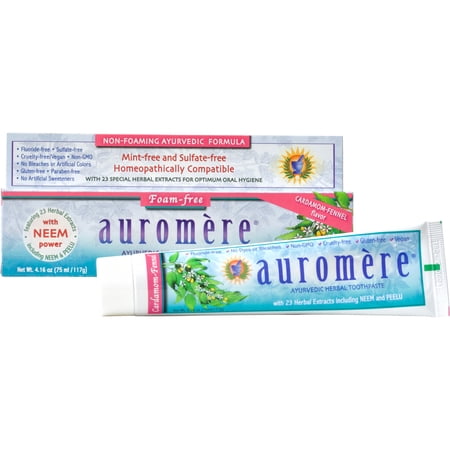

Auromere Ayurvedic Herbal Natural Toothpaste Foam-Free Cardamom-Fennel 4.16 oz
Analysis updated September 2026 · How Scout scores
At a glance
Summary
This toothpaste features a clean formula with a variety of beneficial herbal ingredients such as neem, clove, and cinnamon, which are known for their antimicrobial and anti-inflammatory properties. It avoids harmful chemicals commonly found in oral care products, such as SLS and fluoride, and includes natural oils like fennel and cardamom for flavor. The absence of synthetic additives and the inclusion of natural, evidence-backed ingredients contribute to its high rating.
Key ingredients 34
GlycerineGood
Beneficial ingredient — whole-food or functional value in this product class.
Risks
There are no significant risks associated with glycerine in toothpaste.
Benefits
It helps to keep the toothpaste moist and palatable.
Herbal extract blendGood
Herbal extracts in toothpaste can provide natural antimicrobial and anti-inflammatory benefits. They are often used to promote oral health and freshen breath. The specific benefits depend on the herbs used.
Risks
Some individuals may be allergic to certain herbal extracts.
Benefits
They can provide antimicrobial and anti-inflammatory benefits, promoting oral health.
PeeluGood
Peelu is a natural fiber used in oral care for its gentle abrasive properties. It helps in cleaning teeth without damaging enamel. It is considered a safe and effective natural ingredient.
Risks
There are no significant risks associated with Peelu.
Benefits
It provides gentle cleaning action, helping to remove plaque and surface stains.
NeemGood
Neem is known for its antibacterial properties, making it beneficial in oral care products. It helps in reducing plaque and preventing gum disease. Neem is a natural and effective ingredient for maintaining oral hygiene.
Risks
Some individuals may experience allergic reactions to neem.
Benefits
It has antibacterial properties that help in reducing plaque and preventing gum disease.
Indian Licorice rootGood
Indian Licorice root is used for its anti-inflammatory and antimicrobial properties. It can help soothe gums and reduce oral bacteria. It is a beneficial natural ingredient in oral care.
Risks
Excessive use may lead to increased blood pressure in sensitive individuals.
Benefits
It provides anti-inflammatory and antimicrobial benefits, soothing gums and reducing bacteria.
Pomegranate rindGood
Pomegranate rind is rich in antioxidants and has antimicrobial properties. It can help in reducing oral bacteria and promoting gum health. It is a beneficial addition to oral care products.
Risks
There are no significant risks associated with pomegranate rind in toothpaste.
Benefits
It provides antioxidants and antimicrobial benefits, promoting gum health.
CloveGood
Clove is known for its analgesic and antimicrobial properties, making it beneficial for oral care. It can help in reducing tooth pain and fighting oral bacteria. Clove is a well-regarded natural ingredient in oral health.
Risks
Excessive use may cause irritation in sensitive individuals.
Benefits
It provides analgesic and antimicrobial benefits, reducing tooth pain and fighting bacteria.
CinnamonGood
Cinnamon is known for its antimicrobial properties, making it beneficial for oral care. It can help in reducing oral bacteria and freshening breath. Cinnamon is a well-regarded natural ingredient in oral health.
Risks
Excessive use may cause irritation in sensitive individuals.
Benefits
It provides antimicrobial benefits, reducing oral bacteria and freshening breath.
Fennel oilGood
Fennel oil is known for its antimicrobial properties, making it beneficial for oral care. It can help in reducing oral bacteria and freshening breath. Fennel oil is a well-regarded natural ingredient in oral health.
Risks
Excessive use may cause irritation in sensitive individuals.
Benefits
It provides antimicrobial benefits, reducing oral bacteria and freshening breath.
Cardamom oilGood
Cardamom oil is known for its antimicrobial properties, making it beneficial for oral care. It can help in reducing oral bacteria and freshening breath. Cardamom oil is a well-regarded natural ingredient in oral health.
Risks
Excessive use may cause irritation in sensitive individuals.
Benefits
It provides antimicrobial benefits, reducing oral bacteria and freshening breath.
Fine ChalkNeutral
Fine chalk is used as a mild abrasive in toothpaste to help remove plaque and surface stains. It is generally considered safe for oral care. However, it does not provide any additional health benefits beyond its abrasive properties.
Risks
Excessive use of abrasive materials can potentially wear down enamel over time.
Benefits
It helps in cleaning teeth by removing surface stains and plaque.
WaterNeutral
Water is a common ingredient in toothpaste, used as a solvent to dissolve other ingredients. It is essential for the formulation but does not provide direct oral health benefits.
Risks
There are no risks associated with water in toothpaste.
Benefits
It acts as a solvent and helps in mixing other ingredients.
Common JujubeNeutral
Common Jujube is used for its potential soothing properties in oral care. It is generally considered safe but does not have significant evidence supporting its oral health benefits.
Risks
There are no significant risks associated with Common Jujube in toothpaste.
Benefits
It may provide soothing properties for oral tissues.
Rose AppleNeutral
Rose Apple is included for its potential antioxidant properties. It is generally safe but lacks specific evidence for oral health benefits.
Risks
There are no significant risks associated with Rose Apple in toothpaste.
Benefits
It may offer antioxidant benefits.
Persian WalnutNeutral
Persian Walnut is included for its potential astringent properties. It is generally safe but does not have significant evidence supporting its oral health benefits.
Risks
There are no significant risks associated with Persian Walnut in toothpaste.
Benefits
It may offer astringent properties.
Barleria prionitis barkNeutral
Barleria prionitis bark is used for its potential anti-inflammatory properties. It is generally safe but lacks specific evidence for oral health benefits.
Risks
There are no significant risks associated with Barleria prionitis bark in toothpaste.
Benefits
It may provide anti-inflammatory benefits.
Indian AlmondNeutral
Indian Almond is included for its potential antioxidant properties. It is generally safe but lacks specific evidence for oral health benefits.
Risks
There are no significant risks associated with Indian Almond in toothpaste.
Benefits
It may offer antioxidant benefits.
Bedda nutNeutral
Bedda nut is used for its potential astringent properties. It is generally safe but lacks specific evidence for oral health benefits.
Risks
There are no significant risks associated with Bedda nut in toothpaste.
Benefits
It may offer astringent properties.
Asian Holly OakNeutral
Asian Holly Oak is included for its potential astringent properties. It is generally safe but lacks specific evidence for oral health benefits.
Risks
There are no significant risks associated with Asian Holly Oak in toothpaste.
Benefits
It may offer astringent properties.
Prickly AshNeutral
Prickly Ash is used for its potential analgesic properties. It is generally safe but lacks specific evidence for oral health benefits.
Risks
There are no significant risks associated with Prickly Ash in toothpaste.
Benefits
It may provide analgesic benefits.
Zanthoxylum alatumNeutral
Zanthoxylum alatum is included for its potential analgesic properties. It is generally safe but lacks specific evidence for oral health benefits.
Risks
There are no significant risks associated with Zanthoxylum alatum in toothpaste.
Benefits
It may provide analgesic benefits.
Sappan woodNeutral
Sappan wood is used for its potential antimicrobial properties. It is generally safe but lacks specific evidence for oral health benefits.
Risks
There are no significant risks associated with Sappan wood in toothpaste.
Benefits
It may offer antimicrobial benefits.
CatechuNeutral
Catechu is included for its potential astringent properties. It is generally safe but lacks specific evidence for oral health benefits.
Risks
There are no significant risks associated with Catechu in toothpaste.
Benefits
It may offer astringent properties.
Bengal MadderNeutral
Bengal Madder is used for its potential anti-inflammatory properties. It is generally safe but lacks specific evidence for oral health benefits.
Risks
There are no significant risks associated with Bengal Madder in toothpaste.
Benefits
It may provide anti-inflammatory benefits.
Acacia arabica barkNeutral
Acacia arabica bark is included for its potential astringent properties. It is generally safe but lacks specific evidence for oral health benefits.
Risks
There are no significant risks associated with Acacia arabica bark in toothpaste.
Benefits
It may offer astringent properties.
SarsaparillaNeutral
Sarsaparilla is used for its potential anti-inflammatory properties. It is generally safe but lacks specific evidence for oral health benefits.
Risks
There are no significant risks associated with Sarsaparilla in toothpaste.
Benefits
It may provide anti-inflammatory benefits.
Medlar barkNeutral
Medlar bark is included for its potential astringent properties. It is generally safe but lacks specific evidence for oral health benefits.
Risks
There are no significant risks associated with Medlar bark in toothpaste.
Benefits
It may offer astringent properties.
MayweedNeutral
Mayweed is used for its potential anti-inflammatory properties. It is generally safe but lacks specific evidence for oral health benefits.
Risks
There are no significant risks associated with Mayweed in toothpaste.
Benefits
It may provide anti-inflammatory benefits.
Bishop's weedNeutral
Bishop's weed is included for its potential antimicrobial properties. It is generally safe but lacks specific evidence for oral health benefits.
Risks
There are no significant risks associated with Bishop's weed in toothpaste.
Benefits
It may offer antimicrobial benefits.
SilicaNeutral
Silica is used as a mild abrasive in toothpaste to help remove plaque and surface stains. It is generally considered safe for oral care. However, it does not provide any additional health benefits beyond its abrasive properties.
Risks
Excessive use of abrasive materials can potentially wear down enamel over time.
Benefits
It helps in cleaning teeth by removing surface stains and plaque.
Cellulose gumNeutral
Cellulose gum is used as a thickening agent in toothpaste. It is generally recognized as safe for oral use. However, it does not contribute to oral health beyond its role as a stabilizer.
Risks
There are no significant risks associated with cellulose gum in toothpaste.
Benefits
It helps to stabilize and thicken the toothpaste.
p ThymolNeutral
p Thymol is used for its antimicrobial properties in oral care products. It is generally considered safe but does not have significant evidence supporting its oral health benefits.
Risks
There are no significant risks associated with p Thymol in toothpaste.
Benefits
It may offer antimicrobial benefits.
CarrageenanBad
Processed additive flagged under Scout's ingredient doctrine.
Risks
There are concerns about gastrointestinal inflammation with excessive consumption, but it is considered safe in toothpaste.
Benefits
It helps to stabilize and thicken the toothpaste.
Potassium SorbateBad
Synthetic preservative — flagged in daily-use products.
Risks
There are no significant risks associated with potassium sorbate in toothpaste.
Benefits
It helps to preserve the toothpaste by preventing microbial growth.
Processing
Processed Foods
Get the full breakdown in the Scout appTake Scout shopping
Scan any product to see lab results, healthy alternatives, and your personalized analysis.
Download on theApp Store GET IT ONGoogle PlayAmazon pricing & content
Amazon price as of . Product prices and availability are accurate as of the date/time indicated and are subject to change. Any price and availability information displayed on Amazon.com at the time of purchase will apply to the purchase of this product.
CERTAIN CONTENT THAT APPEARS ON THIS SITE COMES FROM AMAZON. THIS CONTENT IS PROVIDED “AS IS” AND IS SUBJECT TO CHANGE OR REMOVAL AT ANY TIME.