
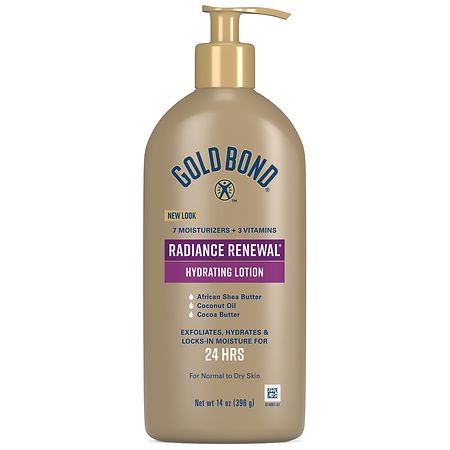


Gold Bond Cocoa Butter Glow Daily Hydrating Lotion with Shea Butter Cocoa Butter and Coconut Oil Exfoliating Moisturizer for Dry Skin 14 oz.
Analysis updated August 2026 · How Scout scores
At a glance
Summary
This body lotion contains beneficial ingredients like glycerin, coconut oil, shea butter, and aloe vera, which provide moisturizing and soothing properties. However, the presence of petrolatum raises concerns due to potential contamination with harmful compounds, and the inclusion of fragrance can cause irritation for sensitive skin. The product also contains cyclopentasiloxane, a silicone that may contribute to environmental pollution, which affects its overall safety profile.
Key ingredients 48
Cocos Nucifera (Coconut) OilVery Good
Coconut oil is a natural emollient that helps moisturize and soften the skin. It contains fatty acids that are beneficial for skin health.
Risks
Can cause breakouts in acne-prone skin due to its comedogenic nature.
Benefits
Deeply moisturizes and nourishes the skin, improving its texture.
Jojoba EstersVery Good
Jojoba Esters are derived from jojoba oil and provide emollient properties. They mimic the skin's natural oils, making them highly compatible with skin.
Risks
Low risk of irritation or allergic reaction.
Benefits
Moisturizes and conditions the skin, enhancing its softness.
Aloe Barbadensis Leaf JuiceVery Good
Aloe Vera is known for its soothing and hydrating properties. It helps calm irritated skin and provides moisture.
Risks
Rarely, aloe can cause allergic reactions in sensitive individuals.
Benefits
Soothes and hydrates the skin, reducing redness and irritation.
Butyrospermum Parkii (Shea) Butter ExtractVery Good
Shea Butter is a natural fat extracted from the nuts of the shea tree. It is known for its moisturizing and anti-inflammatory properties.
Risks
Rarely, shea butter can cause allergic reactions in sensitive individuals.
Benefits
Deeply moisturizes and nourishes the skin, improving its elasticity.
Theobroma Cacao (Cocoa) Seed ButterVery Good
Cocoa Butter is a natural fat extracted from cocoa beans. It is rich in fatty acids and provides excellent moisturizing properties.
Risks
Can cause breakouts in acne-prone skin due to its comedogenic nature.
Benefits
Moisturizes and softens the skin, improving its texture and appearance.
PanthenolVery Good
Panthenol, also known as provitamin B5, is a humectant that attracts moisture to the skin. It has soothing and anti-inflammatory properties.
Risks
Low risk of irritation or allergic reaction.
Benefits
Hydrates and soothes the skin, reducing redness and irritation.
Ceramide NSVery Good
Ceramide NS is a skin-identical lipid that helps restore the skin barrier and retain moisture. It is essential for healthy skin function.
Risks
Low risk of irritation or allergic reaction.
Benefits
Strengthens the skin barrier and improves moisture retention.
Ceramide EOSVery Good
Ceramide EOS is a skin-identical lipid that helps restore the skin barrier and retain moisture. It is essential for healthy skin function.
Risks
Low risk of irritation or allergic reaction.
Benefits
Strengthens the skin barrier and improves moisture retention.
Hydrolyzed Jojoba EstersVery Good
Hydrolyzed Jojoba Esters are derived from jojoba oil and provide emollient properties. They mimic the skin's natural oils, making them highly compatible with skin.
Risks
Low risk of irritation or allergic reaction.
Benefits
Moisturizes and conditions the skin, enhancing its softness.
Ceramide EOPVery Good
Ceramide EOP is a skin-identical lipid that helps restore the skin barrier and retain moisture. It is essential for healthy skin function.
Risks
Low risk of irritation or allergic reaction.
Benefits
Strengthens the skin barrier and improves moisture retention.
Ceramide APVery Good
Ceramide AP is a skin-identical lipid that helps restore the skin barrier and retain moisture. It is essential for healthy skin function.
Risks
Low risk of irritation or allergic reaction.
Benefits
Strengthens the skin barrier and improves moisture retention.
GlycerinGood
Glycerin is a humectant that attracts moisture to the skin, helping to keep it hydrated. It is widely used in skincare for its moisturizing properties.
Risks
Rarely, glycerin can cause irritation in sensitive individuals.
Benefits
Helps maintain skin hydration and improves skin barrier function.
Hydroxyethyl UreaGood
Hydroxyethyl Urea is a moisturizing agent that helps improve skin hydration. It is less sticky than glycerin and provides a smooth feel.
Risks
Generally considered safe, but may cause irritation in very sensitive skin.
Benefits
Enhances skin moisture levels and provides a smooth texture.
GluconolactoneGood
Gluconolactone is a polyhydroxy acid (PHA) that provides gentle exfoliation and hydration. It is suitable for sensitive skin types.
Risks
May cause mild irritation if used in high concentrations.
Benefits
Exfoliates dead skin cells and enhances skin moisture retention.
Ammonium LactateGood
Ammonium Lactate is a combination of lactic acid and ammonium hydroxide. It acts as a moisturizer and exfoliant, improving skin texture.
Risks
May cause irritation or stinging in sensitive skin.
Benefits
Exfoliates and hydrates the skin, improving its texture and appearance.
Ceramide NPGood
Ceramide NP is a skin-identical lipid that helps restore the skin barrier and retain moisture. It is essential for healthy skin function.
Risks
Low risk of irritation or allergic reaction.
Benefits
Strengthens the skin barrier and improves moisture retention.
Magnesium Ascorbyl PhosphateGood
Magnesium Ascorbyl Phosphate is a stable form of Vitamin C that provides antioxidant benefits and brightens the skin. It is less irritating than other forms of Vitamin C.
Risks
May cause irritation in very sensitive skin.
Benefits
Brightens the skin and provides antioxidant protection.
Tocopheryl AcetateGood
Tocopheryl Acetate is a form of Vitamin E that provides antioxidant benefits and helps protect the skin from environmental damage.
Risks
Low risk of irritation or allergic reaction.
Benefits
Protects the skin from oxidative stress and improves skin health.
Zingiber Officinale (Ginger) Root ExtractGood
Ginger Root Extract is known for its antioxidant and anti-inflammatory properties. It helps soothe the skin and reduce redness.
Risks
May cause irritation in very sensitive skin.
Benefits
Soothes and protects the skin, reducing inflammation and redness.
BisabololGood
Bisabolol is a natural compound known for its soothing and anti-inflammatory properties. It helps calm irritated skin and reduce redness.
Risks
Low risk of irritation or allergic reaction.
Benefits
Soothes and calms the skin, reducing inflammation and redness.
Caprooyl PhytosphingosineGood
Caprooyl Phytosphingosine is a lipid that helps restore the skin barrier and improve moisture retention. It is beneficial for maintaining healthy skin.
Risks
Low risk of irritation or allergic reaction.
Benefits
Strengthens the skin barrier and enhances moisture retention.
Caprooyl SphingosineGood
Caprooyl Sphingosine is a lipid that helps restore the skin barrier and improve moisture retention. It is beneficial for maintaining healthy skin.
Risks
Low risk of irritation or allergic reaction.
Benefits
Strengthens the skin barrier and enhances moisture retention.
CholesterolGood
Cholesterol is a lipid that helps restore the skin barrier and improve moisture retention. It is essential for maintaining healthy skin.
Risks
Low risk of irritation or allergic reaction.
Benefits
Strengthens the skin barrier and enhances moisture retention.
WaterNeutral
Water is a common solvent used in cosmetic formulations. It helps dissolve other ingredients and provides a base for the lotion. It does not have any direct benefits or risks.
Benefits
Provides a base for the formulation and helps in the application of the product.
Steareth-21Neutral
Steareth-21 is an emulsifier that helps blend oil and water components in formulations. It is generally considered safe for use in cosmetics.
Risks
May cause irritation in very sensitive skin.
Benefits
Stabilizes emulsions and improves product texture.
Cetyl AlcoholNeutral
Cetyl Alcohol is a fatty alcohol used as an emollient and thickener in skincare products. It is not drying like other alcohols.
Risks
Generally safe, but can cause irritation in sensitive individuals.
Benefits
Improves product texture and provides moisturizing benefits.
Distearyldimonium ChlorideNeutral
Distearyldimonium Chloride is a conditioning agent that helps improve the texture and feel of the product. It is commonly used in hair and skin care products.
Risks
May cause irritation if used in high concentrations.
Benefits
Improves product spreadability and skin feel.
Stearyl AlcoholNeutral
Stearyl Alcohol is a fatty alcohol used as an emollient and thickener. It is not drying like other alcohols and is safe for use in cosmetics.
Risks
Generally safe, but can cause irritation in sensitive individuals.
Benefits
Improves product texture and provides moisturizing benefits.
Cetearyl AlcoholNeutral
Cetearyl Alcohol is a fatty alcohol used as an emollient and thickener. It is not drying like other alcohols and is safe for use in cosmetics.
Risks
Generally safe, but can cause irritation in sensitive individuals.
Benefits
Improves product texture and provides moisturizing benefits.
Glyceryl StearateNeutral
Glyceryl Stearate is an emulsifier that helps blend oil and water components in formulations. It is generally considered safe for use in cosmetics.
Risks
May cause irritation in very sensitive skin.
Benefits
Stabilizes emulsions and improves product texture.
Methyl Gluceth-20Neutral
Methyl Gluceth-20 is a humectant and emollient that helps moisturize the skin. It is derived from glucose and is considered safe for use.
Risks
Low risk of irritation or allergic reaction.
Benefits
Moisturizes and softens the skin, enhancing its texture.
EthylhexylglycerinNeutral
Ethylhexylglycerin is a preservative and skin conditioning agent. It is used to enhance the efficacy of other preservatives.
Risks
May cause irritation in very sensitive skin.
Benefits
Improves product preservation and provides mild skin conditioning.
Behenic AcidNeutral
Behenic Acid is a fatty acid used as an emollient and thickener in skincare products. It is generally considered safe for use.
Risks
Low risk of irritation or allergic reaction.
Benefits
Improves product texture and provides moisturizing benefits.
Butylene GlycolNeutral
Butylene Glycol is a humectant that helps attract moisture to the skin. It is commonly used in skincare products for its moisturizing properties.
Risks
May cause irritation in very sensitive skin.
Benefits
Moisturizes and softens the skin, enhancing its texture.
DimethiconolNeutral
Dimethiconol is a silicone used to provide a smooth application and improve product spreadability. It is non-comedogenic and widely used in skincare.
Risks
May cause build-up on the skin with prolonged use.
Benefits
Creates a protective barrier on the skin and improves product spreadability.
Stearamidopropyl PG-Dimonium Chloride PhosphateNeutral
Stearamidopropyl PG-Dimonium Chloride Phosphate is a conditioning agent used in hair and skin care products. It is generally considered safe for use.
Risks
Low risk of irritation or allergic reaction.
Benefits
Improves product spreadability and provides conditioning benefits.
Ceteareth-25Neutral
Ceteareth-25 is an emulsifier that helps blend oil and water components in formulations. It is generally considered safe for use in cosmetics.
Risks
May cause irritation in very sensitive skin.
Benefits
Stabilizes emulsions and improves product texture.
HydroxyacetophenoneNeutral
Hydroxyacetophenone is an antioxidant and preservative booster used in cosmetic formulations. It helps protect the product from degradation.
Risks
Low risk of irritation or allergic reaction.
Benefits
Enhances product stability and provides antioxidant protection.
Potassium HydroxideNeutral
Potassium Hydroxide is used to adjust the pH of cosmetic formulations. It is generally considered safe in low concentrations.
Risks
Can cause irritation if used in high concentrations.
Benefits
Helps maintain the stability and efficacy of the product.
DimethiconeBad
Occlusive silicone film-former — flagged under clean-beauty doctrine.
Risks
May cause build-up on the skin with prolonged use.
Benefits
Creates a protective barrier on the skin and improves product spreadability.
CyclopentasiloxaneBad
Cyclopentasiloxane is a silicone used to provide a smooth application and improve product spreadability. However, it is a volatile silicone that can contribute to environmental pollution.
Risks
Potential environmental impact and may cause build-up on the skin.
Benefits
Improves product spreadability and provides a silky feel.
Behentrimonium MethosulfateBad
Processed additive flagged under Scout's ingredient doctrine.
Risks
Low risk of irritation or allergic reaction.
Benefits
Improves product spreadability and provides conditioning benefits.
Propylene GlycolBad
Processed additive flagged under Scout's ingredient doctrine.
Risks
May cause irritation in very sensitive skin.
Benefits
Moisturizes and softens the skin, enhancing its texture.
Polysorbate 60Bad
Processed additive flagged under Scout's ingredient doctrine.
Risks
May cause irritation in very sensitive skin.
Benefits
Stabilizes emulsions and improves product texture.
Disodium EDTABad
Processed additive flagged under Scout's ingredient doctrine.
Risks
May cause irritation in very sensitive skin.
Benefits
Stabilizes formulations and enhances product shelf life.
CaramelBad
Processed additive flagged under Scout's ingredient doctrine.
Risks
Low risk of irritation or allergic reaction.
Benefits
Provides color to the product.
PetrolatumVery Bad
Petrolatum is a petroleum-derived occlusive agent that locks in moisture. However, it can be contaminated with polycyclic aromatic hydrocarbons (PAHs), which are potential carcinogens.
Risks
Potential contamination with harmful substances and can cause pore blockage.
Benefits
Provides a strong occlusive barrier to prevent moisture loss.
FragranceVery Bad
Fragrance is a mixture of aromatic compounds used to impart scent to products. It can cause allergic reactions and skin irritation in sensitive individuals.
Risks
Potential allergen and irritant, especially for sensitive skin.
Benefits
Provides a pleasant scent to the product.
Get the full breakdown in the Scout appTake Scout shopping
Scan any product to see lab results, healthy alternatives, and your personalized analysis.
Download on theApp Store GET IT ONGoogle PlayAmazon pricing & content
Amazon price as of . Product prices and availability are accurate as of the date/time indicated and are subject to change. Any price and availability information displayed on Amazon.com at the time of purchase will apply to the purchase of this product.
CERTAIN CONTENT THAT APPEARS ON THIS SITE COMES FROM AMAZON. THIS CONTENT IS PROVIDED “AS IS” AND IS SUBJECT TO CHANGE OR REMOVAL AT ANY TIME.