
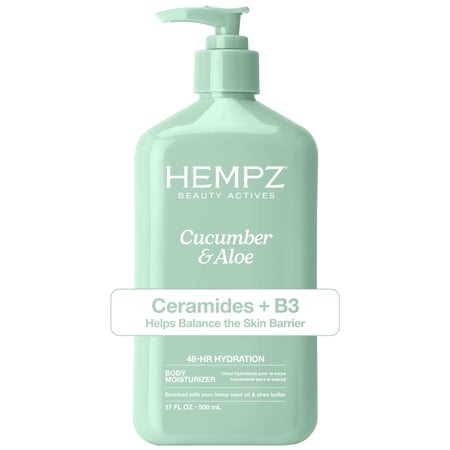
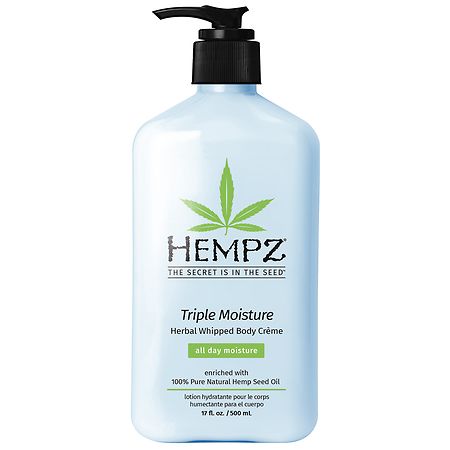
Hempz Beauty Actives Cucumber & Aloe Daily Body Moisturizer Lotion with Ceramides + B3 for Dry Skin 17 fl oz
Analysis updated August 2026 · How Scout scores
At a glance
Summary
This body lotion contains beneficial ingredients such as shea butter, niacinamide, and ceramides, which are known for their moisturizing and skin-repairing properties. However, the presence of synthetic fragrance and several potential allergens like linalool and limonene can cause skin irritation for sensitive users. Additionally, the inclusion of phenoxyethanol and other preservatives contributes to a moderate level of processing, impacting the overall score.
Key ingredients 37
Butyrospermum Parkii (Shea) ButterVery Good
Shea Butter is a natural fat extracted from the nuts of the shea tree. It is known for its moisturizing and anti-inflammatory properties.
Risks
There are minimal risks, though it may cause allergic reactions in individuals with nut allergies.
Benefits
It deeply moisturizes the skin and helps to improve skin elasticity.
Cannabis Sativa Seed OilVery Good
Cannabis Sativa Seed Oil is rich in essential fatty acids and antioxidants. It is known for its moisturizing and anti-inflammatory properties.
Risks
There are minimal risks, though it may cause allergic reactions in some individuals.
Benefits
It helps to nourish and hydrate the skin, reducing dryness and irritation.
Aloe Barbadensis Leaf JuiceVery Good
Aloe Vera is known for its soothing and hydrating properties. It helps to calm irritated skin and provides moisture.
Risks
There are minimal risks, though it may cause allergic reactions in some individuals.
Benefits
It helps to soothe and hydrate the skin, reducing redness and irritation.
GlycerinGood
Glycerin is a humectant that attracts moisture to the skin. It is a common ingredient in skincare products due to its hydrating properties.
Risks
There are minimal risks associated with glycerin.
Benefits
It helps to maintain the skin's moisture balance and improves skin hydration.
NiacinamideGood
Niacinamide is a form of Vitamin B3 that is known for its anti-inflammatory and skin-brightening properties. It helps to improve skin texture and tone.
Risks
There are minimal risks, though it may cause mild irritation in sensitive skin.
Benefits
It helps to reduce redness, improve skin elasticity, and enhance the skin barrier.
Ceramide NPGood
Ceramide NP is a lipid that helps to restore the skin barrier and retain moisture. It is essential for maintaining healthy skin.
Risks
There are minimal risks associated with ceramides.
Benefits
It helps to strengthen the skin barrier and improve hydration.
Cucumis Sativus (Cucumber) Fruit ExtractGood
Cucumber Extract is known for its cooling and soothing properties. It helps to refresh and hydrate the skin.
Risks
There are minimal risks associated with cucumber extract.
Benefits
It helps to soothe and hydrate the skin, providing a refreshing feel.
Helianthus Annuus (Sunflower) Seed OilGood
Sunflower Seed Oil is rich in essential fatty acids and Vitamin E. It is known for its moisturizing and antioxidant properties.
Risks
There are minimal risks, though it may cause allergic reactions in some individuals.
Benefits
It helps to nourish and protect the skin, improving hydration and elasticity.
Ascorbic AcidGood
Ascorbic Acid, also known as Vitamin C, is an antioxidant that helps to brighten the skin and reduce signs of aging.
Risks
There are minimal risks, though it may cause mild irritation in sensitive skin.
Benefits
It helps to brighten the skin and protect against environmental damage.
Tocopheryl AcetateGood
Tocopheryl Acetate is a form of Vitamin E that acts as an antioxidant. It helps to protect the skin from free radical damage.
Risks
There are minimal risks associated with tocopheryl acetate.
Benefits
It helps to nourish and protect the skin, improving hydration and elasticity.
TocopherolGood
Tocopherol, also known as Vitamin E, is an antioxidant that helps to protect the skin from free radical damage.
Risks
There are minimal risks associated with tocopherol.
Benefits
It helps to nourish and protect the skin, improving hydration and elasticity.
Water/Aqua/EauNeutral
Water is a common solvent used in cosmetic formulations to dissolve other ingredients. It helps in spreading the product evenly on the skin.
Risks
There are no significant risks associated with water in cosmetic formulations.
Benefits
Water helps in hydrating the skin and acts as a base for other ingredients.
Isopropyl PalmitateNeutral
Isopropyl Palmitate is an emollient that helps to soften and smooth the skin. It is derived from palm oil and is commonly used in lotions.
Risks
It may cause skin irritation in sensitive individuals.
Benefits
It provides a smooth application and helps to lock in moisture.
Butylene GlycolNeutral
Butylene Glycol is a humectant that helps to retain moisture in the skin. It also acts as a solvent for other ingredients.
Risks
It can cause irritation in some individuals with sensitive skin.
Benefits
It enhances the penetration of other ingredients and provides a smooth texture.
PropanediolNeutral
Propanediol is a glycol that acts as a solvent and humectant in cosmetic formulations. It is derived from corn sugar.
Risks
There is a low risk of skin irritation.
Benefits
It helps to improve the texture and feel of the product on the skin.
Sorbitan StearateNeutral
Sorbitan Stearate is an emulsifier that helps to stabilize and thicken formulations. It is derived from sorbitol and stearic acid.
Risks
It may cause mild irritation in sensitive skin.
Benefits
It helps to improve the texture and consistency of the product.
Stearic AcidNeutral
Stearic Acid is a fatty acid used as an emulsifier and thickener in cosmetic formulations. It helps to stabilize and maintain the consistency of the product.
Risks
There are minimal risks associated with stearic acid.
Benefits
It helps to improve the texture and stability of the product.
Glyceryl StearateNeutral
Glyceryl Stearate is an emulsifier that helps to blend water and oil components in formulations. It is derived from glycerin and stearic acid.
Risks
It may cause mild irritation in sensitive individuals.
Benefits
It helps to improve the texture and consistency of the product.
PEG-100 StearateNeutral
PEG-100 Stearate is an emulsifier that helps to stabilize formulations. It is a polyethylene glycol derivative of stearic acid.
Risks
There is a potential risk of contamination with ethylene oxide and 1,4-dioxane.
Benefits
It helps to improve the texture and stability of the product.
Cetyl AlcoholNeutral
Cetyl Alcohol is a fatty alcohol used as an emollient and thickener in cosmetic formulations. It helps to stabilize and improve the texture of the product.
Risks
There are minimal risks associated with cetyl alcohol.
Benefits
It helps to soften and smooth the skin, providing a creamy texture.
Polysorbate 40Neutral
Polysorbate 40 is an emulsifier that helps to blend oil and water components in formulations. It is derived from sorbitol.
Risks
There is a potential risk of contamination with ethylene oxide and 1,4-dioxane.
Benefits
It helps to improve the texture and stability of the product.
CarbomerNeutral
Carbomer is a thickening agent used to stabilize and thicken formulations. It helps to create a gel-like consistency.
Risks
There are minimal risks associated with carbomer.
Benefits
It helps to improve the texture and consistency of the product.
Nylon-12Neutral
Nylon-12 is a synthetic polymer used to improve the texture and feel of cosmetic products. It provides a smooth, silky finish.
Risks
There are minimal risks associated with nylon-12.
Benefits
It helps to improve the texture and feel of the product on the skin.
EthylhexylglycerinNeutral
Ethylhexylglycerin is a preservative and skin-conditioning agent. It is often used as an alternative to parabens.
Risks
There are minimal risks associated with ethylhexylglycerin.
Benefits
It helps to preserve the product and improve skin feel.
Trisodium Ethylenediamine DisuccinateNeutral
Trisodium Ethylenediamine Disuccinate is a chelating agent that helps to stabilize formulations by binding metal ions. It enhances the effectiveness of preservatives.
Risks
There are minimal risks associated with this ingredient.
Benefits
It helps to improve the stability and effectiveness of the product.
Citric AcidNeutral
Citric Acid is used to adjust the pH of cosmetic formulations. It also acts as a mild exfoliant.
Risks
There are minimal risks, though it may cause mild irritation in sensitive skin.
Benefits
It helps to maintain the pH balance and improve skin texture.
DimethiconeBad
Occlusive silicone film-former — flagged under clean-beauty doctrine.
Risks
It may cause breakouts in acne-prone skin due to its occlusive nature.
Benefits
It provides a silky feel and helps to smooth the skin's surface.
PhenoxyethanolBad
Phenoxyethanol is a preservative used to prevent microbial growth in cosmetic products. It is considered a safer alternative to parabens.
Risks
It can cause skin irritation and allergic reactions in some individuals.
Benefits
It helps to preserve the product and extend its shelf life.
ChlorphenesinBad
Chlorphenesin is a preservative used to prevent microbial growth in cosmetic products. It is effective against bacteria and fungi.
Risks
It can cause skin irritation and allergic reactions in some individuals.
Benefits
It helps to preserve the product and extend its shelf life.
Aminomethyl PropanolBad
Processed additive flagged under Scout's ingredient doctrine.
Risks
There are minimal risks associated with aminomethyl propanol.
Benefits
It helps to maintain the pH balance and stability of the product.
LinaloolBad
Linalool is a fragrance component that provides a floral scent. It is a common allergen and can cause skin irritation.
Risks
It can cause allergic reactions and skin irritation in sensitive individuals.
Benefits
It provides a pleasant floral scent to the product.
HydroxycitronellalBad
Hydroxycitronellal is a fragrance ingredient used for its floral scent. It is a known allergen and can cause skin irritation.
Risks
It can cause allergic reactions and skin irritation in sensitive individuals.
Benefits
It provides a pleasant floral scent to the product.
Benzyl BenzoateBad
Benzyl Benzoate is used as a fragrance ingredient and solvent. It is a known allergen and can cause skin irritation.
Risks
It can cause allergic reactions and skin irritation in sensitive individuals.
Benefits
It provides a pleasant scent and acts as a solvent in formulations.
LimoneneBad
Limonene is a fragrance component with a citrus scent. It is a common allergen and can cause skin irritation.
Risks
It can cause allergic reactions and skin irritation in sensitive individuals.
Benefits
It provides a fresh citrus scent to the product.
Potassium SorbateBad
Synthetic preservative — flagged in daily-use products.
Risks
There are minimal risks, though it may cause mild irritation in sensitive skin.
Benefits
It helps to preserve the product and extend its shelf life.
Sodium BenzoateBad
Synthetic preservative that can form benzene in the presence of vitamin C.
Risks
There are minimal risks, though it may cause mild irritation in sensitive skin.
Benefits
It helps to preserve the product and extend its shelf life.
Fragrance (Parfum)Very Bad
Fragrance is used to impart a pleasant scent to the product. However, it can be a mixture of various chemicals that may cause skin irritation.
Risks
It is a common allergen and can cause skin irritation or allergic reactions.
Benefits
It provides a pleasant scent to the product.
Get the full breakdown in the Scout appTake Scout shopping
Scan any product to see lab results, healthy alternatives, and your personalized analysis.
Download on theApp Store GET IT ONGoogle PlayAmazon pricing & content
Amazon price as of . Product prices and availability are accurate as of the date/time indicated and are subject to change. Any price and availability information displayed on Amazon.com at the time of purchase will apply to the purchase of this product.
CERTAIN CONTENT THAT APPEARS ON THIS SITE COMES FROM AMAZON. THIS CONTENT IS PROVIDED “AS IS” AND IS SUBJECT TO CHANGE OR REMOVAL AT ANY TIME.