
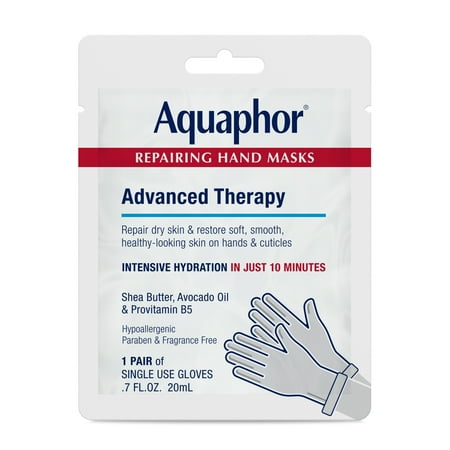


Aquaphor Repairing Hand Masks for Dry Hands Moisturizing Gloves with Shea Butter & Avocado Oil 1 Pair
Analysis updated September 2026 · How Scout scores
At a glance
Summary
This product contains a variety of beneficial ingredients such as shea butter, avocado oil, and glycerin, which provide excellent moisturizing and nourishing properties for the skin. The presence of phenoxyethanol as a preservative is a minor concern due to potential irritation, but it is used in low concentrations. Overall, the formulation is largely composed of safe and effective ingredients, contributing to a favorable score.
Key ingredients 23
Butyrospermum Parkii ButterVery Good
Butyrospermum Parkii Butter, also known as shea butter, is a natural fat extracted from the nuts of the shea tree. It is rich in vitamins and fatty acids, providing excellent moisturizing and healing properties. It is highly beneficial for dry and damaged skin.
Risks
There are minimal risks associated with shea butter, though it may cause allergic reactions in individuals with nut allergies.
Benefits
Shea butter deeply moisturizes and nourishes the skin, improving its elasticity and softness.
Persea Gratissima OilVery Good
Persea Gratissima Oil, commonly known as avocado oil, is rich in vitamins and fatty acids. It provides excellent moisturizing and nourishing properties for the skin. It is beneficial for dry and sensitive skin types.
Risks
There are minimal risks associated with avocado oil, though it may cause allergic reactions in some individuals.
Benefits
Avocado oil deeply moisturizes and nourishes the skin, improving its texture and appearance.
PanthenolVery Good
Panthenol, also known as provitamin B5, is a moisturizing agent that helps to improve skin hydration and elasticity. It has anti-inflammatory properties that can soothe irritated skin. It is widely used in skincare for its beneficial effects on skin health.
Risks
There are minimal risks associated with panthenol, though it may cause irritation in very sensitive skin.
Benefits
Panthenol enhances skin hydration and soothes irritation, promoting healthy skin.
BisabololVery Good
Bisabolol is a natural compound derived from chamomile that has anti-inflammatory and soothing properties. It helps to calm irritated skin and enhance the absorption of other ingredients. It is beneficial for sensitive and irritated skin.
Risks
There are minimal risks associated with bisabolol, though it may cause allergic reactions in some individuals.
Benefits
Bisabolol soothes and calms the skin, reducing redness and irritation.
GlycerinGood
Glycerin is a humectant that attracts moisture to the skin, helping to keep it hydrated. It is widely used in skincare for its moisturizing properties. It is considered safe and beneficial for most skin types.
Risks
There are minimal risks associated with glycerin, though it may cause irritation in very sensitive skin.
Benefits
Glycerin helps to maintain skin hydration and improve skin barrier function.
UreaGood
Urea is a natural moisturizing factor that helps to maintain skin hydration. It also has keratolytic properties, which can help in exfoliating the skin. It is beneficial for dry and rough skin.
Risks
In high concentrations, urea can cause irritation or sensitivity in some individuals.
Benefits
Urea enhances skin moisture and can improve the texture of dry, rough skin.
Tocopheryl AcetateGood
Tocopheryl Acetate is a form of vitamin E that acts as an antioxidant, protecting the skin from free radical damage. It also has moisturizing properties that help to improve skin texture. It is widely used in skincare for its protective and nourishing effects.
Risks
There are minimal risks associated with tocopheryl acetate, though it may cause irritation in very sensitive skin.
Benefits
Tocopheryl Acetate protects the skin from environmental damage and improves its moisture content.
WaterNeutral
Water is a common solvent used in cosmetics to dissolve other ingredients. It helps in the application and absorption of the product. It does not provide direct benefits or risks.
Risks
There are no significant risks associated with water in cosmetics.
Benefits
Water helps in hydrating the skin by acting as a vehicle for other moisturizing ingredients.
Hydrogenated PolyisobuteneNeutral
Hydrogenated Polyisobutene is a synthetic emollient used to provide a smooth application. It helps in forming a barrier on the skin to prevent moisture loss. It is generally considered safe for use in cosmetics.
Risks
There are no significant risks associated with this ingredient.
Benefits
It helps in improving the texture and feel of the product on the skin.
Cetearyl AlcoholNeutral
Cetearyl Alcohol is a fatty alcohol used as an emollient and thickener in cosmetics. It helps to stabilize and thicken formulations. It is considered safe and non-irritating for most skin types.
Risks
There are minimal risks associated with cetearyl alcohol, though it may cause irritation in very sensitive skin.
Benefits
It helps in improving the texture and stability of the product.
Glyceryl StearateNeutral
Glyceryl Stearate is an emulsifier that helps to blend water and oil components in formulations. It provides a smooth texture and enhances the moisturizing properties of the product. It is generally considered safe for use in cosmetics.
Risks
There are no significant risks associated with glyceryl stearate.
Benefits
It helps in improving the texture and moisturizing properties of the product.
PEG-100 StearateNeutral
PEG-100 Stearate is an emulsifier that helps to blend water and oil components in formulations. It provides a smooth texture and enhances the stability of the product. It is generally considered safe for use in cosmetics.
Risks
There are concerns about potential contamination with ethylene oxide and 1,4-dioxane, which are by-products of the ethoxylation process.
Benefits
It helps in improving the texture and stability of the product.
Caprylic/Capric TriglycerideNeutral
Caprylic/Capric Triglyceride is an emollient derived from coconut oil and glycerin. It helps to improve the spreadability and absorption of the product. It is considered safe and non-irritating for most skin types.
Risks
There are no significant risks associated with this ingredient.
Benefits
It helps in improving the texture and absorption of the product.
BetaineNeutral
Betaine is a natural compound derived from sugar beets that helps to maintain skin hydration. It has humectant properties that attract moisture to the skin. It is generally considered safe for use in cosmetics.
Risks
There are no significant risks associated with betaine.
Benefits
Betaine helps to maintain skin hydration and improve skin texture.
Ceteareth-25Neutral
Ceteareth-25 is an emulsifier that helps to blend water and oil components in formulations. It provides a smooth texture and enhances the stability of the product. It is generally considered safe for use in cosmetics.
Risks
There are concerns about potential contamination with ethylene oxide and 1,4-dioxane, which are by-products of the ethoxylation process.
Benefits
It helps in improving the texture and stability of the product.
Glyceryl CaprylateNeutral
Glyceryl Caprylate is an emollient and emulsifier that helps to improve the texture and stability of formulations. It also has antimicrobial properties that can enhance the preservation of the product. It is generally considered safe for use in cosmetics.
Risks
There are no significant risks associated with glyceryl caprylate.
Benefits
It helps in improving the texture and preservation of the product.
Xanthan GumNeutral
Xanthan Gum is a natural thickening agent used to improve the texture and stability of formulations. It helps to create a smooth, gel-like consistency. It is generally considered safe for use in cosmetics.
Risks
There are no significant risks associated with xanthan gum.
Benefits
It helps in improving the texture and stability of the product.
Sodium HydroxideNeutral
Sodium Hydroxide is used to adjust the pH of cosmetic formulations. It is effective in small concentrations but can be irritating in higher amounts. It is generally considered safe when used appropriately.
Risks
Sodium Hydroxide can cause skin irritation and burns if used in high concentrations.
Benefits
It helps in maintaining the stability and effectiveness of the product by adjusting its pH.
HydroxyacetophenoneNeutral
Hydroxyacetophenone is an antioxidant and preservative used to enhance the stability and shelf-life of cosmetic formulations. It helps to protect the product from oxidative damage. It is generally considered safe for use in cosmetics.
Risks
There are no significant risks associated with hydroxyacetophenone.
Benefits
It helps in preserving the product and protecting it from oxidative damage.
DimethiconeBad
Occlusive silicone film-former — flagged under clean-beauty doctrine.
Risks
Dimethicone can potentially cause build-up on the skin, leading to clogged pores in some individuals.
Benefits
It helps in smoothing the skin and improving the texture of the product.
PhenoxyethanolBad
Phenoxyethanol is a preservative used to prevent microbial growth in cosmetics. It is effective in low concentrations but can cause irritation in some individuals. There are concerns about its potential neurotoxic effects at high concentrations.
Risks
Phenoxyethanol can cause skin irritation and allergic reactions in sensitive individuals.
Benefits
It helps in preserving the product by preventing microbial growth.
Acrylates/C10-30 Alkyl Acrylate CrosspolymerBad
Processed additive flagged under Scout's ingredient doctrine.
Risks
There are no significant risks associated with this ingredient.
Benefits
It helps in improving the texture and stability of the product.
Disodium EDTABad
Processed additive flagged under Scout's ingredient doctrine.
Risks
There are concerns about its potential to enhance the penetration of other ingredients, which may increase the risk of irritation.
Benefits
It helps in improving the stability and efficacy of the product.
Get the full breakdown in the Scout appTake Scout shopping
Scan any product to see lab results, healthy alternatives, and your personalized analysis.
Download on theApp Store GET IT ONGoogle PlayAmazon pricing & content
Amazon price as of . Product prices and availability are accurate as of the date/time indicated and are subject to change. Any price and availability information displayed on Amazon.com at the time of purchase will apply to the purchase of this product.
CERTAIN CONTENT THAT APPEARS ON THIS SITE COMES FROM AMAZON. THIS CONTENT IS PROVIDED “AS IS” AND IS SUBJECT TO CHANGE OR REMOVAL AT ANY TIME.