
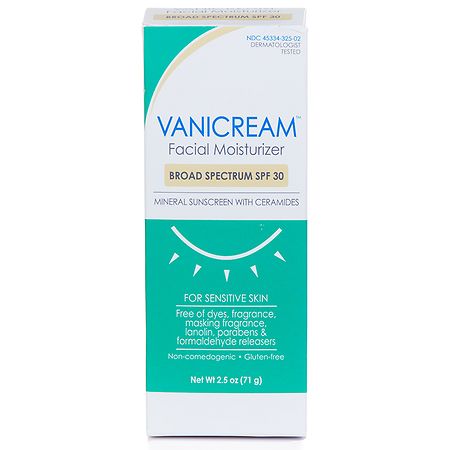

Vanicream Facial Moisturizer SPF 30 Zinc Oxide Mineral Sunscreen for Sensitive Skin - Unscented - 2.5oz
Analysis updated August 2026 · How Scout scores
At a glance
Summary
This moisturizer features zinc oxide as a mineral sunscreen, which is safe and effective for sensitive skin. It includes beneficial ingredients like squalane and various ceramides that support skin hydration and barrier function. However, the presence of PEG-100 Stearate, which carries a risk of contamination with 1,4-dioxane, slightly lowers the score despite the overall clean and beneficial formulation.
Key ingredients 26
SqualaneVery Good
Squalane is a highly effective emollient and natural antioxidant. It mimics the skin's natural oils, making it an excellent moisturizer. It is non-comedogenic and suitable for all skin types.
Risks
There are minimal risks, but overuse may lead to a greasy feel for some skin types.
Benefits
It helps to hydrate and maintain the skin's moisture barrier, improving skin texture and elasticity.
Ceramide EOPVery Good
Ceramide EOP is a lipid that helps to restore the skin's natural barrier. It is essential for maintaining skin hydration and integrity. It is beneficial for dry and sensitive skin types.
Risks
There are minimal risks, though it may cause irritation in very sensitive skin.
Benefits
It strengthens the skin barrier and improves moisture retention.
Ceramide NGVery Good
Ceramide NG is a skin-identical lipid that helps to reinforce the skin's barrier. It is crucial for maintaining skin hydration and resilience. It is beneficial for dry and sensitive skin types.
Risks
There are minimal risks, though it may cause irritation in very sensitive skin.
Benefits
It enhances skin barrier function and improves moisture retention.
Ceramide ASVery Good
Ceramide AS is a lipid that helps to restore the skin's natural barrier. It is essential for maintaining skin hydration and integrity. It is beneficial for dry and sensitive skin types.
Risks
There are minimal risks, though it may cause irritation in very sensitive skin.
Benefits
It strengthens the skin barrier and improves moisture retention.
Ceramide APVery Good
Ceramide AP is a lipid that supports the skin's natural barrier function. It helps to maintain skin hydration and protect against environmental stressors. It is beneficial for dry and sensitive skin types.
Risks
There are minimal risks, though it may cause irritation in very sensitive skin.
Benefits
It strengthens the skin barrier and enhances moisture retention.
Zinc OxideGood
Zinc Oxide is a mineral sunscreen agent that provides broad-spectrum UV protection. It is considered safe and effective for sensitive skin. It forms a protective barrier on the skin's surface.
Risks
There are minimal risks associated with Zinc Oxide, though it may leave a white cast on the skin.
Benefits
It offers excellent protection against both UVA and UVB rays and is non-irritating.
GlycerinGood
Glycerin is a humectant that attracts moisture to the skin. It helps to keep the skin hydrated and soft. It is widely used in skincare for its moisturizing properties.
Risks
There are minimal risks, though it may cause irritation in very sensitive skin.
Benefits
It enhances skin hydration and improves skin barrier function.
Ceramide NPGood
Ceramide NP is a lipid that supports the skin's natural barrier function. It helps to maintain skin hydration and protect against environmental stressors. It is beneficial for dry and sensitive skin types.
Risks
There are minimal risks, though it may cause irritation in very sensitive skin.
Benefits
It strengthens the skin barrier and enhances moisture retention.
Purified WaterNeutral
Purified Water is used as a solvent in cosmetic formulations. It helps to dissolve other ingredients and provides a base for the product. It is essential for the formulation but does not provide direct skin benefits.
Risks
There are no significant risks associated with purified water.
Benefits
It acts as a carrier for active ingredients and hydrates the skin.
C12-15 Alkyl BenzoateNeutral
C12-15 Alkyl Benzoate is an emollient that provides a silky feel to the skin. It helps to improve the spreadability of the product. It is generally considered safe for use in cosmetics.
Risks
There are minimal risks, though it may cause irritation in very sensitive skin.
Benefits
It enhances the texture and feel of the product on the skin.
IsopentyldiolNeutral
Isopentyldiol is a solvent and humectant that helps to retain moisture in the skin. It is used to improve the texture and feel of cosmetic products. It is generally considered safe for use in cosmetics.
Risks
There are minimal risks, though it may cause irritation in very sensitive skin.
Benefits
It helps to improve skin hydration and product texture.
Coco-Caprylate/CaprateNeutral
Coco-Caprylate/Caprate is an emollient derived from coconut oil and caprylic acid. It provides a lightweight, non-greasy feel to the skin. It is generally considered safe for use in cosmetics.
Risks
There are minimal risks, though it may cause irritation in very sensitive skin.
Benefits
It enhances the spreadability and absorption of the product.
Bis-Octyldodecyl Dimer Dilinoleate/Propanediol CopolymerNeutral
This ingredient acts as a film-forming agent and emollient. It helps to improve the texture and longevity of the product on the skin. It is generally considered safe for use in cosmetics.
Risks
There are minimal risks, though it may cause irritation in very sensitive skin.
Benefits
It provides a smooth, even application and enhances product durability.
Glyceryl StearateNeutral
Glyceryl Stearate is an emulsifier that helps to blend oil and water components. It provides a creamy texture to the product. It is generally considered safe for use in cosmetics.
Risks
There are minimal risks, though it may cause irritation in very sensitive skin.
Benefits
It stabilizes formulations and improves product consistency.
Polyhydroxystearic AcidNeutral
Polyhydroxystearic Acid is used as a thickening agent in cosmetic formulations. It helps to stabilize emulsions and improve texture. It is generally considered safe for use in cosmetics.
Risks
There are minimal risks, though it may cause irritation in very sensitive skin.
Benefits
It enhances the viscosity and stability of the product.
Cetearyl AlcoholNeutral
Cetearyl Alcohol is a fatty alcohol used as an emollient and emulsifier. It helps to soften and smooth the skin. It is generally considered safe for use in cosmetics.
Risks
There are minimal risks, though it may cause irritation in very sensitive skin.
Benefits
It improves the texture and feel of the product on the skin.
Sucrose StearateNeutral
Sucrose Stearate is an emulsifier that helps to blend oil and water components. It provides a smooth texture to the product. It is generally considered safe for use in cosmetics.
Risks
There are minimal risks, though it may cause irritation in very sensitive skin.
Benefits
It stabilizes formulations and enhances product consistency.
CarnosineNeutral
Carnosine is a dipeptide with antioxidant properties. It helps to protect the skin from oxidative stress and aging. It is generally considered safe for use in cosmetics.
Risks
There are minimal risks, though it may cause irritation in very sensitive skin.
Benefits
It provides antioxidant protection and may help to reduce signs of aging.
PhytosterolsNeutral
Phytosterols are plant-derived compounds that help to reinforce the skin barrier. They provide moisturizing and anti-inflammatory benefits. They are generally considered safe for use in cosmetics.
Risks
There are minimal risks, though they may cause irritation in very sensitive skin.
Benefits
They enhance skin barrier function and provide anti-inflammatory benefits.
Hydrogenated LecithinNeutral
Hydrogenated Lecithin is an emulsifier that helps to stabilize formulations. It provides moisturizing benefits and improves product texture. It is generally considered safe for use in cosmetics.
Risks
There are minimal risks, though it may cause irritation in very sensitive skin.
Benefits
It enhances product stability and provides moisturizing benefits.
TriethoxycaprylylsilaneNeutral
Triethoxycaprylylsilane is a silicone-based compound used as a surface modifier. It helps to improve the dispersion of mineral sunscreens. It is generally considered safe for use in cosmetics.
Risks
There are minimal risks, though it may cause irritation in very sensitive skin.
Benefits
It enhances the stability and effectiveness of mineral sunscreens.
Polyacrylate Crosspolymer-11Neutral
Polyacrylate Crosspolymer-11 is a thickening agent used to improve product texture. It helps to stabilize formulations and provide a smooth feel. It is generally considered safe for use in cosmetics.
Risks
There are minimal risks, though it may cause irritation in very sensitive skin.
Benefits
It enhances product viscosity and stability.
Caprylyl GlycolNeutral
Caprylyl Glycol is a humectant and skin conditioning agent. It helps to retain moisture and improve skin texture. It is generally considered safe for use in cosmetics.
Risks
There are minimal risks, though it may cause irritation in very sensitive skin.
Benefits
It enhances skin hydration and provides antimicrobial benefits.
1,2-HexanediolNeutral
1,2-Hexanediol is a solvent and preservative booster. It helps to improve product stability and extend shelf life. It is generally considered safe for use in cosmetics.
Risks
There are minimal risks, though it may cause irritation in very sensitive skin.
Benefits
It enhances product stability and provides antimicrobial benefits.
PEG-100 StearateBad
PEG-100 Stearate is an emulsifier that helps to blend ingredients together. It is derived from ethoxylation, which can lead to contamination with 1,4-dioxane, a potential carcinogen. It is generally considered safe in low concentrations.
Risks
There is a risk of contamination with 1,4-dioxane, which is a concern for long-term exposure.
Benefits
It helps to stabilize formulations and improve texture.
DimethiconeBad
Occlusive silicone film-former — flagged under clean-beauty doctrine.
Risks
There are minimal risks, though it may cause irritation in very sensitive skin.
Benefits
It provides a smooth application and helps to lock in moisture.
Get the full breakdown in the Scout appTake Scout shopping
Scan any product to see lab results, healthy alternatives, and your personalized analysis.
Download on theApp Store GET IT ONGoogle PlayAmazon pricing & content
Amazon price as of . Product prices and availability are accurate as of the date/time indicated and are subject to change. Any price and availability information displayed on Amazon.com at the time of purchase will apply to the purchase of this product.
CERTAIN CONTENT THAT APPEARS ON THIS SITE COMES FROM AMAZON. THIS CONTENT IS PROVIDED “AS IS” AND IS SUBJECT TO CHANGE OR REMOVAL AT ANY TIME.