
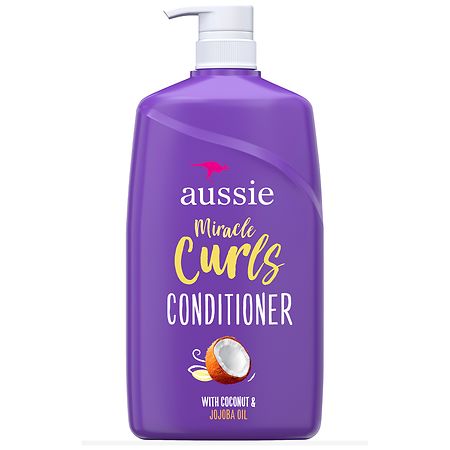
Aussie Miracle Curls with Coconut and Jojoba Oil Paraben-Free Conditioner - 26.2 fl oz: Moisturizing for All Hair
Analysis updated July 2026 · How Scout scores
At a glance
Summary
This conditioner contains beneficial ingredients like coconut oil and glycerin, which provide moisture and conditioning benefits. However, it also includes non-water-soluble silicone, which can lead to buildup, and several preservatives and synthetic fragrance that may cause irritation. The presence of sodium chloride as a thickener and other synthetic additives contributes to a moderate processing level, impacting the overall score.
Key ingredients 16
Cocos Nucifera (Coconut) OilVery Good
Coconut Oil is a natural oil known for its moisturizing and conditioning properties. It penetrates the hair shaft to provide deep hydration. It is considered safe and beneficial for hair health.
Risks
There are minimal risks, though it may weigh down fine hair if used excessively.
Benefits
It nourishes and strengthens the hair, reducing breakage.
GlycerinGood
Glycerin is a humectant that attracts moisture to the hair, helping to keep it hydrated. It is derived from natural sources and is widely used in cosmetics. It is considered safe and beneficial for hair health.
Risks
There are minimal risks, though excessive use can lead to a sticky feel.
Benefits
It helps maintain moisture balance in the hair, preventing dryness.
WaterNeutral
Water is the primary solvent in many cosmetic formulations. It helps dissolve other ingredients and provides a base for the product. It is generally considered safe and non-irritating.
Risks
There are no significant risks associated with water in cosmetic formulations.
Benefits
Water hydrates and helps distribute other ingredients evenly throughout the hair.
Cetyl AlcoholNeutral
Standard formulation ingredient — neither beneficial nor harmful at typical use.
Risks
There are minimal risks associated with cetyl alcohol, though some individuals may experience mild irritation.
Benefits
It provides moisturizing properties and improves the texture of hair products.
Stearamidopropyl DimethylamineNeutral
Stearamidopropyl Dimethylamine is a conditioning agent that helps detangle hair and reduce static. It is often used as an alternative to silicones. It is generally considered safe for use in hair care products.
Risks
There are minimal risks, though it may cause irritation in sensitive individuals.
Benefits
It enhances the manageability and smoothness of hair.
Stearyl AlcoholNeutral
Standard formulation ingredient — neither beneficial nor harmful at typical use.
Risks
There are minimal risks associated with stearyl alcohol, though some individuals may experience mild irritation.
Benefits
It provides moisturizing properties and improves the texture of hair products.
Glutamic AcidNeutral
Glutamic Acid is an amino acid used in hair care products for its conditioning properties. It helps to improve the texture and manageability of hair. It is generally considered safe for use in cosmetics.
Risks
There are minimal risks, though it may cause irritation in sensitive individuals.
Benefits
It enhances the smoothness and softness of hair.
Sodium ChlorideNeutral
Standard formulation ingredient — neither beneficial nor harmful at typical use.
Risks
It may cause dryness and irritation of the scalp.
Benefits
It helps to thicken the product, improving its texture.
Citric AcidNeutral
Citric Acid is used to adjust the pH of cosmetic formulations. It helps to maintain the stability and efficacy of the product. It is generally considered safe for use in cosmetics.
Risks
There are minimal risks, though it may cause irritation in sensitive individuals.
Benefits
It helps maintain the desired pH level of the product.
Bis-Aminopropyl DimethiconeBad
Bis-Aminopropyl Dimethicone is a silicone used for its conditioning and smoothing properties. It can lead to buildup on the hair over time. It is not water-soluble, which can make it difficult to remove.
Risks
It may cause buildup, leading to dull and brittle hair.
Benefits
It provides immediate smoothness and shine to the hair.
Benzyl AlcoholBad
Benzyl Alcohol is used as a preservative and solvent in cosmetics. It can be drying to the hair and scalp. It is generally safe in low concentrations but can cause irritation.
Risks
It may cause dryness and irritation, particularly in sensitive individuals.
Benefits
It helps preserve the product by preventing microbial growth.
Disodium EdtaBad
Processed additive flagged under Scout's ingredient doctrine.
Risks
There are minimal risks, though it may cause irritation in sensitive individuals.
Benefits
It enhances the stability and efficacy of the product.
PhenoxyethanolBad
Phenoxyethanol is a preservative used to prevent microbial growth in cosmetics. It can cause irritation and allergic reactions in some individuals. It is generally considered safe in low concentrations.
Risks
It may cause irritation or allergic reactions, particularly in sensitive individuals.
Benefits
It helps preserve the product by preventing microbial growth.
MethylchloroisothiazolinoneBad
Methylchloroisothiazolinone is a preservative used to prevent microbial growth in cosmetics. It is known to cause allergic reactions and skin irritation. It is generally considered safe in low concentrations but is restricted in some regions.
Risks
It may cause allergic reactions or irritation, particularly in sensitive individuals.
Benefits
It helps preserve the product by preventing microbial growth.
FragranceVery Bad
Fragrance is used to impart a pleasant scent to hair care products. It often contains synthetic compounds that can cause irritation. It is not always disclosed what specific chemicals are used.
Risks
It may cause allergic reactions or irritation in sensitive individuals.
Benefits
It provides a pleasant scent to the product.
MethylisothiazolinoneVery Bad
Methylisothiazolinone is a preservative used to prevent microbial growth in cosmetics. It is known to cause allergic reactions and skin irritation. It is generally considered safe in low concentrations but is restricted in some regions.
Risks
It may cause allergic reactions or irritation, particularly in sensitive individuals.
Benefits
It helps preserve the product by preventing microbial growth.
Get the full breakdown in the Scout appTake Scout shopping
Scan any product to see lab results, healthy alternatives, and your personalized analysis.
Download on theApp Store GET IT ONGoogle PlayAmazon pricing & content
Amazon price as of . Product prices and availability are accurate as of the date/time indicated and are subject to change. Any price and availability information displayed on Amazon.com at the time of purchase will apply to the purchase of this product.
CERTAIN CONTENT THAT APPEARS ON THIS SITE COMES FROM AMAZON. THIS CONTENT IS PROVIDED “AS IS” AND IS SUBJECT TO CHANGE OR REMOVAL AT ANY TIME.