
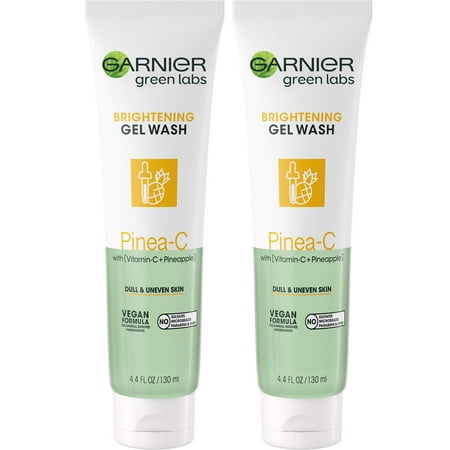

Garnier SkinActive Green Labs Pinea-C Brightening Gel Washable Cleanser with Vitamin C and Pineapple for Dull and Uneven Skin 2 Count Packaging May Vary
Analysis updated July 2026 · How Scout scores
At a glance
Summary
This face wash contains a mix of natural and synthetic ingredients, including beneficial components like pineapple fruit extract and Vitamin C. However, the presence of synthetic fragrance and PEG compounds, which can be irritating or have contamination risks, lowers its safety profile. The product is moderately processed, which further impacts its overall rating.
Key ingredients 20
Ascorbyl GlucosideVery Good
Ascorbyl Glucoside is a stable form of Vitamin C that provides antioxidant protection and brightens the skin. It helps reduce the appearance of dark spots and promotes an even skin tone. It is highly valued in skincare for its brightening and anti-aging benefits.
Risks
There are minimal risks associated with this ingredient, though it may cause irritation in very sensitive individuals.
Benefits
It provides antioxidant protection and helps brighten the skin.
GlycerinGood
Glycerin is a powerful humectant that attracts moisture to the skin, helping to keep it hydrated. It is a natural component of the skin's own moisturizing factor. It is widely used in skincare for its hydrating properties.
Risks
There are no significant risks associated with glycerin in cosmetics.
Benefits
It helps maintain skin hydration and improves the skin's barrier function.
Ananas Sativus Fruit Extract/Pineapple Fruit ExtractGood
Pineapple Fruit Extract is rich in antioxidants and enzymes that can help exfoliate the skin and promote a brighter complexion. It is known for its skin-smoothing properties. It is often used in brightening and exfoliating products.
Risks
There is a potential for skin irritation, especially in sensitive individuals.
Benefits
It helps exfoliate the skin and improve skin tone and texture.
Tocopheryl AcetateGood
Tocopheryl Acetate is a form of Vitamin E that provides antioxidant protection and helps moisturize the skin. It is commonly used in skincare for its protective and hydrating properties. It helps improve the skin's barrier function.
Risks
There are minimal risks associated with this ingredient.
Benefits
It provides antioxidant protection and helps maintain skin hydration.
PapainGood
Papain is an enzyme derived from papaya that helps exfoliate the skin by breaking down dead skin cells. It is known for its gentle exfoliating properties and is often used in brightening products. It helps improve skin texture and tone.
Risks
There is a potential for skin irritation, especially in sensitive individuals.
Benefits
It helps exfoliate the skin and improve skin texture and tone.
Glycolic AcidGood
Glycolic Acid is an alpha hydroxy acid (AHA) that helps exfoliate the skin and promote cell turnover. It is known for its ability to improve skin texture and reduce the appearance of fine lines and dark spots. It is widely used in skincare for its exfoliating and brightening benefits.
Risks
It can cause skin irritation or sensitivity, especially in high concentrations.
Benefits
It helps exfoliate the skin and improve skin texture and tone.
Aqua/Water/EauNeutral
Water is a universal solvent and is used as a base in many cosmetic formulations. It helps dissolve other ingredients and provides a medium for them to function. It is generally considered safe and non-irritating.
Risks
There are no significant risks associated with water in cosmetics.
Benefits
Water helps hydrate the skin and is essential for the formulation of most cosmetic products.
PEG-30 Glyceryl CocoateNeutral
PEG-30 Glyceryl Cocoate is an emulsifier and surfactant derived from coconut oil. It helps blend oil and water-based ingredients and improves the texture of the product. It is generally considered safe for use in cosmetics.
Risks
There is a potential risk of contamination with 1,4-dioxane, a byproduct of ethoxylation.
Benefits
It enhances the texture and stability of cosmetic formulations.
Capryl/Capramidopropyl BetaineNeutral
Capryl/Capramidopropyl Betaine is a mild surfactant used to cleanse the skin without stripping natural oils. It is derived from coconut oil and is considered gentle. It is often used in formulations for sensitive skin.
Risks
There are minimal risks associated with this ingredient, though it may cause irritation in very sensitive individuals.
Benefits
It provides gentle cleansing and is suitable for sensitive skin types.
Cocamidopropyl BetaineNeutral
Cocamidopropyl Betaine is a surfactant derived from coconut oil, used to create foam and cleanse the skin. It is considered milder than traditional sulfates. It is commonly used in formulations for sensitive skin.
Risks
It can cause skin irritation or allergic reactions in some individuals.
Benefits
It provides effective cleansing while being gentle on the skin.
Disodium Laureth SulfosuccinateNeutral
Disodium Laureth Sulfosuccinate is a mild surfactant used to cleanse the skin without stripping natural oils. It is considered less irritating than traditional sulfates. It is often used in formulations for sensitive skin.
Risks
There are minimal risks associated with this ingredient, though it may cause irritation in very sensitive individuals.
Benefits
It provides gentle cleansing and is suitable for sensitive skin types.
Sodium ChlorideNeutral
Sodium Chloride, or table salt, is used as a thickening agent in cosmetic formulations. It helps improve the texture and stability of products. It is generally considered safe for use in cosmetics.
Risks
In high concentrations, it can be drying to the skin.
Benefits
It helps improve the texture and stability of cosmetic formulations.
Sodium HydroxideNeutral
Sodium Hydroxide is used to adjust the pH of cosmetic formulations. It is a strong base that helps maintain the stability and effectiveness of the product. It is used in very low concentrations to ensure safety.
Risks
In high concentrations, it can be irritating to the skin.
Benefits
It helps maintain the pH balance of cosmetic formulations.
PEG-32Neutral
PEG-32 is an emulsifier and thickening agent used to improve the texture of cosmetic formulations. It helps blend oil and water-based ingredients. It is generally considered safe for use in cosmetics.
Risks
There is a potential risk of contamination with 1,4-dioxane, a byproduct of ethoxylation.
Benefits
It enhances the texture and stability of cosmetic formulations.
Xanthan GumNeutral
Xanthan Gum is a natural thickening agent used to stabilize cosmetic formulations. It helps improve the texture and consistency of products. It is derived from natural sources and is considered safe for use in cosmetics.
Risks
There are no significant risks associated with Xanthan Gum in cosmetics.
Benefits
It helps improve the texture and stability of cosmetic formulations.
Benzoic AcidNeutral
Benzoic Acid is a preservative used to prevent microbial growth in cosmetic products. It is effective in low concentrations and is considered safe for use in cosmetics. It helps extend the shelf life of products.
Risks
It can cause skin irritation or allergic reactions in some individuals.
Benefits
It helps preserve the product and extend its shelf life.
PropanediolNeutral
Propanediol is a humectant and solvent used to improve the texture and hydration of cosmetic formulations. It is derived from corn sugar and is considered safe for use in cosmetics. It helps enhance the absorption of other ingredients.
Risks
There are minimal risks associated with this ingredient.
Benefits
It helps maintain skin hydration and improves the texture of cosmetic products.
Propylene GlycolBad
Processed additive flagged under Scout's ingredient doctrine.
Risks
In rare cases, it can cause skin irritation or allergic reactions.
Benefits
It helps maintain skin hydration and improves the texture of cosmetic products.
PhenoxyethanolBad
Processed additive flagged under Scout's ingredient doctrine.
Risks
It can cause skin irritation or allergic reactions in some individuals.
Benefits
It helps preserve the product and extend its shelf life.
Parfum/FragranceVery Bad
Fragrance is used to add scent to cosmetic products but can be irritating to the skin. It is a common allergen and can cause skin sensitivity or allergic reactions. It is often criticized for its potential to cause irritation.
Risks
It can cause skin irritation or allergic reactions in sensitive individuals.
Benefits
It adds a pleasant scent to cosmetic products.
Get the full breakdown in the Scout appTake Scout shopping
Scan any product to see lab results, healthy alternatives, and your personalized analysis.
Download on theApp Store GET IT ONGoogle PlayAmazon pricing & content
CERTAIN CONTENT THAT APPEARS ON THIS SITE COMES FROM AMAZON. THIS CONTENT IS PROVIDED “AS IS” AND IS SUBJECT TO CHANGE OR REMOVAL AT ANY TIME.