
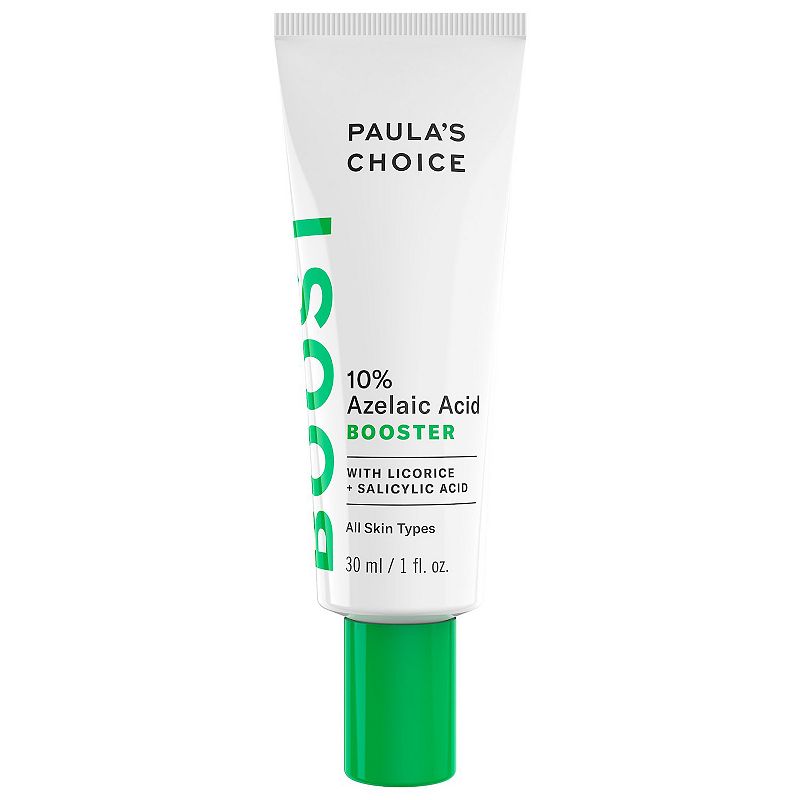


Paula's Choice 10% Azelaic Acid Booster
Paula's ChoiceAnalysis updated July 2026 · How Scout scores
At a glance
Summary
This product contains beneficial ingredients such as azelaic acid, salicylic acid, and licorice root extract, which are known for their skin-soothing and brightening properties. However, the presence of phenoxyethanol, a synthetic preservative, and dimethicone, a silicone, slightly lowers its score due to potential skin sensitivity concerns. The formulation is mostly safe, but the inclusion of these synthetic components affects its overall rating.
Key ingredients 21
Azelaic AcidVery Good
Azelaic Acid is known for its anti-inflammatory and antimicrobial properties. It is effective in treating acne and rosacea by reducing redness and swelling. It also helps in evening out skin tone.
Risks
Some individuals may experience mild irritation or dryness.
Benefits
It helps in reducing acne and improving skin texture and tone.
Glycyrrhiza Glabra (Licorice) Root ExtractVery Good
Licorice Root Extract is known for its skin brightening and anti-inflammatory properties. It helps to reduce hyperpigmentation and soothe irritated skin. It is a natural ingredient with antioxidant benefits.
Risks
There are no significant risks associated with this ingredient.
Benefits
It brightens the skin and reduces inflammation.
Caprylic/Capric TriglycerideGood
Caprylic/Capric Triglyceride is derived from coconut oil and glycerin. It is used as an emollient and helps to moisturize and replenish the skin. It is lightweight and non-greasy, making it suitable for all skin types.
Risks
There are no significant risks associated with this ingredient.
Benefits
It provides moisturizing benefits and enhances the skin's barrier function.
GlycerinGood
Glycerin is a humectant that attracts moisture to the skin. It is widely used in skincare for its hydrating properties. It helps to maintain the skin's moisture balance and improve its barrier function.
Risks
There are no significant risks associated with glycerin.
Benefits
It provides excellent hydration and helps to maintain skin moisture.
Salicylic AcidGood
Salicylic Acid is a beta hydroxy acid (BHA) known for its exfoliating properties. It penetrates into the pores to remove excess oil and dead skin cells, making it effective for acne treatment. It also helps to reduce inflammation and redness.
Risks
Overuse can lead to skin irritation and dryness.
Benefits
It effectively treats acne and improves skin texture.
AdenosineGood
Adenosine is a beneficial ingredient known for its anti-aging properties. It helps to smooth out wrinkles and improve skin elasticity. It also has soothing and anti-inflammatory effects.
Risks
There are no significant risks associated with adenosine.
Benefits
It helps to reduce the appearance of wrinkles and improve skin elasticity.
Boerhavia Diffusa Root ExtractGood
Boerhavia Diffusa Root Extract is known for its anti-inflammatory and antioxidant properties. It helps to soothe the skin and reduce redness. It is a natural ingredient that supports skin health.
Risks
There are no significant risks associated with this ingredient.
Benefits
It soothes the skin and provides antioxidant protection.
AllantoinGood
Allantoin is a skin-soothing agent that helps to calm irritated skin. It promotes skin healing and improves moisture retention. It is widely used in skincare for its gentle and non-irritating properties.
Risks
There are no significant risks associated with allantoin.
Benefits
It soothes and heals the skin, improving moisture retention.
BisabololGood
Bisabolol is a natural compound known for its anti-inflammatory and soothing properties. It helps to reduce skin irritation and redness. It is derived from chamomile and is gentle on the skin.
Risks
There are no significant risks associated with bisabolol.
Benefits
It reduces skin irritation and provides soothing effects.
Water (Aqua)Neutral
Water is a common solvent used in cosmetic formulations. It helps dissolve other ingredients and provides a base for the product. It does not have any direct benefits or risks.
Risks
There are no inherent risks associated with water in cosmetic products.
Benefits
Water helps in the application and absorption of the product.
C12-15 Alkyl BenzoateNeutral
C12-15 Alkyl Benzoate is an emollient that helps to improve the texture and feel of the skin. It provides a silky finish and enhances the spreadability of the product. It is generally considered safe for use in cosmetics.
Risks
There are minimal risks associated with this ingredient, though it may cause irritation in very sensitive skin.
Benefits
It improves the texture and application of the product.
Methyl Glucose SesquistearateNeutral
Methyl Glucose Sesquistearate is an emulsifier that helps to blend oil and water-based ingredients. It is derived from natural sources and is considered mild and non-irritating. It is used to stabilize formulations.
Risks
There are minimal risks associated with this ingredient.
Benefits
It helps in stabilizing the formulation and improving product consistency.
Cetearyl AlcoholNeutral
Cetearyl Alcohol is a fatty alcohol used as an emollient and thickener. It helps to soften the skin and improve the texture of the product. It is considered safe and non-irritating.
Risks
There are minimal risks associated with this ingredient.
Benefits
It improves the texture and feel of the product.
Glyceryl StearateNeutral
Glyceryl Stearate is an emulsifier that helps to blend oil and water components. It is derived from glycerin and stearic acid and is used to stabilize formulations. It is generally considered safe for use in cosmetics.
Risks
There are minimal risks associated with this ingredient.
Benefits
It helps in stabilizing the formulation and improving product consistency.
CyclopentasiloxaneNeutral
Cyclopentasiloxane is a silicone-based compound used to provide a smooth application and lightweight feel. It helps to improve the spreadability of the product. It is generally considered safe for use in cosmetics.
Risks
There are minimal risks, though it may cause build-up on the skin over time.
Benefits
It provides a smooth application and lightweight feel.
Xanthan GumNeutral
Xanthan Gum is a natural thickening agent used to stabilize formulations. It helps to improve the texture and consistency of the product. It is derived from natural sources and is considered safe for use in cosmetics.
Risks
There are minimal risks associated with this ingredient.
Benefits
It stabilizes formulations and improves product texture.
Sclerotium GumNeutral
Sclerotium Gum is a natural thickening agent used to stabilize formulations. It helps to improve the texture and consistency of the product. It is derived from natural sources and is considered safe for use in cosmetics.
Risks
There are minimal risks associated with this ingredient.
Benefits
It stabilizes formulations and improves product texture.
PropanediolNeutral
Propanediol is a glycol used as a solvent and humectant in cosmetics. It helps to improve the texture and feel of the product. It is considered safe for use in cosmetics.
Risks
There are minimal risks associated with this ingredient.
Benefits
It improves product texture and provides moisturizing benefits.
Butylene GlycolNeutral
Butylene Glycol is a common solvent and humectant used in cosmetics. It helps to improve the texture and spreadability of the product. It is considered safe for use in cosmetics.
Risks
There are minimal risks associated with this ingredient.
Benefits
It improves product texture and provides moisturizing benefits.
DimethiconeBad
Occlusive silicone film-former — flagged under clean-beauty doctrine.
Risks
There are minimal risks, though it may cause build-up on the skin over time.
Benefits
It provides a smooth application and helps to lock in moisture.
PhenoxyethanolBad
Phenoxyethanol is a preservative used to prevent microbial growth in cosmetics. It is effective in low concentrations but can cause irritation in some individuals. It is considered a potential skin irritant and allergen.
Risks
It may cause skin irritation and allergic reactions in sensitive individuals.
Benefits
It helps to preserve the product and extend its shelf life.
Get the full breakdown in the Scout appTake Scout shopping
Scan any product to see lab results, healthy alternatives, and your personalized analysis.
Download on theApp Store GET IT ONGoogle PlayAmazon pricing & content
Amazon price as of . Product prices and availability are accurate as of the date/time indicated and are subject to change. Any price and availability information displayed on Amazon.com at the time of purchase will apply to the purchase of this product.
CERTAIN CONTENT THAT APPEARS ON THIS SITE COMES FROM AMAZON. THIS CONTENT IS PROVIDED “AS IS” AND IS SUBJECT TO CHANGE OR REMOVAL AT ANY TIME.