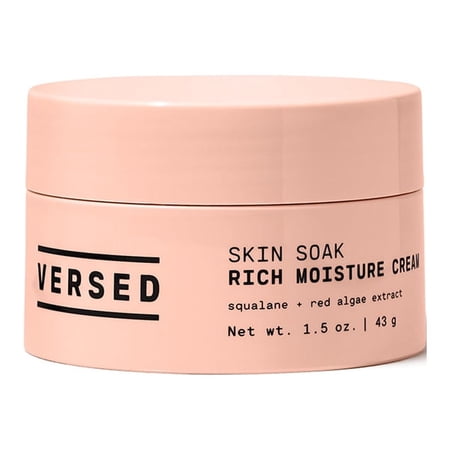
Versed Skin Soak Rich Moisture Cream Squalane + Red Algae Extract 1.5 oz
At a glance
Summary
This moisturizer contains beneficial ingredients like squalane, hyaluronic acid, and red algae extract, which provide hydration and antioxidant protection. However, the presence of phenoxyethanol, a preservative that can cause irritation in sensitive individuals, slightly lowers its safety profile. The product is mostly composed of safe and effective ingredients, with minimal processing concerns. Its plastic packaging can shed microplastics into the product and lowers its score.
Key ingredients 17
SqualaneVery Good
Squalane is a highly effective emollient and natural antioxidant. It helps to moisturize and protect the skin without leaving a greasy residue. It is well-tolerated by most skin types and is non-comedogenic.
Risks
There are minimal risks, though it can cause irritation in very sensitive skin.
Benefits
Squalane moisturizes and protects the skin, enhancing its smoothness and elasticity.
Hydrolyzed Hyaluronic AcidVery Good
Hydrolyzed Hyaluronic Acid is a smaller molecule form of hyaluronic acid that penetrates the skin more deeply. It provides intense hydration and helps to plump the skin. It is well-tolerated by most skin types.
Risks
There are minimal risks, though it can cause irritation in very sensitive skin.
Benefits
It provides intense hydration and helps to plump the skin, reducing the appearance of fine lines.
GlycerinGood
Glycerin is a humectant that attracts moisture to the skin, making it a popular ingredient in moisturizers. It helps to keep the skin hydrated and soft. It is well-tolerated by most skin types.
Risks
There are minimal risks, though it can cause irritation in very sensitive skin.
Benefits
Glycerin helps to keep the skin hydrated and soft by attracting moisture.
Palmaria Palmata ExtractGood
Palmaria Palmata Extract is derived from red algae and is known for its antioxidant properties. It helps to protect the skin from environmental stressors. It is generally considered safe for use in cosmetics.
Risks
There are minimal risks, primarily related to potential skin irritation.
Benefits
It provides antioxidant protection, helping to shield the skin from environmental damage.
Sodium HyaluronateGood
Sodium Hyaluronate is a salt form of hyaluronic acid that is highly effective in retaining moisture. It helps to keep the skin hydrated and plump. It is well-tolerated by most skin types.
Risks
There are minimal risks, though it can cause irritation in very sensitive skin.
Benefits
It retains moisture effectively, keeping the skin hydrated and plump.
Tocopheryl AcetateGood
Tocopheryl Acetate is a form of Vitamin E that acts as an antioxidant. It helps to protect the skin from free radical damage. It is generally considered safe for use in cosmetics.
Risks
There are minimal risks, primarily related to potential skin irritation.
Benefits
It provides antioxidant protection, helping to shield the skin from free radical damage.
WaterNeutral
Water is a common solvent used in cosmetics to dissolve other ingredients. It helps in the application and absorption of the product. It does not provide direct benefits or risks.
Risks
There are no significant risks associated with water in cosmetics.
Benefits
Water helps in the application and absorption of the product.
Hydrogenated PolyisobuteneNeutral
Hydrogenated Polyisobutene is used as an emollient and moisturizer in cosmetics. It provides a smooth application and helps to lock in moisture. It is generally considered safe for use in cosmetics.
Risks
There are minimal risks associated with its use, primarily related to potential skin sensitivity.
Benefits
It acts as an emollient, providing a smooth application and helping to lock in moisture.
1, 2-HexanediolNeutral
1, 2-Hexanediol is used as a preservative and humectant in cosmetics. It helps to maintain product stability and moisture. It is generally considered safe for use in cosmetics.
Risks
There are minimal risks, primarily related to potential skin irritation.
Benefits
It helps to maintain product stability and moisture.
Hydroxyethyl Acrylate/Sodium Acryloyldimethyl Taurate CopolymerNeutral
This copolymer is used as a thickening agent and stabilizer in cosmetics. It helps to improve the texture and consistency of the product. It is generally considered safe for use in cosmetics.
Risks
There are minimal risks, primarily related to potential skin irritation.
Benefits
It improves the texture and consistency of the product.
Glyceryl StearateNeutral
Glyceryl Stearate is an emulsifier that helps to blend water and oils in cosmetics. It improves the texture and stability of the product. It is generally considered safe for use in cosmetics.
Risks
There are minimal risks, primarily related to potential skin irritation.
Benefits
It improves the texture and stability of the product.
PEG-100 StearateNeutral
PEG-100 Stearate is an emulsifier used to blend water and oils in cosmetics. It helps to improve the texture and consistency of the product. It is generally considered safe for use in cosmetics.
Risks
There are minimal risks, primarily related to potential skin irritation.
Benefits
It improves the texture and consistency of the product.
Sorbitan IsostearateNeutral
Sorbitan Isostearate is an emulsifier used to blend water and oils in cosmetics. It helps to improve the texture and consistency of the product. It is generally considered safe for use in cosmetics.
Risks
There are minimal risks, primarily related to potential skin irritation.
Benefits
It improves the texture and consistency of the product.
Cetyl AlcoholNeutral
Cetyl Alcohol is a fatty alcohol used as an emollient and thickener in cosmetics. It helps to soften and smooth the skin. It is generally considered safe for use in cosmetics.
Risks
There are minimal risks, primarily related to potential skin irritation.
Benefits
It softens and smooths the skin, improving the texture of the product.
Trisodium Ethylenediamine DisuccinateNeutral
Trisodium Ethylenediamine Disuccinate is a chelating agent used to improve the stability of cosmetics. It helps to prevent the degradation of the product. It is generally considered safe for use in cosmetics.
Risks
There are minimal risks, primarily related to potential skin irritation.
Benefits
It improves the stability of the product, preventing degradation.
PhenoxyethanolBad
Phenoxyethanol is a preservative used to prevent microbial growth in cosmetics. It can cause skin irritation and allergic reactions in some individuals. It is generally considered safe in low concentrations but can be problematic for sensitive skin.
Risks
It can cause skin irritation and allergic reactions, especially in sensitive individuals.
Benefits
It helps to prevent microbial growth, extending the shelf life of the product.
Polysorbate 60Bad
Processed additive flagged under Scout's ingredient doctrine.
Risks
There are minimal risks, primarily related to potential skin irritation.
Benefits
It improves the texture and consistency of the product.
Get the full breakdown in the Scout appTake Scout shopping
Scan any product to see lab results, healthy alternatives, and your personalized analysis.
Are you Versed? Fix an error Get the badge Get tested
Amazon pricing & content
Amazon price as of . Product prices and availability are accurate as of the date/time indicated and are subject to change. Any price and availability information displayed on Amazon.com at the time of purchase will apply to the purchase of this product.
CERTAIN CONTENT THAT APPEARS ON THIS SITE COMES FROM AMAZON. THIS CONTENT IS PROVIDED “AS IS” AND IS SUBJECT TO CHANGE OR REMOVAL AT ANY TIME.