
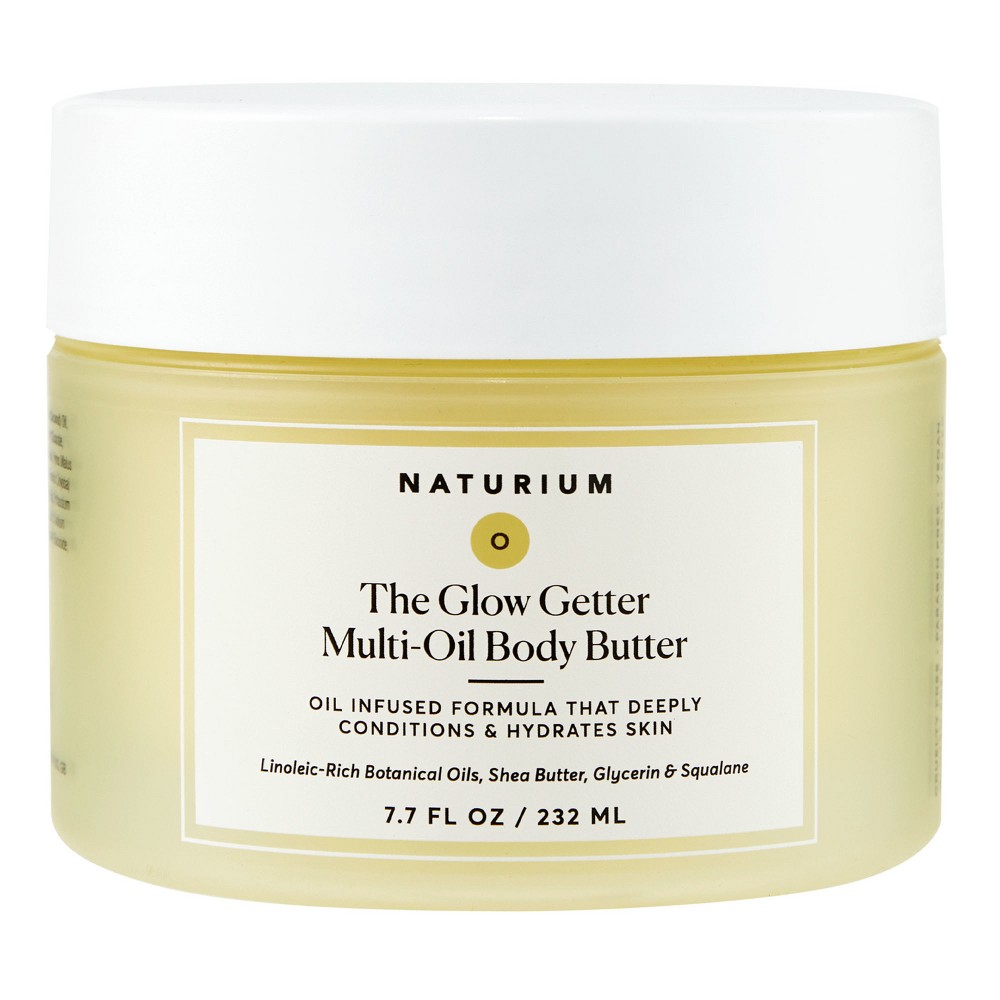
Naturium The Glow Getter Multi-Oil Body Butter - 7.7 fl oz: Deep Hydration, Whole Body, For Normal to Dry Skin
Analysis updated August 2026 · How Scout scores
At a glance
Summary
This body butter contains a variety of beneficial natural oils and butters, such as shea butter, coconut oil, and jojoba oil, which provide deep hydration and nourishment to the skin. However, the presence of sodium hydroxide and limonene, which can be irritating to some individuals, slightly detracts from its overall safety profile. Additionally, the inclusion of synthetic preservatives and fragrances contributes to a higher level of processing, which impacts the overall score.
Key ingredients 32
Oryza Sativa Bran OilVery Good
Rice bran oil is rich in antioxidants, vitamins, and fatty acids, which help nourish and protect the skin. It is known for its anti-aging properties and ability to improve skin texture.
Risks
There are minimal risks associated with rice bran oil, though rare allergic reactions may occur.
Benefits
It provides deep hydration and helps to maintain skin elasticity.
Cocos Nucifera (Coconut) OilVery Good
Coconut oil is a natural emollient that helps to moisturize and protect the skin. It is rich in fatty acids and has antibacterial properties.
Risks
Some individuals may experience clogged pores or breakouts with coconut oil.
Benefits
It deeply hydrates and nourishes the skin, improving its overall health.
Carthamus Tinctorius (Safflower) Seed OilVery Good
Safflower seed oil is high in linoleic acid, which helps to maintain the integrity of the skin barrier. It is known for its moisturizing and anti-inflammatory properties.
Risks
There are minimal risks, though it may cause irritation in sensitive individuals.
Benefits
It helps to soothe and hydrate the skin, reducing dryness and flakiness.
Butyrospermum Parkii (Shea) ButterVery Good
Shea butter is a rich emollient that provides intense hydration and nourishment to the skin. It contains vitamins A and E, which promote skin health.
Risks
Rarely, it may cause allergic reactions in individuals with nut allergies.
Benefits
It helps to soften and smooth the skin, reducing the appearance of dry patches.
Rosa Canina Fruit OilVery Good
Rosehip oil is rich in essential fatty acids and vitamins A and C, which help to rejuvenate and repair the skin. It is known for its anti-aging and brightening effects.
Risks
There are minimal risks, though it may cause irritation in sensitive individuals.
Benefits
It helps to improve skin tone and texture, reducing the appearance of scars and fine lines.
Simmondsia Chinensis (Jojoba) Seed OilVery Good
Jojoba oil is a natural emollient that closely resembles the skin's natural sebum. It helps to balance oil production and provides deep hydration.
Risks
There are minimal risks, though it may cause irritation in sensitive individuals.
Benefits
It helps to moisturize and protect the skin, improving its overall health.
SqualaneVery Good
Squalane is a lightweight, non-greasy oil that mimics the skin's natural oils. It provides excellent hydration and helps to improve skin elasticity.
Risks
There are no significant risks associated with squalane.
Benefits
It helps to lock in moisture and protect the skin from environmental damage.
Hippophae Rhamnoides Fruit/Seed OilVery Good
Sea buckthorn oil is rich in vitamins, antioxidants, and essential fatty acids. It is known for its regenerative and anti-inflammatory properties.
Risks
There are minimal risks, though it may cause irritation in sensitive individuals.
Benefits
It helps to rejuvenate and repair the skin, reducing the appearance of fine lines and wrinkles.
Caprylic/Capric TriglycerideGood
This ingredient is derived from coconut oil and glycerin, providing a lightweight, non-greasy emollient effect. It helps to moisturize and soften the skin.
Risks
There are no significant risks associated with this ingredient.
Benefits
It enhances the spreadability of the product and provides a silky feel.
GlycerinGood
Glycerin is a humectant that attracts moisture to the skin, helping to keep it hydrated. It is widely used in skincare for its moisturizing properties.
Risks
There are no significant risks associated with glycerin.
Benefits
It helps to maintain skin hydration and improve skin barrier function.
Coco-Caprylate/CaprateGood
This ingredient is a natural emollient derived from coconut oil, providing a lightweight and silky feel. It enhances skin hydration and smoothness.
Risks
There are no significant risks associated with this ingredient.
Benefits
It improves the spreadability of the product and leaves the skin feeling soft.
Pyrus Malus (Apple) Fruit ExtractGood
Apple fruit extract is rich in antioxidants and vitamins, which help to protect and nourish the skin. It has hydrating and anti-aging properties.
Risks
There are minimal risks, though it may cause irritation in sensitive individuals.
Benefits
It helps to improve skin texture and provides antioxidant protection.
Cocos Nucifera (Coconut) Fruit ExtractGood
Coconut fruit extract is known for its moisturizing and soothing properties. It helps to hydrate and nourish the skin.
Risks
There are minimal risks, though it may cause irritation in sensitive individuals.
Benefits
It provides hydration and helps to maintain skin health.
Hydrolyzed Rice ProteinGood
Hydrolyzed rice protein is known for its conditioning and strengthening properties. It helps to improve skin texture and elasticity.
Risks
There are minimal risks, though it may cause irritation in sensitive individuals.
Benefits
It helps to nourish and protect the skin, enhancing its overall appearance.
Vanilla Planifolia Fruit ExtractGood
Vanilla extract is known for its antioxidant properties and pleasant aroma. It helps to soothe and calm the skin.
Risks
There are minimal risks, though it may cause irritation in sensitive individuals.
Benefits
It provides a pleasant scent and helps to protect the skin from oxidative stress.
Aqua/Water/EauNeutral
Water is a common solvent used in cosmetics to dissolve other ingredients. It is essential for hydration but does not provide any active benefits on its own.
Risks
There are no known risks associated with water in cosmetics.
Benefits
Water helps to hydrate the skin and acts as a carrier for other beneficial ingredients.
Glyceryl StearateNeutral
Glyceryl stearate is an emulsifier that helps to blend oil and water components in formulations. It provides a smooth texture to the product.
Risks
There are no significant risks associated with glyceryl stearate.
Benefits
It helps to stabilize the formulation and improve product consistency.
Sodium Acrylate/Sodium Acryloyldimethyl Taurate CopolymerNeutral
This copolymer is used as a thickening agent and stabilizer in cosmetic formulations. It helps to improve the texture and consistency of the product.
Risks
There are no significant risks associated with this ingredient.
Benefits
It provides a smooth and stable formulation, enhancing the user experience.
C15-19 AlkaneNeutral
C15-19 alkane is used as an emollient and solvent in cosmetics. It helps to improve the texture and spreadability of the product.
Risks
There are no significant risks associated with this ingredient.
Benefits
It provides a lightweight feel and enhances the application of the product.
Stearyl PhosphateNeutral
Stearyl phosphate is used as an emulsifier and surfactant in cosmetics. It helps to stabilize formulations and improve texture.
Risks
There are no significant risks associated with this ingredient.
Benefits
It helps to maintain the stability and consistency of the product.
Potassium Cetyl PhosphateNeutral
Potassium cetyl phosphate is an emulsifier that helps to blend oil and water components in formulations. It provides a smooth texture to the product.
Risks
There are no significant risks associated with this ingredient.
Benefits
It helps to stabilize the formulation and improve product consistency.
Gamma-DecalactoneNeutral
Gamma-decalactone is a fragrance ingredient used to impart a fruity aroma to cosmetic products. It is commonly used in small concentrations.
Risks
There are minimal risks, though it may cause irritation in sensitive individuals.
Benefits
It enhances the sensory experience of the product with a pleasant scent.
Gamma-NonalactoneNeutral
Gamma-nonalactone is a fragrance ingredient used to impart a creamy, coconut-like aroma to cosmetic products. It is commonly used in small concentrations.
Risks
There are minimal risks, though it may cause irritation in sensitive individuals.
Benefits
It enhances the sensory experience of the product with a pleasant scent.
Sodium HydroxideNeutral
Standard formulation ingredient — neither beneficial nor harmful at typical use.
Risks
It can cause skin irritation and dryness if not properly neutralized.
Benefits
When used in small amounts, it helps to maintain the stability and effectiveness of the product.
Citric AcidNeutral
Citric acid is used to adjust the pH of cosmetic formulations and as a preservative. It is commonly found in small concentrations.
Risks
There are minimal risks, though it may cause irritation in sensitive individuals.
Benefits
It helps to maintain the stability and effectiveness of the product.
Tetrasodium Glutamate DiacetateNeutral
This ingredient is a chelating agent used to enhance the effectiveness of preservatives. It helps to stabilize formulations.
Risks
There are no significant risks associated with this ingredient.
Benefits
It helps to improve the stability and shelf life of the product.
EthylhexylglycerinNeutral
Ethylhexylglycerin is used as a preservative and skin-conditioning agent in cosmetics. It helps to enhance the effectiveness of other preservatives.
Risks
There are minimal risks, though it may cause irritation in sensitive individuals.
Benefits
It helps to maintain the stability and safety of the product.
Lauryl GlucosideNeutral
Lauryl glucoside is a mild surfactant used to cleanse and emulsify cosmetic formulations. It is derived from natural sources.
Risks
There are minimal risks, though it may cause irritation in sensitive individuals.
Benefits
It provides gentle cleansing and helps to stabilize formulations.
VanillinBad
Processed additive flagged under Scout's ingredient doctrine.
Risks
There are minimal risks, though it may cause irritation in sensitive individuals.
Benefits
It enhances the sensory experience of the product with a pleasant scent.
Sodium BenzoateBad
Synthetic preservative that can form benzene in the presence of vitamin C.
Risks
There are minimal risks, though it may cause irritation in sensitive individuals.
Benefits
It helps to extend the shelf life of the product by preventing spoilage.
LimoneneBad
Limonene is a fragrance ingredient that can cause skin irritation and sensitization in some individuals. It is a common allergen in cosmetics.
Risks
It can cause allergic reactions and skin irritation, especially in sensitive individuals.
Benefits
It provides a citrus scent to the product.
PhenoxyethanolBad
Processed additive flagged under Scout's ingredient doctrine.
Risks
There are minimal risks, though it may cause irritation in sensitive individuals.
Benefits
It helps to extend the shelf life of the product by preventing spoilage.
Processing
Processed Foods
Get the full breakdown in the Scout appTake Scout shopping
Scan any product to see lab results, healthy alternatives, and your personalized analysis.
Download on theApp Store GET IT ONGoogle PlayAmazon pricing & content
Amazon price as of . Product prices and availability are accurate as of the date/time indicated and are subject to change. Any price and availability information displayed on Amazon.com at the time of purchase will apply to the purchase of this product.
CERTAIN CONTENT THAT APPEARS ON THIS SITE COMES FROM AMAZON. THIS CONTENT IS PROVIDED “AS IS” AND IS SUBJECT TO CHANGE OR REMOVAL AT ANY TIME.