




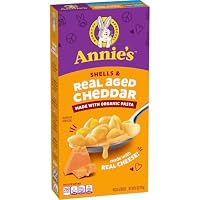
Annie's Organic Cheddar Bunnies
Analysis updated September 2026 · How Scout scores
At a glance
Summary
Annie's Organic Cheddar Bunnies are ultra-processed and contain refined wheat flour and sunflower oil, which are significant factors in lowering their health score. Despite the use of organic ingredients and the absence of artificial additives, the presence of seed oil and refined flour as primary components limits their nutritional value. The product's processing level and ingredient composition align it with typical packaged snack foods, which are generally less healthy.
Contaminants 8
Source: Consumer Reports, Contaminants in Kids' Snacks (August 2026) — three samples from 2–3 lots bought at retail, ISO 17025-accredited lab
Acrylamide 103 ppb (3.09 mcg per 30 g serving) High
One serving carries about 15 times California's Prop 65 no-significant-risk level for acrylamide (0.2 mcg per day), the threshold Consumer Reports applied at a serving a day. Acrylamide forms whenever starchy food is fried, baked or roasted. At 103 ppb it was the third highest of the nine chips and crackers CR tested, after Lay's Classic (263 ppb) and Snyder's Mini Pretzels (160 ppb).
Consumer Reports' August 2026 kids' snacks test (acrylamide by LC-MS/MS, J. Agric. Food Chem. 54:7001 (2006)) on three Annie's Organic Cheddar Bunnies samples from two to three lots: 103 ppb, which is 3.09 mcg in the 30 g (51 crackers) serving. CR's reference values: OEHHA NSRL 0.2 mcg/day, MADL 140 mcg/day, EPA reference dose 2 mcg/kg body weight/day.
Glycidyl esters 67 ppb (2.01 mcg per 30 g serving) Moderate
Glycidyl esters form when vegetable oils are refined at high heat and turn into glycidol in the gut — a probable human carcinogen with no safe intake set by EFSA. One serving is about 3.7 times California's no-significant-risk level for glycidol (0.54 mcg per day), the reference CR applied. At 67 ppb it was the third highest glycidyl ester level of the nine chips and crackers CR tested, after Takis Fuego (122 ppb) and Doritos (102 ppb).
Consumer Reports' August 2026 kids' snacks test (glycidyl esters by GC-MS/MS, AOAC 2018.03) on three Annie's Organic Cheddar Bunnies samples from two to three lots: 67 ppb, which is 2.01 mcg per 30 g serving. CR's reference value: OEHHA NSRL for glycidol 0.54 mcg/day. The EU caps GE in retail vegetable oils at 1,000 µg/kg as glycidol; the U.S. has no limit.
3-MCPD 50 ppb (1.51 mcg per 30 g serving) Safe
3-MCPD is a by-product of refining vegetable oil at high heat. EFSA's tolerable daily intake is 2 mcg per kg of body weight — about 46 mcg a day for a 23 kg child — so one serving is about 3% of that. Takis Fuego had the highest 3-MCPD of the chips and crackers CR tested (160 ppb).
Consumer Reports' August 2026 kids' snacks test (3-MCPD by GC-MS/MS, AOAC 2018.03) on three Annie's Organic Cheddar Bunnies samples from two to three lots: 50 ppb, which is 1.51 mcg per 30 g serving. Reference: EFSA tolerable daily intake 2 mcg/kg body weight/day (2018).
Lead Not detected Not detected
Not detected — below the laboratory's method detection limit in every sample.
Consumer Reports' August 2026 kids' snacks test (lead by ICP-QQQ-MS, AOAC 2015.01) on three Annie's Organic Cheddar Bunnies samples from two to three lots: not detected in any sample.
Cadmium 18.4 ppb (0.55 mcg per 30 g serving) Low
One serving is about 13% of California's Prop 65 maximum allowable dose for cadmium (4.1 mcg per day).
Consumer Reports' August 2026 kids' snacks test (cadmium by ICP-QQQ-MS, AOAC 2015.01) on three Annie's Organic Cheddar Bunnies samples from two to three lots: 18.4 ppb, which is 0.55 mcg per 30 g serving, against the OEHHA MADL of 4.1 mcg/day.
Arsenic 5.13 ppb total (0.2 mcg per 30 g serving) Safe
CR ran its inorganic-arsenic follow-up only on the four products with the highest total arsenic, and this was not one of them. Even counted entirely as inorganic, one serving is about 2% of California's no-significant-risk level for inorganic arsenic (10 mcg per day).
Consumer Reports' August 2026 kids' snacks test (total arsenic by ICP-QQQ-MS, AOAC 2015.01) on three Annie's Organic Cheddar Bunnies samples from two to three lots: 5.13 ppb, which is 0.2 mcg per 30 g serving; inorganic arsenic was tested only on the four products with the highest totals.
Mercury Not detected Not detected
Not detected — below the laboratory's method detection limit in every sample.
Consumer Reports' August 2026 kids' snacks test (mercury by ICP-QQQ-MS, AOAC 2015.01) on three Annie's Organic Cheddar Bunnies samples from two to three lots: not detected in any sample.
DEHP (phthalate) 27 ppb (810 ng per 30 g serving) Safe
DEHP is a plasticiser that migrates from processing equipment and packaging. One serving is about 0.2% of California's Prop 65 maximum allowable dose for DEHP (410 mcg per day) and well under EPA's reference dose. Total phthalates were 1330 ng per serving.
Consumer Reports' August 2026 kids' snacks test (phthalates by GC-MS/MS, GB 5009.271-2016 mod.) on three Annie's Organic Cheddar Bunnies samples from two to three lots: DEHP 27 ppb, which is 810 ng per 30 g serving; total phthalates 1330 ng. References: OEHHA MADL 410 mcg/day, NSRL 310 mcg/day, EPA reference dose 20 mcg/kg body weight/day.
Key ingredients 8
Organic expeller-pressed sunflower oilVery Bad
This oil is highly processed and may contain unhealthy trans fats or oxidized compounds, making it less desirable in a healthy diet.
See more about Organic expeller-pressed sunflower oil →Organic wheat flourNeutral
Standard formulation ingredient — neither beneficial nor harmful at typical use.
See more about Organic wheat flour →SaltNeutral
Salt is a common seasoning that can enhance flavor but should be consumed in moderation to avoid excessive intake.
See more about Salt →Organic cheddar cheeseGood
Cheddar cheese provides calcium and protein, contributing to bone health and muscle maintenance.
See more about Organic cheddar cheese →Pasteurized organic milkGood
Milk is a good source of calcium, vitamin D, and protein, supporting overall bone and muscle health.
See more about Pasteurized organic milk →Cheese culturesGood
Cultures help ferment the cheese, aiding digestion and adding beneficial probiotics.
See more about Cheese cultures →Sea saltGood
Beneficial ingredient — whole-food or functional value in this product class.
See more about Sea salt →Organic yeastGood
Yeast is a natural source of B vitamins and can aid in digestion and fermentation processes.
See more about Organic yeast →Processing
Ultra-Processed Foods
Get the full breakdown in the Scout appTake Scout shopping
Scan any product to see lab results, healthy alternatives, and your personalized analysis.
Download on theApp Store GET IT ONGoogle PlayAmazon pricing & content
Amazon price as of . Product prices and availability are accurate as of the date/time indicated and are subject to change. Any price and availability information displayed on Amazon.com at the time of purchase will apply to the purchase of this product.
CERTAIN CONTENT THAT APPEARS ON THIS SITE COMES FROM AMAZON. THIS CONTENT IS PROVIDED “AS IS” AND IS SUBJECT TO CHANGE OR REMOVAL AT ANY TIME.