
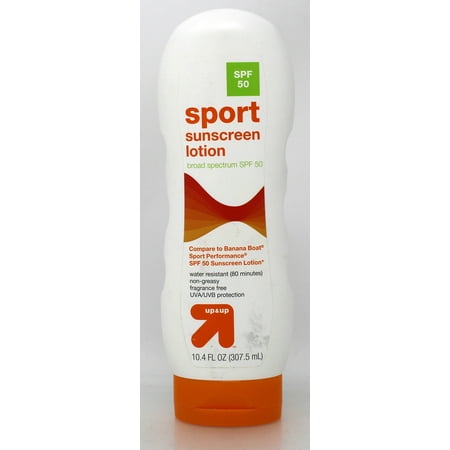

Sport Sunscreen Lotion - SPF 50 - 10.4 fl oz - up&up™
Analysis updated August 2026 · How Scout scores
At a glance
Summary
This sunscreen contains beneficial ingredients like glycerin, sodium ascorbyl phosphate, and aloe vera, which provide moisturizing and antioxidant benefits. However, it also includes phenoxyethanol and triethanolamine, which can be irritating and raise concerns over potential toxicity. The presence of these ingredients, along with a moderate level of processing, impacts the overall safety and quality of the product.
Key ingredients 23
Sodium Ascorbyl PhosphateVery Good
Sodium Ascorbyl Phosphate is a stable form of Vitamin C used for its antioxidant properties. It helps to protect the skin from free radical damage. It is considered beneficial for skin health and appearance.
Risks
There are minimal risks associated with this ingredient, though it may cause irritation in very sensitive skin.
Benefits
Provides antioxidant protection, brightens the skin, and supports collagen production.
Aloe Barbadensis Leaf JuiceVery Good
Aloe Barbadensis Leaf Juice is known for its soothing and hydrating properties. It helps to calm irritated skin and provide moisture. It is considered beneficial for all skin types, especially sensitive skin.
Risks
There are minimal risks associated with aloe vera, though it may cause irritation in very sensitive skin.
Benefits
Soothes and hydrates the skin, reducing redness and irritation.
GlycerinGood
Glycerin is a humectant that attracts moisture to the skin, helping to keep it hydrated. It is widely used in skincare products for its moisturizing properties. It is considered safe and beneficial for most skin types.
Risks
There are minimal risks associated with glycerin, though it may cause irritation in very sensitive skin.
Benefits
Glycerin helps to maintain skin hydration, improving skin barrier function and smoothness.
Tocopheryl AcetateGood
Tocopheryl Acetate is a form of Vitamin E used for its antioxidant properties. It helps to protect the skin from environmental damage. It is widely used in skincare products for its moisturizing and protective benefits.
Risks
There are minimal risks associated with this ingredient, though it may cause irritation in very sensitive skin.
Benefits
Provides antioxidant protection, moisturizes the skin, and supports skin health.
WaterNeutral
Water is a common solvent used in many cosmetic formulations. It helps to dissolve other ingredients and provides a base for the lotion. It is generally considered safe and non-irritating.
Risks
There are no significant risks associated with water in cosmetic formulations.
Benefits
Water helps to hydrate the skin and improve the texture of the product.
Cetearyl AlcoholNeutral
Cetearyl Alcohol is a fatty alcohol used as an emollient and thickener in cosmetics. It helps to stabilize and thicken formulations. It is generally considered safe for use in skincare products.
Risks
In rare cases, it may cause mild skin irritation or allergic reactions.
Benefits
It helps to soften and smooth the skin, improving the overall feel of the product.
Stearyl AlcoholNeutral
Stearyl Alcohol is a fatty alcohol used to thicken and stabilize formulations. It acts as an emollient, providing a smooth texture. It is generally regarded as safe for use in cosmetics.
Risks
May cause mild irritation in sensitive individuals.
Benefits
It helps to moisturize and condition the skin, enhancing the product's texture.
Acrylates/C12-22 Alkyl Methacrylate CopolymerNeutral
This copolymer is used as a film-forming agent in sunscreens to provide water resistance. It helps the product adhere to the skin. It is generally considered safe for use in cosmetics.
Risks
May cause mild irritation if used in high concentrations.
Benefits
Enhances the water resistance of the sunscreen, improving its effectiveness.
Cetyl AlcoholNeutral
Cetyl Alcohol is a fatty alcohol used as an emollient and thickener. It helps to stabilize and thicken formulations. It is generally considered safe for use in skincare products.
Risks
May cause mild irritation in sensitive individuals.
Benefits
It helps to soften and smooth the skin, improving the overall feel of the product.
CarbomerNeutral
Carbomer is a thickening agent used to stabilize emulsions in cosmetic products. It helps to create a smooth texture. It is generally considered safe for use in cosmetics.
Risks
May cause mild irritation if used in high concentrations.
Benefits
Provides a smooth and consistent texture to the product, enhancing user experience.
Ceteth-10 PhosphateNeutral
Ceteth-10 Phosphate is an emulsifier used to blend oil and water-based ingredients. It helps to stabilize formulations. It is generally considered safe for use in cosmetics.
Risks
May cause mild irritation in sensitive individuals.
Benefits
Helps to maintain the stability and consistency of the product.
Dicetyl PhosphateNeutral
Dicetyl Phosphate is used as an emulsifier and stabilizer in cosmetic formulations. It helps to maintain the consistency of the product. It is generally considered safe for use in cosmetics.
Risks
May cause mild irritation in sensitive individuals.
Benefits
Contributes to the stability and texture of the product.
Coco-GlucosideNeutral
Coco-Glucoside is a mild surfactant derived from coconut oil and glucose. It is used to cleanse and condition the skin. It is generally considered safe and non-irritating.
Risks
Rarely, it may cause mild irritation in very sensitive skin.
Benefits
Provides gentle cleansing and conditioning properties, suitable for sensitive skin.
Xanthan GumNeutral
Xanthan Gum is a natural thickening agent used to stabilize emulsions. It helps to create a smooth texture in cosmetic products. It is generally considered safe for use in cosmetics.
Risks
May cause mild irritation if used in high concentrations.
Benefits
Enhances the texture and stability of the product, improving user experience.
Methyl DihydroabietateNeutral
Methyl Dihydroabietate is used as a fragrance ingredient in cosmetics. It provides a pleasant scent to the product. It is generally considered safe for use in cosmetics.
Risks
May cause allergic reactions or irritation in sensitive individuals.
Benefits
Enhances the sensory experience of the product with a pleasant fragrance.
Lauryl PEG-8 DimethiconeNeutral
Lauryl PEG-8 Dimethicone is a silicone-based surfactant used to improve the spreadability of products. It helps to create a smooth application. It is generally considered safe for use in cosmetics.
Risks
May cause mild irritation in sensitive individuals.
Benefits
Improves the texture and application of the product, enhancing user experience.
Phenylisopropyl DimethiconeNeutral
Phenylisopropyl Dimethicone is a silicone-based emollient used to provide a smooth feel to the skin. It helps to improve the texture of the product. It is generally considered safe for use in cosmetics.
Risks
May cause mild irritation in sensitive individuals.
Benefits
Enhances the smoothness and spreadability of the product, improving user experience.
Polyglyceryl-3 Stearate/Isostearate/Dimer Dilinoleate CrosspolymerNeutral
This crosspolymer is used as an emulsifier and stabilizer in cosmetic formulations. It helps to blend oil and water-based ingredients. It is generally considered safe for use in cosmetics.
Risks
May cause mild irritation in sensitive individuals.
Benefits
Contributes to the stability and consistency of the product.
HydroxyacetophenoneNeutral
Hydroxyacetophenone is an antioxidant and preservative used to protect cosmetic formulations from degradation. It helps to stabilize the product and extend its shelf life. It is generally considered safe for use in cosmetics.
Risks
May cause mild irritation in sensitive individuals.
Benefits
Provides antioxidant protection and helps to preserve the product.
Disodium EDTABad
Processed additive flagged under Scout's ingredient doctrine.
Risks
May cause mild irritation in sensitive individuals.
Benefits
Helps to maintain the stability and effectiveness of the product over time.
PhenoxyethanolBad
Phenoxyethanol is a preservative used to prevent microbial growth in cosmetics. It is effective at low concentrations but can be irritating to the skin. It is generally considered safe in small amounts but has raised concerns over potential toxicity.
Risks
May cause skin irritation and allergic reactions, especially in sensitive individuals.
Benefits
Helps to preserve the product and extend its shelf life by preventing microbial contamination.
TriethanolamineBad
Triethanolamine is used to adjust the pH of cosmetic formulations. It can be irritating to the skin and eyes, especially in high concentrations. It is generally considered safe in small amounts but has raised concerns over potential toxicity.
Risks
May cause skin irritation and allergic reactions, especially in sensitive individuals.
Benefits
Helps to stabilize the pH of the product, ensuring its effectiveness and safety.
Propylene GlycolBad
Processed additive flagged under Scout's ingredient doctrine.
Risks
May cause skin irritation and allergic reactions in sensitive individuals.
Benefits
Helps to maintain skin hydration and improve the texture of the product.
Get the full breakdown in the Scout appTake Scout shopping
Scan any product to see lab results, healthy alternatives, and your personalized analysis.
Download on theApp Store GET IT ONGoogle PlayAmazon pricing & content
Amazon price as of . Product prices and availability are accurate as of the date/time indicated and are subject to change. Any price and availability information displayed on Amazon.com at the time of purchase will apply to the purchase of this product.
CERTAIN CONTENT THAT APPEARS ON THIS SITE COMES FROM AMAZON. THIS CONTENT IS PROVIDED “AS IS” AND IS SUBJECT TO CHANGE OR REMOVAL AT ANY TIME.