
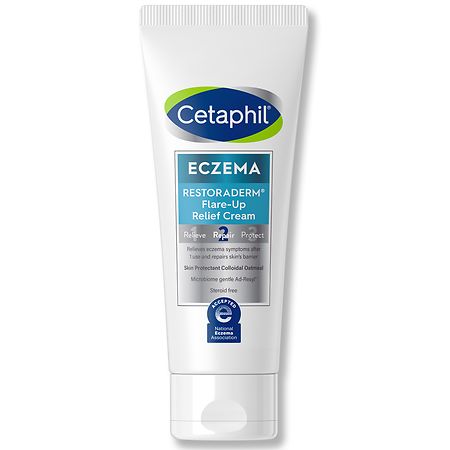


Cetaphil Restoraderm Flare-Up Eczema Relief Body Cream, 2% Colloidal Oatmeal - Unscented - 8oz: Moisturizing, Hypoallergenic, Paraben-Free, Whole Body
Analysis updated August 2026 · How Scout scores
At a glance
Summary
This body cream contains beneficial ingredients like colloidal oatmeal, shea butter, and ceramide NP, which are known for their moisturizing and skin-soothing properties. However, the presence of PEG-100 stearate and sodium polyacrylate starch indicates a moderate level of processing, which slightly impacts the overall score. The absence of parabens and synthetic fragrances is a positive aspect, contributing to its suitability for sensitive skin.
Key ingredients 24
Colloidal OatmealVery Good
Colloidal oatmeal is known for its soothing properties and ability to relieve itching and irritation associated with eczema. It forms a protective barrier on the skin, helping to retain moisture.
Risks
There are minimal risks associated with colloidal oatmeal, though rare allergic reactions can occur.
Benefits
It is highly beneficial for sensitive skin, providing anti-inflammatory and antioxidant effects.
Butyrospermum Parkii (Shea) ButterVery Good
Shea butter is a natural fat extracted from the nuts of the shea tree, known for its moisturizing and anti-inflammatory properties. It is rich in vitamins A and E.
Risks
Rarely, it can cause allergic reactions in individuals with nut allergies.
Benefits
It deeply nourishes and softens the skin, making it ideal for dry and sensitive skin.
Helianthus Annuus (Sunflower) Seed OilVery Good
Sunflower seed oil is rich in linoleic acid, which helps maintain the skin's natural barrier and supports its ability to retain moisture. It is lightweight and non-comedogenic.
Risks
It is generally safe, but may cause allergic reactions in some individuals.
Benefits
It provides antioxidant protection and helps soothe and condition the skin.
GlycerinGood
Glycerin is a humectant that attracts moisture to the skin, helping to maintain hydration. It is non-irritating and suitable for sensitive skin types.
Risks
Glycerin is generally safe, but in very high concentrations, it may cause irritation.
Benefits
It enhances skin barrier function and provides a smooth, supple feel.
Ceramide NPGood
Ceramide NP is a skin-identical lipid that helps restore the skin's barrier function and retain moisture. It is crucial for maintaining skin hydration and integrity.
Risks
There are no significant risks associated with ceramides.
Benefits
It strengthens the skin barrier and improves hydration, making it beneficial for dry and sensitive skin.
Tocopheryl AcetateGood
Beneficial ingredient — whole-food or functional value in this product class.
Risks
It is generally safe, but may cause irritation in sensitive skin.
Benefits
It provides antioxidant protection and helps to maintain skin health.
WaterNeutral
Water is used as a solvent in cosmetic formulations, helping to dissolve other ingredients. It is essential for the consistency and application of the product.
Risks
There are no inherent risks associated with water in cosmetic formulations.
Benefits
It acts as a base for the formulation, allowing for the distribution of active ingredients.
Ethylhexyl PalmitateNeutral
Ethylhexyl palmitate is an ester of 2-ethylhexyl alcohol and palmitic acid, used as an emollient and texture enhancer. It provides a smooth application and a silky feel.
Risks
It may cause mild irritation in sensitive individuals.
Benefits
It helps to soften and smooth the skin, enhancing the sensory experience of the product.
Cetearyl AlcoholNeutral
Cetearyl alcohol is a fatty alcohol used as an emollient and emulsifier in cosmetics. It helps to stabilize formulations and improve texture.
Risks
It is generally safe, but may cause irritation in very sensitive skin.
Benefits
It provides a creamy texture and helps to lock in moisture.
Pentylene GlycolNeutral
Pentylene glycol is a synthetic humectant and solvent that helps to retain moisture in the skin. It also has antimicrobial properties.
Risks
It is generally considered safe, but may cause irritation in sensitive skin.
Benefits
It enhances the skin's hydration and helps to preserve the product.
Glyceryl StearateNeutral
Glyceryl stearate is an emulsifier that helps to blend oil and water components in formulations. It also acts as a lubricant on the skin's surface.
Risks
It is generally safe, but may cause mild irritation in sensitive individuals.
Benefits
It improves the texture and stability of the product.
PEG-100 StearateNeutral
PEG-100 stearate is an emulsifier that helps to stabilize formulations and improve texture. It is derived from stearic acid and polyethylene glycol.
Risks
There is a potential risk of contamination with ethylene oxide and 1,4-dioxane during production.
Benefits
It helps to maintain the consistency and stability of the product.
Microcrystalline CelluloseNeutral
Microcrystalline cellulose is used as a thickening agent and stabilizer in cosmetic formulations. It helps to improve the texture and consistency of products.
Risks
It is generally considered safe with minimal risk of irritation.
Benefits
It enhances the product's texture and stability.
Sodium PCANeutral
Sodium PCA is a naturally occurring humectant derived from amino acids. It helps to attract moisture to the skin, improving hydration.
Risks
It is generally safe, but may cause irritation in very sensitive skin.
Benefits
It enhances skin hydration and helps maintain a healthy moisture balance.
ArginineNeutral
Arginine is an amino acid that helps to improve skin hydration and elasticity. It is often used in anti-aging formulations.
Risks
It is generally safe, but may cause irritation in sensitive skin.
Benefits
It supports skin repair and improves moisture retention.
Sodium Polyacrylate StarchNeutral
Sodium polyacrylate starch is a thickening agent and film-former used in cosmetics. It helps to improve the texture and stability of formulations.
Risks
It is generally safe, but may cause irritation in sensitive skin.
Benefits
It enhances the product's texture and provides a smooth application.
Caprylyl GlycolNeutral
Caprylyl glycol is a humectant and skin conditioning agent that helps to retain moisture. It also has antimicrobial properties.
Risks
It is generally considered safe, but may cause irritation in sensitive skin.
Benefits
It enhances skin hydration and helps to preserve the product.
Citric AcidNeutral
Citric acid is used to adjust the pH of cosmetic formulations. It also has mild exfoliating properties.
Risks
In high concentrations, it can cause irritation or sensitivity.
Benefits
It helps to maintain the stability and effectiveness of the product.
Sodium PhytateNeutral
Sodium phytate is a chelating agent that helps to stabilize formulations by binding metal ions. It is derived from phytic acid, found in plant seeds.
Risks
It is generally safe with minimal risk of irritation.
Benefits
It enhances the stability and shelf-life of the product.
Cellulose GumNeutral
Cellulose gum is a thickening agent used to improve the texture and consistency of cosmetic formulations. It is derived from cellulose, a natural polymer.
Risks
It is generally considered safe with minimal risk of irritation.
Benefits
It provides a smooth texture and helps to stabilize the product.
Ophiopogon Japonicus Root ExtractNeutral
Ophiopogon japonicus root extract is a botanical ingredient used for its moisturizing and soothing properties. It is often used in traditional medicine.
Risks
It is generally safe, but may cause allergic reactions in sensitive individuals.
Benefits
It helps to hydrate and soothe the skin, providing a calming effect.
Xanthan GumNeutral
Xanthan gum is a natural thickening agent used to stabilize and improve the texture of cosmetic formulations. It is produced by fermenting sugars with bacteria.
Risks
It is generally safe with minimal risk of irritation.
Benefits
It enhances the product's texture and provides a smooth application.
MaltodextrinNeutral
Maltodextrin is a polysaccharide used as a binding and stabilizing agent in cosmetics. It is derived from starch.
Risks
It is generally considered safe with minimal risk of irritation.
Benefits
It helps to improve the texture and stability of the product.
DimethiconeBad
Occlusive silicone film-former — flagged under clean-beauty doctrine.
Risks
It can potentially cause breakouts in acne-prone skin due to its occlusive nature.
Benefits
It enhances the skin's smoothness and provides a silky feel.
Processing
Processed Foods
Get the full breakdown in the Scout appTake Scout shopping
Scan any product to see lab results, healthy alternatives, and your personalized analysis.
Download on theApp Store GET IT ONGoogle PlayAmazon pricing & content
Amazon price as of . Product prices and availability are accurate as of the date/time indicated and are subject to change. Any price and availability information displayed on Amazon.com at the time of purchase will apply to the purchase of this product.
CERTAIN CONTENT THAT APPEARS ON THIS SITE COMES FROM AMAZON. THIS CONTENT IS PROVIDED “AS IS” AND IS SUBJECT TO CHANGE OR REMOVAL AT ANY TIME.