
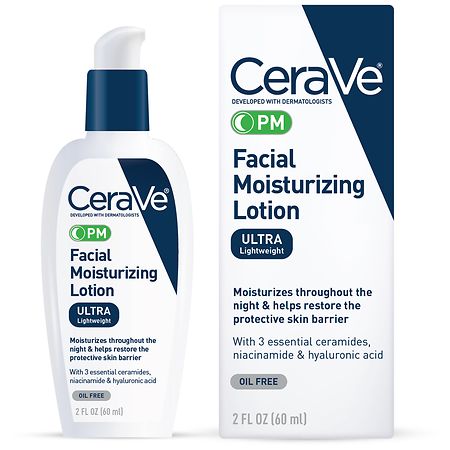

CeraVe PM Moisturizing Lotion, Night Cream for All Skin Types - 2 fl oz: No Fragrance Added, Noncomedogenic, Oil-Free, Contains Ceramides
Analysis updated August 2026 · How Scout scores
At a glance
Summary
This moisturizer contains beneficial ingredients like niacinamide, ceramides, and sodium hyaluronate, which support skin hydration and barrier function. The presence of phenoxyethanol as a preservative is a minor concern due to potential irritation, but it is used within safe limits. The product is processed, which slightly limits its score, but overall it offers a good balance of effective and safe ingredients.
Key ingredients 24
CERAMIDE APVery Good
Ceramide AP is another type of ceramide that supports the skin's barrier function. It helps to lock in moisture and protect against irritants. It is beneficial for maintaining healthy skin.
Benefits
Improves skin hydration and resilience.
CERAMIDE EOPVery Good
Ceramide EOP is crucial for maintaining the skin's lipid barrier and preventing moisture loss. It helps to repair and protect the skin. It is particularly beneficial for dry and compromised skin.
Benefits
Enhances skin barrier function and hydration.
GLYCERINGood
Glycerin is a humectant that attracts moisture to the skin, helping to keep it hydrated. It is widely used in skincare for its moisturizing properties. It is considered safe and beneficial for most skin types.
Risks
Rarely, glycerin can cause irritation in very sensitive skin.
Benefits
Helps maintain skin hydration and improves skin barrier function.
CAPRYLIC/CAPRIC TRIGLYCERIDEGood
This ingredient is derived from coconut oil and glycerin, providing a lightweight texture and moisturizing properties. It is non-greasy and helps to improve the spreadability of the product. It is generally well-tolerated by most skin types.
Risks
Minimal risk of irritation or allergic reaction.
Benefits
Provides a silky feel and helps to lock in moisture without clogging pores.
NIACINAMIDEGood
Niacinamide is a form of Vitamin B3 that offers multiple skin benefits, including improving skin tone and texture. It helps to reduce inflammation and can improve the appearance of enlarged pores. It is well-regarded for its anti-aging and skin-soothing properties.
Risks
In rare cases, it may cause mild irritation or redness.
Benefits
Enhances skin barrier function and reduces signs of aging.
CERAMIDE NPGood
Ceramide NP is a lipid that helps to restore and maintain the skin's natural barrier. It is essential for retaining moisture and protecting the skin from environmental damage. It is highly beneficial for dry and sensitive skin types.
Benefits
Strengthens skin barrier and enhances hydration.
SODIUM HYALURONATEGood
Sodium hyaluronate is a form of hyaluronic acid that provides intense hydration by attracting and retaining moisture in the skin. It is highly effective in improving skin plumpness and reducing fine lines. It is well-tolerated by all skin types.
Benefits
Deeply hydrates and improves skin elasticity.
CHOLESTEROLGood
Cholesterol is a lipid that helps to maintain the skin's barrier function and retain moisture. It is essential for healthy skin and is often used in combination with ceramides. It is beneficial for dry and aging skin.
Benefits
Supports skin barrier and enhances hydration.
PHYTOSPHINGOSINEGood
Phytosphingosine is a lipid that helps to restore the skin's natural barrier and has anti-inflammatory properties. It is beneficial for reducing redness and irritation. It is well-tolerated by most skin types.
Benefits
Reduces inflammation and supports skin barrier function.
AQUA / WATER / EAUNeutral
Water is a common solvent used in cosmetics to dissolve other ingredients. It helps in the application and absorption of the product. It does not provide any direct benefits or risks.
Benefits
Acts as a base for the formulation, allowing other ingredients to be delivered effectively.
CETEARYL ALCOHOLNeutral
Cetearyl alcohol is a fatty alcohol used as an emollient and thickening agent in cosmetics. It helps to stabilize and thicken formulations. It is not drying like other alcohols and is generally considered safe.
Risks
Very low risk of irritation or allergic reaction.
Benefits
Improves texture and consistency of the product.
POTASSIUM PHOSPHATENeutral
Potassium phosphate is used as a buffering agent to maintain the pH balance of the product. It helps to stabilize the formulation. It does not have direct skin benefits or risks.
Benefits
Ensures product stability and effectiveness.
CARBOMERNeutral
Carbomer is a thickening agent used to create gel-like textures in cosmetics. It helps to stabilize emulsions and improve product consistency. It does not provide direct skin benefits or risks.
Benefits
Improves product texture and stability.
CETEARETH-20Neutral
Ceteareth-20 is an emulsifier that helps to blend oil and water-based ingredients. It stabilizes formulations and improves texture. It is generally considered safe for use in cosmetics.
Risks
Potential contamination with 1,4-dioxane if not properly purified.
Benefits
Enhances product stability and consistency.
SODIUM LAUROYL LACTYLATENeutral
Sodium lauroyl lactylate is a mild surfactant and emulsifier that helps to stabilize formulations. It is derived from natural sources and is considered safe for use in cosmetics. It does not have significant direct skin benefits.
Risks
Low risk of irritation or allergic reaction.
Benefits
Enhances product stability and texture.
DIPOTASSIUM PHOSPHATENeutral
Dipotassium phosphate is used as a buffering agent to maintain the pH balance of the product. It helps to stabilize the formulation. It does not have direct skin benefits or risks.
Benefits
Ensures product stability and effectiveness.
CAPRYLYL GLYCOLNeutral
Caprylyl glycol is a skin conditioning agent that also acts as a preservative booster. It helps to improve skin feel and extend product shelf life. It is generally considered safe for use in cosmetics.
Risks
Low risk of irritation or allergic reaction.
Benefits
Enhances product preservation and skin feel.
XANTHAN GUMNeutral
Xanthan gum is a natural thickening agent used to stabilize and thicken formulations. It helps to improve product texture. It does not have direct skin benefits or risks.
Benefits
Improves product texture and stability.
POLYGLYCERYL-3 DIISOSTEARATENeutral
Polyglyceryl-3 diisostearate is an emulsifier that helps to blend oil and water-based ingredients. It stabilizes formulations and improves texture. It is generally considered safe for use in cosmetics.
Benefits
Enhances product stability and consistency.
ETHYLHEXYLGLYCERINNeutral
Ethylhexylglycerin is a conditioning agent and preservative enhancer. It helps to improve skin feel and extend product shelf life. It is generally considered safe for use in cosmetics.
Risks
Low risk of irritation or allergic reaction.
Benefits
Enhances product preservation and skin feel.
DIMETHICONEBad
Occlusive silicone film-former — flagged under clean-beauty doctrine.
Risks
May cause breakouts in very acne-prone skin.
Benefits
Provides a silky texture and helps to retain moisture.
BEHENTRIMONIUM METHOSULFATEBad
Processed additive flagged under Scout's ingredient doctrine.
Risks
Very low risk of irritation.
Benefits
Improves texture and feel of the product.
PHENOXYETHANOLBad
Phenoxyethanol is a preservative used to prevent microbial growth in cosmetics. While effective, it can cause irritation in sensitive individuals and is restricted in concentration by regulatory bodies. It is considered a moderate risk ingredient.
Risks
Potential for skin irritation and allergic reactions.
Benefits
Prevents product spoilage and extends shelf life.
DISODIUM EDTABad
Processed additive flagged under Scout's ingredient doctrine.
Benefits
Improves product stability and effectiveness.
Get the full breakdown in the Scout appTake Scout shopping
Scan any product to see lab results, healthy alternatives, and your personalized analysis.
Download on theApp Store GET IT ONGoogle Play