
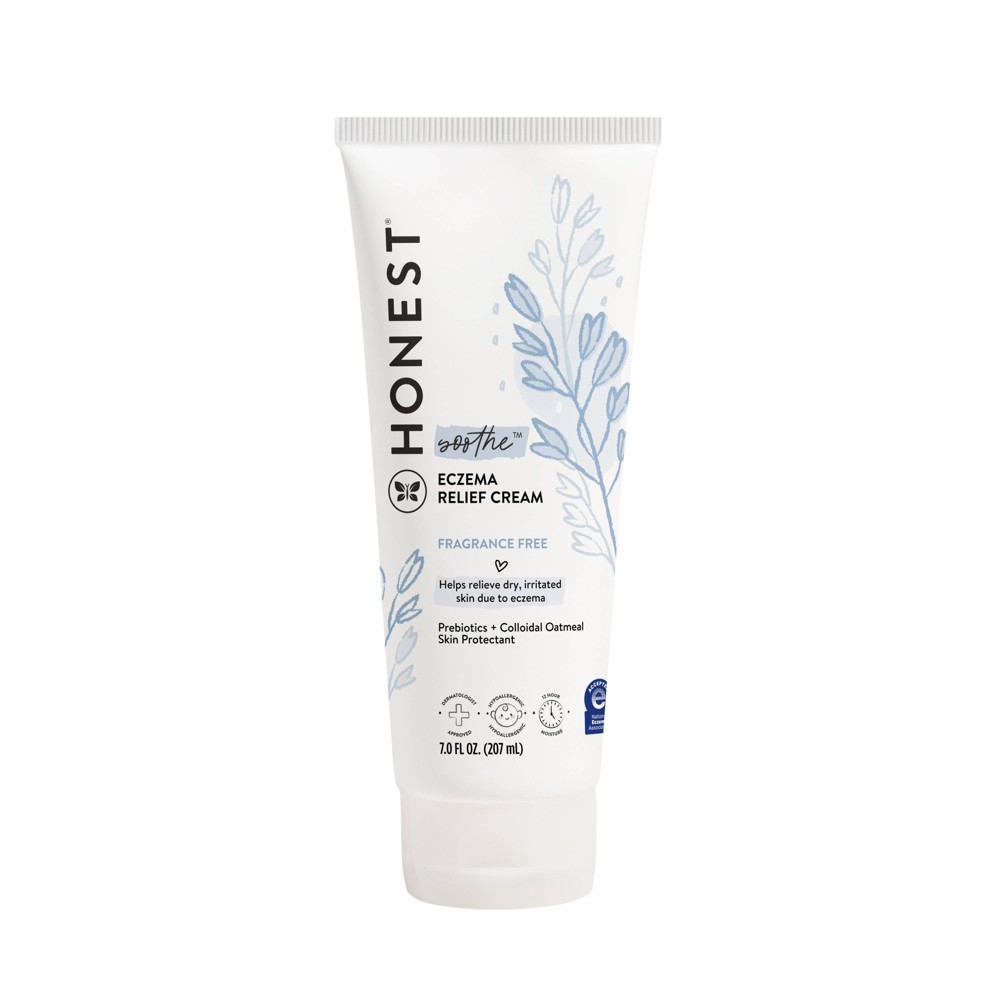
The Honest Company Soothe Fragrance Free Eczema Relief Cream - 7 fl oz: Paraben-Free, Silicone-Free, Steroid-Free
Honest CompanyAnalysis updated August 2026 · How Scout scores
At a glance
Summary
This product features a clean ingredient list with beneficial components like safflower seed oil, coconut oil, shea butter, and aloe vera, which are known for their moisturizing and soothing properties. It avoids harmful substances such as parabens, sulfates, and synthetic fragrances, making it suitable for sensitive skin. The inclusion of natural oils and skin actives enhances its safety and effectiveness, contributing to a high score.
Key ingredients 29
Carthamus Tinctorius (Safflower) Seed OilVery Good
Safflower seed oil is rich in linoleic acid, which helps maintain the skin's barrier and reduce inflammation. It is a natural emollient that softens and smooths the skin.
Risks
There are minimal risks, though some individuals may experience allergic reactions.
Benefits
It provides moisturizing benefits and supports skin health.
Cocos Nucifera (Coconut) OilVery Good
Coconut oil is known for its moisturizing properties and ability to improve skin barrier function. It contains fatty acids that nourish and protect the skin.
Risks
It may cause breakouts in acne-prone skin due to its comedogenic nature.
Benefits
It deeply moisturizes and nourishes the skin.
Butyrospermum Parkii (Shea) ButterVery Good
Shea butter is a natural fat extracted from the nuts of the shea tree. It is rich in vitamins and fatty acids, providing excellent moisturizing and healing properties.
Risks
Rarely, it may cause allergic reactions in sensitive individuals.
Benefits
It deeply moisturizes and soothes dry, irritated skin.
Jojoba EstersVery Good
Jojoba esters are derived from jojoba oil and are used as emollients. They mimic the skin's natural oils, providing excellent moisturizing properties.
Risks
There are no significant risks associated with jojoba esters.
Benefits
They help moisturize and protect the skin.
Aloe Barbadensis Leaf JuiceVery Good
Aloe vera is known for its soothing and healing properties. It is rich in vitamins and antioxidants, providing hydration and reducing inflammation.
Risks
There are minimal risks, though some individuals may experience allergic reactions.
Benefits
It soothes irritated skin and provides hydration.
SqualaneVery Good
Squalane is a highly effective emollient that mimics the skin's natural oils. It is known for its moisturizing and anti-aging properties.
Risks
There are no significant risks associated with squalane.
Benefits
It hydrates the skin and improves elasticity.
AllantoinVery Good
Allantoin is a skin-soothing agent that promotes healing and reduces irritation. It is commonly used in products for sensitive skin.
Risks
There are no significant risks associated with allantoin.
Benefits
It soothes and protects the skin.
TocopherolVery Good
Tocopherol, or Vitamin E, is an antioxidant that protects the skin from free radical damage. It also provides moisturizing benefits.
Risks
There are no significant risks associated with tocopherol.
Benefits
It protects the skin and enhances moisture retention.
GlycerinGood
Glycerin is a humectant that attracts moisture to the skin, keeping it hydrated. It is widely used in skincare for its ability to improve skin barrier function.
Risks
There are no significant risks associated with glycerin.
Benefits
It enhances skin hydration and smoothness.
Water (Aqua)Neutral
Water is a common solvent used in cosmetic formulations. It helps dissolve other ingredients and provides a base for the product.
Risks
There are no significant risks associated with water in cosmetics.
Benefits
Water hydrates the skin and helps in the application of the product.
Polyglyceryl-6 DistearateNeutral
Polyglyceryl-6 Distearate is an emulsifier that helps blend oil and water components in formulations. It is derived from natural sources and is considered safe.
Risks
There are no significant risks associated with this ingredient.
Benefits
It stabilizes the formulation and improves texture.
Diheptyl SuccinateNeutral
Diheptyl Succinate is used as a skin conditioning agent and emollient. It is derived from natural sources and is considered safe for use in cosmetics.
Risks
There are no significant risks associated with this ingredient.
Benefits
It helps improve skin texture and provides a smooth feel.
Ethylhexyl OlivateNeutral
Ethylhexyl Olivate is an emollient derived from olive oil. It is used to enhance the texture and spreadability of cosmetic products.
Risks
There are no significant risks associated with this ingredient.
Benefits
It provides a silky feel and helps moisturize the skin.
Cetearyl AlcoholNeutral
Cetearyl Alcohol is a fatty alcohol used as an emollient and emulsifier. It helps stabilize formulations and provides a creamy texture.
Risks
There are no significant risks associated with this ingredient.
Benefits
It helps soften and smooth the skin.
PropanediolNeutral
Propanediol is a glycol used as a solvent and humectant in cosmetics. It helps improve the absorption of other ingredients.
Risks
There are no significant risks associated with this ingredient.
Benefits
It enhances skin hydration and improves product texture.
Glyceryl Stearate CitrateNeutral
Glyceryl Stearate Citrate is an emulsifier that helps blend oil and water components. It is derived from natural sources and is considered safe.
Risks
There are no significant risks associated with this ingredient.
Benefits
It stabilizes formulations and improves texture.
Polyglyceryl-3 BeeswaxNeutral
Polyglyceryl-3 Beeswax is an emulsifier and thickener derived from beeswax. It helps stabilize formulations and provides a smooth texture.
Risks
There are no significant risks associated with this ingredient.
Benefits
It helps improve product texture and stability.
CelluloseNeutral
Cellulose is a natural polymer used as a thickener and stabilizer in cosmetics. It is derived from plant sources and is considered safe.
Risks
There are no significant risks associated with cellulose.
Benefits
It helps improve product texture and stability.
1, 2-HexanediolNeutral
1, 2-Hexanediol is a synthetic preservative and humectant. It helps maintain product stability and improve skin hydration.
Risks
There are no significant risks associated with this ingredient.
Benefits
It helps preserve the product and enhance moisture.
Alpha-Glucan OligosaccharideNeutral
Alpha-Glucan Oligosaccharide is a prebiotic that supports the skin's microbiome. It helps maintain a healthy skin barrier.
Risks
There are no significant risks associated with this ingredient.
Benefits
It supports skin health and barrier function.
Cetyl AlcoholNeutral
Cetyl Alcohol is a fatty alcohol used as an emollient and emulsifier. It helps stabilize formulations and provides a creamy texture.
Risks
There are no significant risks associated with this ingredient.
Benefits
It helps soften and smooth the skin.
Xanthan GumNeutral
Xanthan Gum is a natural thickener and stabilizer used in cosmetics. It helps improve the texture and consistency of products.
Risks
There are no significant risks associated with xanthan gum.
Benefits
It stabilizes formulations and enhances texture.
HectoriteNeutral
Hectorite is a clay mineral used as a thickener and stabilizer in cosmetics. It helps improve the texture and consistency of products.
Risks
There are no significant risks associated with hectorite.
Benefits
It stabilizes formulations and enhances texture.
Caprylhydroxamic AcidNeutral
Caprylhydroxamic Acid is a preservative used to prevent microbial growth in cosmetics. It is considered safe and effective.
Risks
There are no significant risks associated with this ingredient.
Benefits
It helps preserve the product and prevent spoilage.
Trisodium Ethylenediamine DisuccinateNeutral
Trisodium Ethylenediamine Disuccinate is a chelating agent that helps stabilize formulations by binding metal ions. It is considered safe for use in cosmetics.
Risks
There are no significant risks associated with this ingredient.
Benefits
It stabilizes formulations and enhances product longevity.
Capryloyl Glycerin/Sebacic Acid CopolymerNeutral
Capryloyl Glycerin/Sebacic Acid Copolymer is a film-forming agent that provides a smooth feel to the skin. It is used to enhance the texture of cosmetic products.
Risks
There are no significant risks associated with this ingredient.
Benefits
It improves product texture and provides a smooth finish.
Citric AcidNeutral
Citric Acid is used to adjust the pH of cosmetic formulations. It is derived from citrus fruits and is considered safe.
Risks
There are no significant risks associated with citric acid.
Benefits
It helps maintain the stability and effectiveness of the product.
Sodium CitrateNeutral
Sodium Citrate is used as a buffering agent to maintain the pH of cosmetic formulations. It is considered safe and effective.
Risks
There are no significant risks associated with sodium citrate.
Benefits
It helps stabilize formulations and maintain product effectiveness.
Sodium BenzoateBad
Synthetic preservative that can form benzene in the presence of vitamin C.
Risks
There are no significant risks associated with sodium benzoate.
Benefits
It helps preserve the product and prevent spoilage.
Processing
Processed Foods
Get the full breakdown in the Scout appTake Scout shopping
Scan any product to see lab results, healthy alternatives, and your personalized analysis.
Download on theApp Store GET IT ONGoogle PlayAmazon pricing & content
Amazon price as of . Product prices and availability are accurate as of the date/time indicated and are subject to change. Any price and availability information displayed on Amazon.com at the time of purchase will apply to the purchase of this product.
CERTAIN CONTENT THAT APPEARS ON THIS SITE COMES FROM AMAZON. THIS CONTENT IS PROVIDED “AS IS” AND IS SUBJECT TO CHANGE OR REMOVAL AT ANY TIME.