
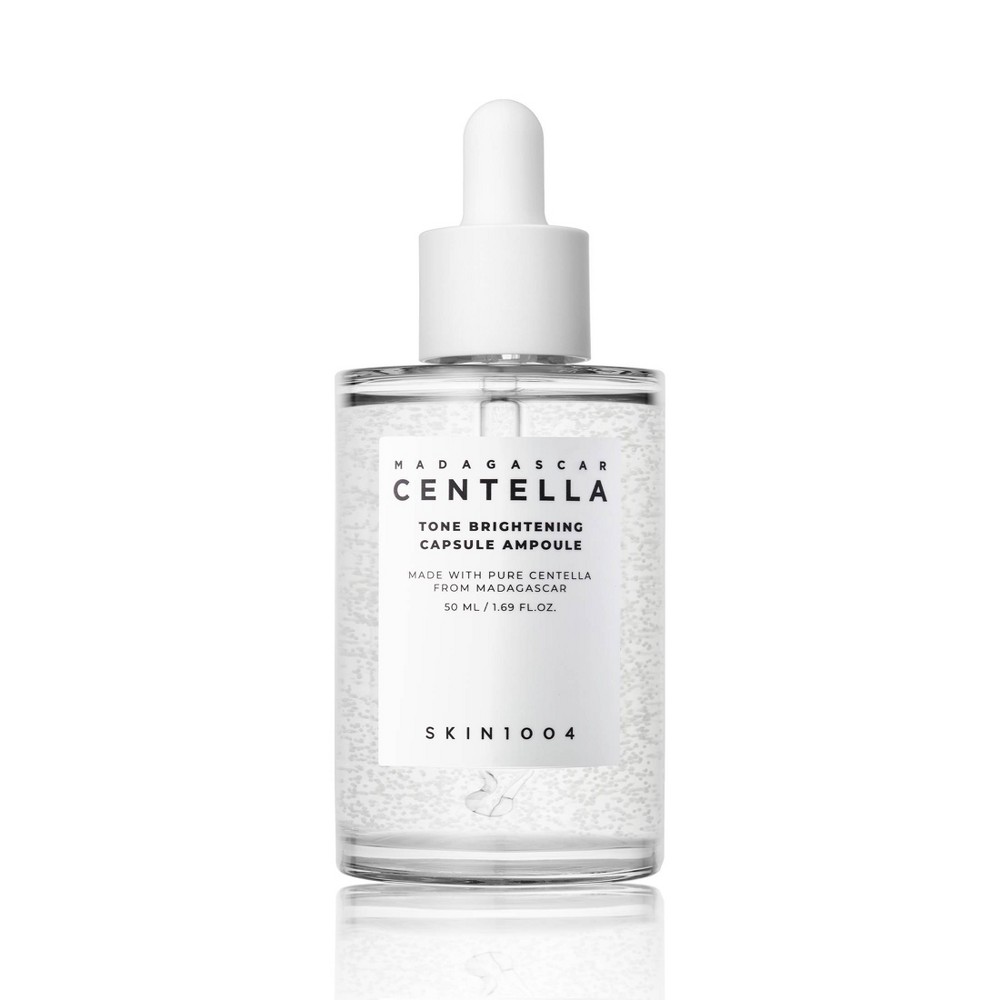
SKIN1004 Madagascar Centella Tone Brightening Capsule Ampoule Korean Skincare for Brightening and Even Skin Tone - 50ml
Analysis updated August 2026 · How Scout scores
At a glance
Summary
This skincare product contains several beneficial ingredients such as niacinamide, glycerin, and Centella Asiatica extract, which are known for their hydrating, soothing, and brightening properties. The presence of tranexamic acid and madecassoside further enhances its skin-repairing capabilities. However, the inclusion of acrylates and a processed formulation slightly impacts its overall rating, despite the predominantly natural and effective ingredient list.
Key ingredients 26
Centella Asiatica ExtractVery Good
Centella Asiatica Extract is a plant-derived ingredient known for its healing and anti-inflammatory properties. It helps soothe irritated skin and promotes collagen production. It is highly valued in skincare for its ability to repair and rejuvenate the skin.
Risks
There are minimal risks, though some individuals may experience mild irritation.
Benefits
It promotes skin healing and reduces inflammation, making it beneficial for sensitive and damaged skin.
PanthenolVery Good
Panthenol, also known as Provitamin B5, is a moisturizing and soothing agent. It helps improve skin hydration and elasticity. It is highly regarded for its ability to soothe and repair the skin.
Risks
There are minimal risks, though some individuals may experience mild irritation.
Benefits
It provides deep hydration and soothes irritated skin, promoting healing.
MadecassosideVery Good
Madecassoside is a compound derived from Centella Asiatica known for its anti-inflammatory and healing properties. It helps soothe irritated skin and promotes collagen synthesis. It is highly valued in skincare for its ability to repair and rejuvenate the skin.
Risks
There are minimal risks, though some individuals may experience mild irritation.
Benefits
It promotes skin healing and reduces inflammation, making it beneficial for sensitive and damaged skin.
3-O-Ethyl Ascorbic AcidVery Good
3-O-Ethyl Ascorbic Acid is a stable form of Vitamin C known for its brightening and antioxidant properties. It helps reduce hyperpigmentation and protect the skin from environmental damage. It is highly valued in skincare for its ability to improve skin tone and texture.
Risks
There are minimal risks, though some individuals may experience mild irritation.
Benefits
It brightens the skin and provides antioxidant protection, reducing signs of aging.
NiacinamideGood
Niacinamide is a form of Vitamin B3 that is known for its anti-inflammatory and brightening properties. It helps improve skin texture and tone. It is highly regarded in skincare for its ability to reduce the appearance of pores and fine lines.
Risks
There are minimal risks associated with niacinamide, though overuse may cause mild irritation.
Benefits
It effectively brightens the skin and reduces signs of aging, making it a valuable ingredient in skincare.
GlycerinGood
Glycerin is a powerful humectant that attracts moisture to the skin. It is widely used in skincare for its hydrating properties. It helps maintain the skin's moisture barrier.
Risks
Glycerin is generally safe, but in very high concentrations, it may cause irritation.
Benefits
It provides deep hydration and helps improve skin resilience.
Tranexamic AcidGood
Tranexamic Acid is known for its ability to reduce hyperpigmentation and improve skin tone. It is often used in products targeting dark spots and melasma. It works by inhibiting melanin synthesis.
Risks
It may cause irritation in sensitive skin types if used excessively.
Benefits
It effectively brightens the skin and reduces discoloration.
BetaineGood
Betaine is a natural amino acid derivative that helps maintain skin hydration. It is known for its soothing and anti-inflammatory properties. It helps protect the skin from environmental stressors.
Risks
Betaine is generally safe, with minimal risk of irritation.
Benefits
It provides hydration and soothes the skin, making it ideal for sensitive skin types.
ArginineGood
Arginine is an amino acid that helps improve skin hydration and elasticity. It is known for its skin-conditioning properties. It is generally considered safe for use in skincare.
Risks
There is a low risk of irritation or allergic reactions.
Benefits
It provides hydration and improves skin texture and elasticity.
Hydrogenated LecithinGood
Hydrogenated Lecithin is an emulsifier and skin-conditioning agent. It helps improve the texture and spreadability of the product. It is known for its ability to enhance the penetration of active ingredients.
Risks
There is a low risk of irritation or allergic reactions.
Benefits
It enhances product texture and improves the delivery of active ingredients.
Lactobacillus FermentGood
Lactobacillus Ferment is a probiotic ingredient known for its soothing and skin-conditioning properties. It helps balance the skin's microbiome and improve its resilience. It is generally considered safe for use in skincare.
Risks
There is a low risk of irritation or allergic reactions.
Benefits
It soothes the skin and supports a healthy skin barrier, enhancing overall skin health.
WaterNeutral
Water is a common solvent used in cosmetics to dissolve other ingredients. It is essential for the formulation but does not provide direct skin benefits. It acts as a base for the product.
Risks
There are no significant risks associated with water in cosmetics.
Benefits
Water helps in the even distribution of other active ingredients on the skin.
Butylene GlycolNeutral
Butylene Glycol is a common humectant that helps retain moisture in the skin. It also acts as a solvent and improves the texture of the product. It is generally considered safe for use in cosmetics.
Risks
In rare cases, it may cause irritation or allergic reactions in sensitive individuals.
Benefits
It helps in keeping the skin hydrated and enhances the penetration of other ingredients.
1,2-HexanediolNeutral
1,2-Hexanediol is a synthetic preservative and moisture-binding agent. It helps stabilize the product and prevent microbial growth. It is considered safe for use in cosmetics.
Risks
There is a low risk of irritation or allergic reactions.
Benefits
It helps maintain product integrity and enhances moisture retention.
Zea Mays (Corn) StarchNeutral
Zea Mays (Corn) Starch is used as a thickening agent in cosmetics. It helps improve the texture and consistency of the product. It is generally considered safe for use in skincare.
Risks
There is a low risk of irritation or allergic reactions.
Benefits
It provides a smooth texture and helps absorb excess oil.
Xanthan GumNeutral
Xanthan Gum is a natural thickening agent used to stabilize cosmetic formulations. It helps improve the texture and spreadability of the product. It is considered safe for use in cosmetics.
Risks
There is a low risk of irritation or allergic reactions.
Benefits
It enhances the product's texture and stability.
Microcrystalline CelluloseNeutral
Microcrystalline Cellulose is used as a bulking agent and stabilizer in cosmetics. It helps improve the texture and consistency of the product. It is considered safe for use in skincare.
Risks
There is a low risk of irritation or allergic reactions.
Benefits
It provides a smooth texture and helps stabilize the formulation.
MannitolNeutral
Mannitol is a sugar alcohol used as a humectant and moisturizer in cosmetics. It helps retain moisture in the skin. It is generally considered safe for use in skincare.
Risks
There is a low risk of irritation or allergic reactions.
Benefits
It provides hydration and helps improve skin texture.
Pentylene GlycolNeutral
Pentylene Glycol is a synthetic humectant and solvent used in cosmetics. It helps retain moisture and improve the texture of the product. It is considered safe for use in skincare.
Risks
There is a low risk of irritation or allergic reactions.
Benefits
It enhances moisture retention and improves product spreadability.
EthylhexylglycerinNeutral
Ethylhexylglycerin is a synthetic preservative and skin-conditioning agent. It helps enhance the efficacy of other preservatives in the formulation. It is considered safe for use in cosmetics.
Risks
There is a low risk of irritation or allergic reactions.
Benefits
It helps maintain product integrity and provides mild skin conditioning.
HydroxyethylcelluloseNeutral
Hydroxyethylcellulose is a thickening and stabilizing agent used in cosmetics. It helps improve the texture and consistency of the product. It is considered safe for use in skincare.
Risks
There is a low risk of irritation or allergic reactions.
Benefits
It enhances the product's texture and stability.
XylitylglucosideNeutral
Xylitylglucoside is a humectant and skin-conditioning agent used in cosmetics. It helps retain moisture in the skin. It is considered safe for use in skincare.
Risks
There is a low risk of irritation or allergic reactions.
Benefits
It provides hydration and helps improve skin texture.
AnhydroxylitolNeutral
Anhydroxylitol is a humectant and skin-conditioning agent used in cosmetics. It helps retain moisture in the skin. It is considered safe for use in skincare.
Risks
There is a low risk of irritation or allergic reactions.
Benefits
It provides hydration and helps improve skin texture.
XylitolNeutral
Xylitol is a sugar alcohol used as a humectant and moisturizer in cosmetics. It helps retain moisture in the skin. It is generally considered safe for use in skincare.
Risks
There is a low risk of irritation or allergic reactions.
Benefits
It provides hydration and helps improve skin texture.
Acrylates/C10-30 Alkyl Acrylate CrosspolymerBad
Processed additive flagged under Scout's ingredient doctrine.
Risks
There is a low risk of irritation or allergic reactions.
Benefits
It enhances the product's texture and stability.
GlucoseBad
Processed additive flagged under Scout's ingredient doctrine.
Risks
There is a low risk of irritation or allergic reactions.
Benefits
It provides hydration and helps improve skin texture.
Get the full breakdown in the Scout appTake Scout shopping
Scan any product to see lab results, healthy alternatives, and your personalized analysis.
Download on theApp Store GET IT ONGoogle PlayAmazon pricing & content
Amazon price as of . Product prices and availability are accurate as of the date/time indicated and are subject to change. Any price and availability information displayed on Amazon.com at the time of purchase will apply to the purchase of this product.
CERTAIN CONTENT THAT APPEARS ON THIS SITE COMES FROM AMAZON. THIS CONTENT IS PROVIDED “AS IS” AND IS SUBJECT TO CHANGE OR REMOVAL AT ANY TIME.