
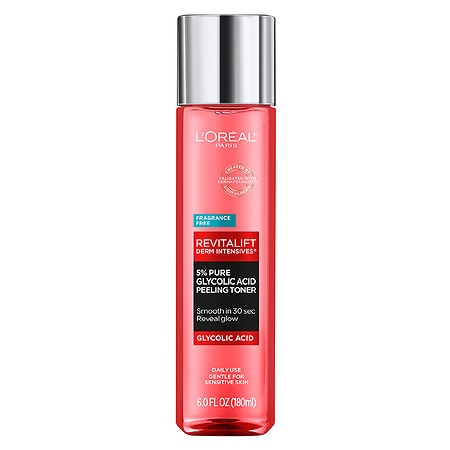
L Oreal Paris Revitalift Derm Intensives Pure Glycolic Acid Peeling Toner 6 fl oz
Analysis updated August 2026 · How Scout scores
At a glance
Summary
This toner contains beneficial ingredients like glycolic acid, glycerin, and aloe vera, which provide exfoliating, moisturizing, and soothing benefits. However, it includes some synthetic components like Bis-PEG-18 Methyl Ether Dimethyl Silane, which slightly lowers its score due to the level of processing involved. The product overall has a good balance of effective skincare actives with minimal concerning additives.
Key ingredients 17
Aloe Barbadensis Leaf JuiceVery Good
Aloe Vera is known for its soothing and moisturizing properties. It helps calm irritated skin and provides hydration. It is widely used in skincare for its healing and anti-inflammatory benefits.
Risks
There are minimal risks, though some individuals may experience allergic reactions.
Benefits
Soothes and hydrates the skin, reducing redness and irritation.
AllantoinVery Good
Allantoin is known for its skin-soothing and healing properties. It helps protect the skin and promote cell regeneration. It is widely used in skincare for its ability to calm and repair the skin.
Risks
There are minimal risks, though it may cause slight irritation in very sensitive individuals.
Benefits
Soothes and heals the skin, promoting a healthy complexion.
Ascorbyl GlucosideVery Good
Ascorbyl Glucoside is a stable form of Vitamin C that provides antioxidant protection. It helps brighten the skin and reduce signs of aging. It is a popular ingredient for its skin-brightening and anti-aging benefits.
Risks
There are minimal risks, though it may cause slight irritation in sensitive skin.
Benefits
Brightens the skin and provides antioxidant protection.
PanthenolVery Good
Panthenol, also known as Provitamin B5, is a moisturizing and soothing agent. It helps improve skin hydration and reduce inflammation. It is commonly used in skincare for its ability to enhance skin barrier function.
Risks
There are minimal risks, though it may cause slight irritation in very sensitive individuals.
Benefits
Moisturizes and soothes the skin, improving its overall health.
TocopherolVery Good
Tocopherol, or Vitamin E, is a powerful antioxidant that protects the skin from free radical damage. It helps nourish and moisturize the skin. It is widely used in skincare for its protective and hydrating benefits.
Risks
There are minimal risks, though it may cause slight irritation in very sensitive individuals.
Benefits
Protects the skin from environmental damage and provides hydration.
Salicylic AcidVery Good
Salicylic Acid is a beta hydroxy acid (BHA) known for its exfoliating and acne-fighting properties. It helps unclog pores and reduce inflammation. It is widely used in skincare for its ability to treat acne and improve skin texture.
Risks
May cause irritation or dryness, especially in sensitive skin or when used excessively.
Benefits
Exfoliates the skin and helps treat acne, improving overall skin clarity.
Glycolic AcidGood
Glycolic Acid is an alpha hydroxy acid (AHA) known for its exfoliating properties. It helps remove dead skin cells, promoting a brighter and more even skin tone. It is widely used for its anti-aging benefits.
Risks
May cause irritation or sensitivity, especially in high concentrations or sensitive skin.
Benefits
Improves skin texture and reduces the appearance of fine lines and wrinkles.
GlycerinGood
Glycerin is a humectant that attracts moisture to the skin, keeping it hydrated. It is a common ingredient in skincare products due to its moisturizing properties. It is safe and effective for all skin types.
Risks
There are minimal risks associated with glycerin, though it may cause slight irritation in very sensitive individuals.
Benefits
Provides deep hydration and helps maintain the skin's moisture barrier.
Citrullus Lanatus Fruit Extract/Watermelon Fruit ExtractGood
Watermelon Extract is rich in vitamins and antioxidants, providing hydration and nourishment to the skin. It helps protect the skin from environmental stressors. It is a beneficial ingredient for maintaining healthy skin.
Risks
There are minimal risks associated with this ingredient.
Benefits
Provides antioxidant protection and hydration.
Aqua/Water/EauNeutral
Water is a universal solvent used as a base in many cosmetic formulations. It helps dissolve other ingredients and provides hydration. It is generally considered safe and non-reactive.
Risks
There are no significant risks associated with water in cosmetics.
Benefits
Water helps in the application and absorption of other ingredients.
Hydroxyethylpiperazine Ethane Sulfonic AcidNeutral
This ingredient is used as a buffering agent to maintain the pH balance of the product. It helps stabilize the formulation and enhance the effectiveness of other active ingredients. It is generally considered safe for use in cosmetics.
Risks
There are no significant risks associated with this ingredient in cosmetic formulations.
Benefits
Helps maintain the stability and efficacy of the product.
Sodium HydroxideNeutral
Sodium Hydroxide is used to adjust the pH of cosmetic products. It is a strong alkaline compound that helps balance the acidity of formulations. In small amounts, it is safe for use in cosmetics.
Risks
In high concentrations, it can be corrosive and cause irritation, but it is used in very low concentrations in cosmetics.
Benefits
Ensures the product maintains a skin-friendly pH level.
Citric AcidNeutral
Common acidulant and preservative — safe at typical use levels, neither beneficial nor harmful.
Risks
May cause irritation in sensitive skin if used in high concentrations.
Benefits
Helps brighten the skin and improve texture.
Pentylene GlycolNeutral
Pentylene Glycol is a synthetic humectant and solvent that helps retain moisture in the skin. It also enhances the absorption of other ingredients. It is generally considered safe for use in cosmetics.
Risks
There are minimal risks associated with this ingredient, though it may cause slight irritation in sensitive individuals.
Benefits
Improves skin hydration and enhances product efficacy.
Bis-PEG-18 Methyl Ether Dimethyl SilaneNeutral
This ingredient is used as an emollient and conditioning agent in cosmetics. It helps improve the texture and feel of the product. It is generally considered safe for use in skincare formulations.
Risks
There are minimal risks associated with this ingredient.
Benefits
Improves the texture and application of the product.
Potassium SorbateBad
Synthetic preservative — flagged in daily-use products.
Risks
May cause irritation in sensitive skin if used in high concentrations.
Benefits
Prevents microbial growth, ensuring product safety and longevity.
Sodium BenzoateBad
Synthetic preservative that can form benzene in the presence of vitamin C.
Risks
May cause irritation in sensitive skin if used in high concentrations.
Benefits
Prevents microbial growth, ensuring product safety and longevity.
Get the full breakdown in the Scout appTake Scout shopping
Scan any product to see lab results, healthy alternatives, and your personalized analysis.
Download on theApp Store GET IT ONGoogle PlayAmazon pricing & content
Amazon price as of . Product prices and availability are accurate as of the date/time indicated and are subject to change. Any price and availability information displayed on Amazon.com at the time of purchase will apply to the purchase of this product.
CERTAIN CONTENT THAT APPEARS ON THIS SITE COMES FROM AMAZON. THIS CONTENT IS PROVIDED “AS IS” AND IS SUBJECT TO CHANGE OR REMOVAL AT ANY TIME.