
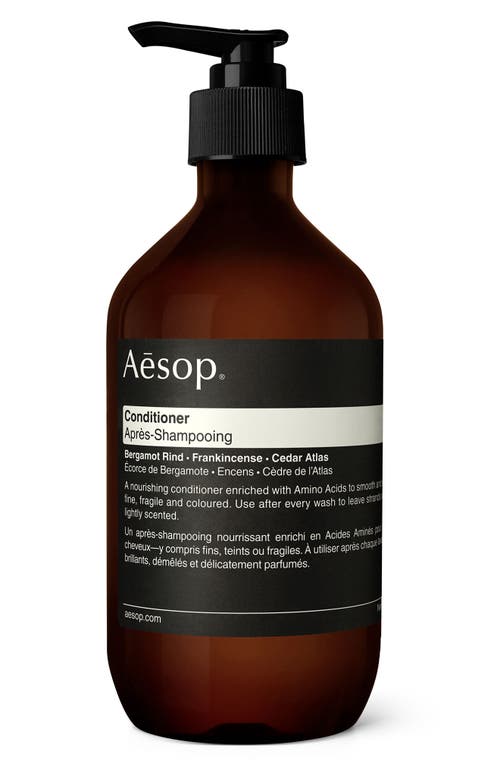

Aesop Conditioner at Nordstrom, Size 16.9 Oz
Analysis updated August 2026 · How Scout scores
At a glance
Summary
This conditioner features a range of beneficial ingredients such as squalane, glycerin, and behentrimonium methosulfate, which are known for their moisturizing and conditioning properties. The inclusion of natural oils like frankincense and bergamot further enhances its appeal by promoting scalp health. However, the presence of phenoxyethanol, a preservative that can cause irritation in some individuals, slightly detracts from its overall safety profile.
Key ingredients 45
Jojoba EstersVery Good
Jojoba Esters are derived from jojoba oil and provide excellent conditioning benefits. They help to moisturize and protect the hair without leaving a greasy residue. They are considered safe and highly beneficial for hair care.
Risks
There are minimal risks associated with Jojoba Esters.
Benefits
They provide deep conditioning and improve hair texture.
SqualaneGood
Squalane is a highly effective emollient and natural antioxidant. It helps to moisturize and protect the hair without leaving a greasy residue. It is derived from plants and is considered safe for use.
Risks
There are minimal risks associated with squalane, though overuse may lead to a greasy feel.
Benefits
Squalane provides deep hydration and helps to improve hair elasticity.
GlycerinGood
Glycerin is a humectant that attracts moisture to the hair. It helps to maintain hydration and improve hair texture. It is widely used in hair care for its moisturizing properties.
Risks
In very humid conditions, glycerin may draw too much moisture, leading to frizz.
Benefits
Glycerin helps to keep hair hydrated and soft.
Boswellia Carterii OilGood
Boswellia Carterii Oil, also known as frankincense oil, is known for its soothing and anti-inflammatory properties. It can help to calm the scalp and promote healthy hair growth. It is considered safe for use in hair care.
Risks
There are minimal risks, though some may experience sensitivity.
Benefits
It provides soothing benefits and may support scalp health.
Citrus Aurantium Bergamia Fruit OilGood
Citrus Aurantium Bergamia Fruit Oil, or bergamot oil, is known for its refreshing scent and antimicrobial properties. It can help to cleanse the scalp and add shine to hair. It is considered safe for use in hair care.
Risks
Photosensitivity may occur if exposed to sunlight after application.
Benefits
It provides a pleasant scent and antimicrobial benefits.
Cedrus Atlantica Bark OilGood
Cedrus Atlantica Bark Oil, or cedarwood oil, is known for its soothing and balancing properties. It can help to promote a healthy scalp and reduce dandruff. It is considered safe for use in hair care.
Risks
There are minimal risks, though some may experience sensitivity.
Benefits
It helps to balance scalp oil production and reduce dandruff.
PanthenolGood
Panthenol, also known as provitamin B5, is a moisturizing and conditioning agent. It helps to improve hair elasticity and shine. It is widely used in hair care for its beneficial properties.
Risks
There are no significant risks associated with Panthenol.
Benefits
It enhances hair moisture, elasticity, and shine.
Sodium PCAGood
Sodium PCA is a natural humectant that helps to maintain moisture balance in the hair. It is derived from amino acids and is considered safe for use. It is effective in keeping hair hydrated and soft.
Risks
There are no significant risks associated with Sodium PCA.
Benefits
It helps to maintain hair moisture and softness.
TocopherolGood
Tocopherol, or vitamin E, is a powerful antioxidant that helps to protect hair from damage. It supports healthy hair growth and improves hair texture. It is considered safe and beneficial for hair care.
Risks
There are no significant risks associated with Tocopherol.
Benefits
It provides antioxidant protection and supports healthy hair.
ArginineGood
Arginine is an amino acid that helps to strengthen and repair hair. It supports healthy hair growth and improves hair elasticity. It is considered safe and beneficial for hair care.
Risks
There are no significant risks associated with Arginine.
Benefits
It strengthens hair and supports healthy growth.
Hydrolyzed Vegetable ProteinGood
Hydrolyzed Vegetable Protein helps to strengthen and repair damaged hair. It improves hair elasticity and reduces breakage. It is considered safe and beneficial for hair care.
Risks
There are no significant risks associated with Hydrolyzed Vegetable Protein.
Benefits
It strengthens hair and reduces breakage.
GlycineGood
Beneficial ingredient — whole-food or functional value in this product class.
Risks
There are no significant risks associated with Glycine.
Benefits
It helps to condition and strengthen hair.
WaterNeutral
Water is a common solvent used in cosmetic formulations. It helps to dissolve other ingredients and provides a base for the product. It does not have any direct benefits or risks associated with its use in conditioners.
Risks
There are no significant risks associated with water in this context.
Benefits
Water helps to hydrate and distribute other ingredients evenly.
Brassica AlcoholNeutral
Brassica Alcohol is a fatty alcohol derived from plants, used as an emollient and thickener. It is generally considered safe and non-irritating. It does not have significant benefits or risks in hair care products.
Risks
There are no significant risks associated with Brassica Alcohol.
Benefits
It helps to improve the texture and spreadability of the conditioner.
Cetearyl AlcoholNeutral
Standard formulation ingredient — neither beneficial nor harmful at typical use.
Risks
There are no significant risks associated with Cetearyl Alcohol.
Benefits
It improves the texture and manageability of hair.
Stearyl AlcoholNeutral
Stearyl Alcohol is a fatty alcohol used as an emollient and thickener. It helps to stabilize and thicken formulations. It is generally considered safe and non-irritating.
Risks
There are no significant risks associated with Stearyl Alcohol.
Benefits
It helps to improve the texture and consistency of the conditioner.
1,2-HexanediolNeutral
1,2-Hexanediol is a synthetic preservative and moisture-binding agent. It helps to stabilize formulations and retain moisture. It is considered safe in low concentrations.
Risks
High concentrations may cause irritation, but it is typically used in safe amounts.
Benefits
It helps to preserve the product and maintain moisture levels.
Quaternium-87Neutral
Quaternium-87 is a conditioning agent that helps to improve hair texture and manageability. It is used to reduce static and enhance softness. It is generally considered safe for use in hair care.
Risks
There are minimal risks associated with Quaternium-87.
Benefits
It provides conditioning benefits and reduces static.
HydroxyethylcelluloseNeutral
Hydroxyethylcellulose is a thickening agent derived from cellulose. It helps to improve the texture and viscosity of the product. It is considered safe and non-irritating.
Risks
There are no significant risks associated with Hydroxyethylcellulose.
Benefits
It helps to stabilize and thicken the conditioner.
EthylhexylglycerinNeutral
Ethylhexylglycerin is a preservative and skin-conditioning agent. It helps to enhance the efficacy of other preservatives and improve skin feel. It is considered safe for use in cosmetics.
Risks
There are minimal risks associated with Ethylhexylglycerin.
Benefits
It helps to preserve the product and improve skin feel.
Sodium LactateNeutral
Sodium Lactate is a natural humectant and pH regulator. It helps to maintain moisture balance and stabilize the product's pH. It is considered safe for use in hair care.
Risks
There are no significant risks associated with Sodium Lactate.
Benefits
It helps to maintain moisture and stabilize pH levels.
Sodium DehydroacetateNeutral
Sodium Dehydroacetate is a preservative used to prevent microbial growth. It helps to extend the shelf life of the product. It is considered safe for use in cosmetics.
Risks
There are minimal risks associated with Sodium Dehydroacetate.
Benefits
It helps to preserve the product and prevent spoilage.
Sodium GluconateNeutral
Sodium Gluconate is a chelating agent that helps to stabilize formulations. It prevents the degradation of the product by binding metal ions. It is considered safe for use in cosmetics.
Risks
There are no significant risks associated with Sodium Gluconate.
Benefits
It helps to stabilize the product and prevent degradation.
Citric AcidNeutral
Citric Acid is used to adjust the pH of cosmetic formulations. It helps to maintain the stability and effectiveness of the product. It is considered safe for use in hair care.
Risks
High concentrations may cause irritation, but it is typically used in safe amounts.
Benefits
It helps to maintain product stability and pH balance.
Aspartic AcidNeutral
Aspartic Acid is an amino acid used to condition and strengthen hair. It helps to improve hair texture and manageability. It is considered safe for use in hair care.
Risks
There are no significant risks associated with Aspartic Acid.
Benefits
It helps to condition and strengthen hair.
Helianthus Annuus Seed WaxNeutral
Helianthus Annuus Seed Wax is derived from sunflower seeds and used as an emollient. It helps to improve the texture and consistency of the product. It is considered safe for use in cosmetics.
Risks
There are no significant risks associated with Helianthus Annuus Seed Wax.
Benefits
It helps to improve product texture and consistency.
PCANeutral
PCA is a humectant that helps to maintain moisture balance in the hair. It is derived from amino acids and is considered safe for use. It is effective in keeping hair hydrated and soft.
Risks
There are no significant risks associated with PCA.
Benefits
It helps to maintain hair moisture and softness.
Glycine Soja OilNeutral
Glycine Soja Oil, or soybean oil, is used as an emollient and conditioning agent. It helps to moisturize and protect the hair. It is considered safe for use in hair care.
Risks
There are minimal risks associated with Glycine Soja Oil.
Benefits
It provides moisture and protection to the hair.
Sodium AcetateNeutral
Sodium Acetate is used as a buffering agent to maintain pH balance. It helps to stabilize formulations and improve product performance. It is considered safe for use in cosmetics.
Risks
There are no significant risks associated with Sodium Acetate.
Benefits
It helps to maintain pH balance and stabilize the product.
AlanineNeutral
Alanine is an amino acid used to condition and strengthen hair. It helps to improve hair texture and manageability. It is considered safe for use in hair care.
Risks
There are no significant risks associated with Alanine.
Benefits
It helps to condition and strengthen hair.
SerineNeutral
Serine is an amino acid used to condition and strengthen hair. It helps to improve hair texture and manageability. It is considered safe for use in hair care.
Risks
There are no significant risks associated with Serine.
Benefits
It helps to condition and strengthen hair.
ValineNeutral
Valine is an amino acid used to condition and strengthen hair. It helps to improve hair texture and manageability. It is considered safe for use in hair care.
Risks
There are no significant risks associated with Valine.
Benefits
It helps to condition and strengthen hair.
Polyglycerin-3Neutral
Polyglycerin-3 is a humectant and emulsifier used to improve product texture. It helps to retain moisture and stabilize formulations. It is considered safe for use in cosmetics.
Risks
There are no significant risks associated with Polyglycerin-3.
Benefits
It helps to retain moisture and stabilize the product.
CelluloseNeutral
Cellulose is a natural thickening agent derived from plants. It helps to improve the texture and viscosity of the product. It is considered safe for use in cosmetics.
Risks
There are no significant risks associated with Cellulose.
Benefits
It helps to thicken and stabilize the conditioner.
IsoleucineNeutral
Isoleucine is an amino acid used to condition and strengthen hair. It helps to improve hair texture and manageability. It is considered safe for use in hair care.
Risks
There are no significant risks associated with Isoleucine.
Benefits
It helps to condition and strengthen hair.
ProlineNeutral
Proline is an amino acid used to condition and strengthen hair. It helps to improve hair texture and manageability. It is considered safe for use in hair care.
Risks
There are no significant risks associated with Proline.
Benefits
It helps to condition and strengthen hair.
ThreonineNeutral
Threonine is an amino acid used to condition and strengthen hair. It helps to improve hair texture and manageability. It is considered safe for use in hair care.
Risks
There are no significant risks associated with Threonine.
Benefits
It helps to condition and strengthen hair.
HistidineNeutral
Histidine is an amino acid used to condition and strengthen hair. It helps to improve hair texture and manageability. It is considered safe for use in hair care.
Risks
There are no significant risks associated with Histidine.
Benefits
It helps to condition and strengthen hair.
PhenylalanineNeutral
Phenylalanine is an amino acid used to condition and strengthen hair. It helps to improve hair texture and manageability. It is considered safe for use in hair care.
Risks
There are no significant risks associated with Phenylalanine.
Benefits
It helps to condition and strengthen hair.
Behentrimonium MethosulfateBad
Processed additive flagged under Scout's ingredient doctrine.
Risks
There are minimal risks associated with this ingredient.
Benefits
It provides excellent conditioning and detangling properties.
PhenoxyethanolBad
Phenoxyethanol is a preservative used to prevent microbial growth. It is effective but can cause irritation in some individuals. It is considered safe in low concentrations but has potential risks.
Risks
It may cause skin irritation or allergic reactions in sensitive individuals.
Benefits
It helps to preserve the product and prevent spoilage.
Potassium SorbateBad
Synthetic preservative — flagged in daily-use products.
Risks
There are minimal risks associated with Potassium Sorbate.
Benefits
It helps to preserve the product and prevent spoilage.
Disodium EDTABad
Processed additive flagged under Scout's ingredient doctrine.
Risks
There are minimal risks associated with Disodium EDTA.
Benefits
It helps to stabilize the product and prevent degradation.
LimoneneBad
Processed additive flagged under Scout's ingredient doctrine.
Risks
It may cause allergic reactions in sensitive individuals.
Benefits
It provides a refreshing citrus scent.
LinaloolBad
Processed additive flagged under Scout's ingredient doctrine.
Risks
It may cause allergic reactions in sensitive individuals.
Benefits
It provides a pleasant floral scent.
Get the full breakdown in the Scout appTake Scout shopping
Scan any product to see lab results, healthy alternatives, and your personalized analysis.
Download on theApp Store GET IT ONGoogle Play