
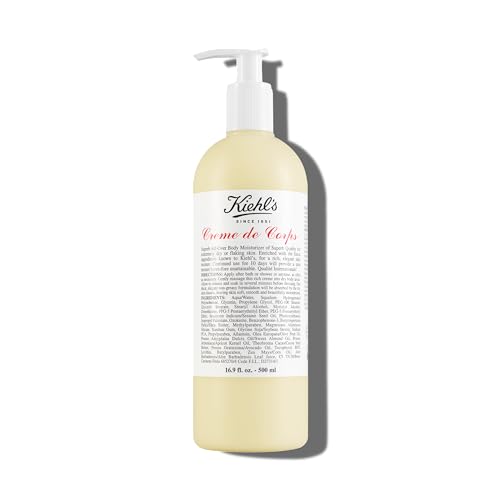


Kiehl's Since 1851 Creme de Corps Body Lotion with Cocoa Butter
At a glance
Summary
This body lotion contains several beneficial ingredients such as glycerin, squalane, shea butter, and various natural oils that provide moisturizing and nourishing properties. However, the presence of phenoxyethanol, a synthetic preservative that can cause irritation, and multiple PEG compounds, which are synthetic emulsifiers, slightly detract from its overall safety profile. The product is moderately processed, which also influences its rating.
Key ingredients 38
SqualaneVery Good
Squalane is a highly effective emollient and natural antioxidant. It mimics the skin's natural oils, making it an excellent moisturizer. It is non-comedogenic and suitable for all skin types.
Risks
There are no significant risks associated with squalane.
Benefits
It helps to hydrate the skin, improve elasticity, and reduce the appearance of fine lines.
Butyrospermum Parkii ButterVery Good
Butyrospermum Parkii Butter, or shea butter, is a natural fat extracted from the nuts of the shea tree. It is known for its rich moisturizing and anti-inflammatory properties. It is widely used in skincare for its ability to soothe and hydrate the skin.
Risks
There are no significant risks associated with shea butter.
Benefits
It helps to deeply moisturize the skin and improve its elasticity.
Olea Europaea Fruit OilVery Good
Olea Europaea Fruit Oil, or olive oil, is a natural emollient rich in antioxidants and vitamins. It is known for its moisturizing and nourishing properties. It is suitable for all skin types and helps to improve skin health.
Risks
There are minimal risks associated with this ingredient.
Benefits
It helps to hydrate and protect the skin, improving its overall texture and appearance.
Theobroma Cacao Seed ButterVery Good
Theobroma Cacao Seed Butter, or cocoa butter, is a natural fat extracted from cocoa beans. It is known for its rich moisturizing and antioxidant properties. It is widely used in skincare for its ability to hydrate and protect the skin.
Risks
There are no significant risks associated with cocoa butter.
Benefits
It helps to deeply moisturize the skin and improve its elasticity.
Persea Gratissima OilVery Good
Persea Gratissima Oil, or avocado oil, is a natural emollient rich in vitamins and fatty acids. It is known for its moisturizing and nourishing properties. It is suitable for all skin types and helps to improve skin health.
Risks
There are minimal risks associated with this ingredient.
Benefits
It helps to hydrate and protect the skin, improving its overall texture and appearance.
TocopherolVery Good
Tocopherol, or Vitamin E, is a powerful antioxidant that helps to protect the skin from free radical damage. It is widely used in skincare for its moisturizing and anti-aging properties. It helps to improve skin texture and appearance.
Risks
There are no significant risks associated with tocopherol.
Benefits
It helps to protect the skin from environmental damage and improve its overall health.
Aloe Barbadensis Leaf Juice PowderVery Good
Aloe Barbadensis Leaf Juice Powder is derived from aloe vera and known for its soothing and hydrating properties. It is widely used in skincare for its ability to calm and moisturize the skin. It is suitable for all skin types.
Risks
There are no significant risks associated with aloe vera.
Benefits
It helps to soothe and hydrate the skin, promoting a healthy appearance.
GlycerinGood
Glycerin is a well-known humectant that attracts moisture to the skin. It is widely used in skincare for its hydrating properties. It helps to maintain the skin's moisture balance.
Risks
There are no significant risks associated with glycerin.
Benefits
Glycerin helps to keep the skin hydrated and soft, improving its overall texture.
Coco-Caprylate/CaprateGood
Coco-Caprylate/Caprate is a natural emollient derived from coconut oil. It provides a silky, smooth feel to the skin. It is often used as a natural alternative to silicones.
Risks
There are minimal risks associated with this ingredient.
Benefits
It enhances the skin's moisture retention and provides a smooth application.
Helianthus Annuus Seed OilGood
Helianthus Annuus Seed Oil, or sunflower seed oil, is a natural emollient rich in vitamins A, D, and E. It is known for its moisturizing and skin-protecting properties. It is suitable for all skin types.
Risks
There are minimal risks associated with this ingredient.
Benefits
It helps to nourish and protect the skin, improving its overall health.
Sesamum Indicum Seed OilGood
Sesamum Indicum Seed Oil, or sesame seed oil, is a natural emollient rich in antioxidants and fatty acids. It is known for its moisturizing and skin-protecting properties. It is suitable for all skin types.
Risks
There are minimal risks associated with this ingredient.
Benefits
It helps to nourish and protect the skin, improving its overall health.
Sodium PCAGood
Sodium PCA is a natural humectant derived from amino acids. It helps to attract moisture to the skin and improve hydration. It is widely used in skincare for its moisturizing properties.
Risks
There are minimal risks associated with this ingredient.
Benefits
It helps to keep the skin hydrated and improve its overall texture.
AllantoinGood
Allantoin is a skin-soothing agent known for its ability to promote skin healing. It helps to reduce irritation and improve skin texture. It is widely used in skincare for its calming properties.
Risks
There are minimal risks associated with this ingredient.
Benefits
It helps to soothe and protect the skin, promoting a healthy appearance.
Prunus Amygdalus Dulcis OilGood
Prunus Amygdalus Dulcis Oil, or sweet almond oil, is a natural emollient rich in vitamins and fatty acids. It is known for its moisturizing and nourishing properties. It is suitable for all skin types.
Risks
There are minimal risks associated with this ingredient.
Benefits
It helps to nourish and protect the skin, improving its overall health.
Prunus Armeniaca Kernel OilGood
Prunus Armeniaca Kernel Oil, or apricot kernel oil, is a natural emollient rich in vitamins and fatty acids. It is known for its moisturizing and nourishing properties. It is suitable for all skin types.
Risks
There are minimal risks associated with this ingredient.
Benefits
It helps to nourish and protect the skin, improving its overall health.
WaterNeutral
Water is a common solvent used in cosmetics to dissolve other ingredients. It helps in the application and absorption of the product. It does not provide direct benefits or risks.
Risks
There are no significant risks associated with water in cosmetics.
Benefits
Water helps in hydrating the skin by allowing other moisturizing ingredients to penetrate better.
Hydrogenated PolyisobuteneNeutral
Hydrogenated Polyisobutene is a synthetic emollient used to provide a smooth application. It is often used as a substitute for mineral oil. It is generally considered safe for use in cosmetics.
Risks
There are minimal risks associated with this ingredient, though it is synthetic.
Benefits
It provides a non-greasy feel and helps to lock in moisture on the skin.
PEG-100 StearateNeutral
PEG-100 Stearate is an emulsifier that helps to blend water and oil components. It is commonly used in lotions and creams. It is generally considered safe for use in cosmetics.
Risks
There is a potential risk of contamination with 1,4-dioxane, a byproduct of ethoxylation.
Benefits
It helps to stabilize the formulation and improve the texture of the product.
Glyceryl StearateNeutral
Standard formulation ingredient — neither beneficial nor harmful at typical use.
Risks
There are minimal risks associated with this ingredient.
Benefits
It helps to maintain the skin's moisture balance and improve the texture of the product.
Stearyl AlcoholNeutral
Stearyl Alcohol is a fatty alcohol used as an emollient and thickener. It helps to stabilize and thicken formulations. It is generally considered safe for use in cosmetics.
Risks
There are minimal risks associated with this ingredient.
Benefits
It provides a smooth texture and helps to soften the skin.
Myristyl AlcoholNeutral
Myristyl Alcohol is a fatty alcohol used as an emollient and thickener. It helps to stabilize and thicken formulations. It is generally considered safe for use in cosmetics.
Risks
There are minimal risks associated with this ingredient.
Benefits
It provides a smooth texture and helps to soften the skin.
PPG-5 Pentaerythrityl EtherNeutral
PPG-5 Pentaerythrityl Ether is a synthetic polymer used as an emollient and conditioning agent. It helps to improve the texture and feel of the product. It is generally considered safe for use in cosmetics.
Risks
There are minimal risks associated with this ingredient.
Benefits
It provides a smooth application and helps to condition the skin.
PEG-5 Pentaerythrityl EtherNeutral
PEG-5 Pentaerythrityl Ether is a synthetic polymer used as an emulsifier and conditioning agent. It helps to blend water and oil components in formulations. It is generally considered safe for use in cosmetics.
Risks
There is a potential risk of contamination with 1,4-dioxane, a byproduct of ethoxylation.
Benefits
It helps to stabilize the formulation and improve the texture of the product.
Isopropyl PalmitateNeutral
Isopropyl Palmitate is an ester of isopropyl alcohol and palmitic acid used as an emollient. It provides a smooth application and helps to soften the skin. It is generally considered safe for use in cosmetics.
Risks
There are minimal risks associated with this ingredient.
Benefits
It helps to improve the texture of the product and enhance skin softness.
Citric AcidNeutral
Citric Acid is a natural acid used to adjust the pH of cosmetic formulations. It is also used as a preservative and antioxidant. It is generally considered safe for use in cosmetics.
Risks
In high concentrations, it may cause irritation in sensitive skin.
Benefits
It helps to maintain the stability of the product and improve its shelf life.
Cera MicrocristallinaNeutral
Cera Microcristallina, or microcrystalline wax, is used as a thickener and stabilizer in cosmetics. It helps to improve the texture and consistency of the product. It is generally considered safe for use in cosmetics.
Risks
There are minimal risks associated with this ingredient.
Benefits
It helps to stabilize the formulation and provide a smooth application.
Pentaerythrityl Tetra-Di-T-Butyl HydroxyhydrocinnamateNeutral
Pentaerythrityl Tetra-Di-T-Butyl Hydroxyhydrocinnamate is an antioxidant used to prevent the oxidation of ingredients. It helps to extend the shelf life of the product. It is generally considered safe for use in cosmetics.
Risks
There are minimal risks associated with this ingredient.
Benefits
It helps to protect the product from degradation and maintain its efficacy.
ChlorphenesinNeutral
Chlorphenesin is a preservative used to prevent microbial growth in cosmetics. It is effective against bacteria and fungi. It is generally considered safe for use in cosmetics.
Risks
In rare cases, it may cause irritation or allergic reactions.
Benefits
It helps to preserve the product and extend its shelf life.
Glycine Soja SterolsNeutral
Glycine Soja Sterols are derived from soybean oil and used as an emollient and skin conditioning agent. They help to improve the texture and feel of the product. They are generally considered safe for use in cosmetics.
Risks
There are minimal risks associated with this ingredient.
Benefits
They help to condition the skin and improve its overall texture.
ArgillaNeutral
Argilla, or clay, is used as a thickening agent and absorbent in cosmetics. It helps to improve the texture and consistency of the product. It is generally considered safe for use in cosmetics.
Risks
There are minimal risks associated with this ingredient.
Benefits
It helps to stabilize the formulation and provide a smooth application.
Xanthan GumNeutral
Xanthan Gum is a natural thickening agent used to stabilize and thicken formulations. It helps to improve the texture and consistency of the product. It is generally considered safe for use in cosmetics.
Risks
There are minimal risks associated with this ingredient.
Benefits
It helps to stabilize the formulation and provide a smooth application.
Glycine Soja OilNeutral
Glycine Soja Oil, or soybean oil, is a natural emollient rich in fatty acids and vitamins. It is used for its moisturizing and skin-conditioning properties. It is generally considered safe for use in cosmetics.
Risks
There are minimal risks associated with this ingredient.
Benefits
It helps to nourish and protect the skin, improving its overall health.
CI 40800Neutral
CI 40800 is a colorant used to impart color to cosmetic products. It is generally considered safe for use in cosmetics. It does not provide direct benefits or risks to the skin.
Risks
There are minimal risks associated with this ingredient.
Benefits
It helps to provide a desired color to the product.
Propylene GlycolBad
Processed additive flagged under Scout's ingredient doctrine.
Risks
In rare cases, it may cause irritation in sensitive skin.
Benefits
It helps to keep the skin hydrated and enhances the absorption of other ingredients.
DimethiconeBad
Occlusive silicone film-former — flagged under clean-beauty doctrine.
Risks
There are minimal risks associated with this ingredient.
Benefits
It helps to create a barrier on the skin, preventing moisture loss and improving texture.
PhenoxyethanolBad
Phenoxyethanol is a synthetic preservative used to prevent microbial growth. It is commonly used as an alternative to parabens. However, it can cause irritation in some individuals, especially in high concentrations.
Risks
It may cause skin irritation or allergic reactions in sensitive individuals.
Benefits
It helps to preserve the product and extend its shelf life.
Potassium SorbateBad
Synthetic preservative — flagged in daily-use products.
Risks
In rare cases, it may cause irritation in sensitive skin.
Benefits
It helps to preserve the product and extend its shelf life.
LecithinBad
Processed additive flagged under Scout's ingredient doctrine.
Risks
There are minimal risks associated with this ingredient.
Benefits
It helps to improve the texture of the product and enhance skin softness.
Get the full breakdown in the Scout appTake Scout shopping
Scan any product to see lab results, healthy alternatives, and your personalized analysis.
Download on theApp Store GET IT ONGoogle PlayAmazon pricing & content
Amazon price as of . Product prices and availability are accurate as of the date/time indicated and are subject to change. Any price and availability information displayed on Amazon.com at the time of purchase will apply to the purchase of this product.
CERTAIN CONTENT THAT APPEARS ON THIS SITE COMES FROM AMAZON. THIS CONTENT IS PROVIDED “AS IS” AND IS SUBJECT TO CHANGE OR REMOVAL AT ANY TIME.