
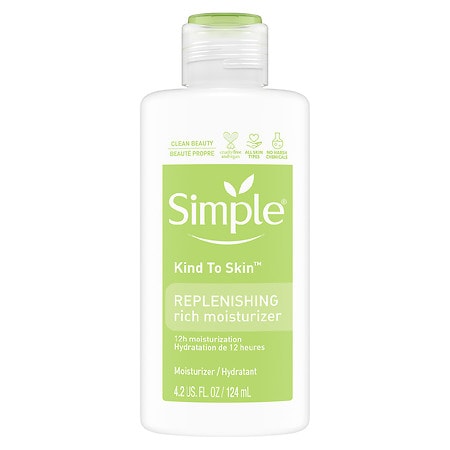


Simple Kind to Skin Face Moisturizer Replenishing Rich 12-Hour Moisturization for All Skin Types 4.2 fl oz
Analysis updated September 2026 · How Scout scores
At a glance
Summary
This moisturizer contains beneficial ingredients like glycerin, niacinamide, and panthenol, which are known for their hydrating and soothing properties. However, the presence of potentially harmful ingredients such as ethylhexyl methoxycinnamate, polyacrylamide, and BHT raises concerns due to their associations with endocrine disruption and potential carcinogenicity. The product's formulation includes a mix of natural and synthetic components, leading to a moderate processing level.
Key ingredients 30
PanthenolVery Good
Panthenol, also known as Provitamin B5, is a moisturizing agent that helps improve skin hydration and elasticity. It is well-tolerated and beneficial for most skin types. It is commonly used in skincare for its soothing and moisturizing properties.
Risks
There are minimal risks; it is generally well-tolerated.
Benefits
Panthenol helps soothe and moisturize the skin, promoting healing and softness.
GlycerinGood
Glycerin is a humectant that attracts moisture to the skin, helping to keep it hydrated. It is widely used in skincare for its moisturizing properties. It is considered safe and beneficial for most skin types.
Risks
There are minimal risks associated with glycerin; it is generally well-tolerated.
Benefits
Glycerin helps maintain skin hydration and improves skin barrier function.
Coco-Caprylate/CaprateGood
Coco-Caprylate/Caprate is an emollient derived from coconut oil and caprylic acid. It provides a lightweight, silky feel to the skin. It is considered safe and beneficial for skin conditioning.
Risks
There are minimal risks; it is generally non-irritating.
Benefits
It enhances skin softness and smoothness without leaving a greasy residue.
NiacinamideGood
Niacinamide is a form of Vitamin B3 that offers multiple skin benefits, including improving skin barrier function and reducing inflammation. It is well-tolerated by most skin types. It is a popular ingredient in skincare for its versatility and effectiveness.
Risks
There are minimal risks; it is generally well-tolerated.
Benefits
Niacinamide helps improve skin texture, reduce redness, and enhance overall skin health.
Tocopheryl AcetateGood
Tocopheryl Acetate is a form of Vitamin E that acts as an antioxidant in cosmetics. It helps protect the skin from free radical damage. It is considered beneficial for skin health.
Risks
There are minimal risks; it is generally well-tolerated.
Benefits
It helps protect the skin from oxidative stress and supports skin health.
BisabololGood
Bisabolol is a natural compound derived from chamomile that has soothing and anti-inflammatory properties. It is beneficial for calming irritated skin. It is considered safe and effective for sensitive skin.
Risks
There are minimal risks; it is generally well-tolerated.
Benefits
It helps soothe and calm the skin, reducing redness and irritation.
UreaGood
Urea is a humectant and keratolytic agent that helps improve skin hydration and exfoliation. It is beneficial for softening and smoothing the skin. It is considered safe and effective for most skin types.
Risks
There are minimal risks; it is generally well-tolerated.
Benefits
It helps hydrate and exfoliate the skin, improving texture and softness.
AllantoinGood
Allantoin is a soothing and moisturizing agent used in cosmetics. It is beneficial for calming irritated skin and promoting healing. It is considered safe and effective for most skin types.
Risks
There are minimal risks; it is generally well-tolerated.
Benefits
It helps soothe and moisturize the skin, promoting healing and softness.
Water (Eau)Neutral
Water is a common solvent used in cosmetics to dissolve other ingredients. It helps in the application and absorption of the product. It does not provide direct benefits or risks.
Risks
There are no significant risks associated with water in cosmetics.
Benefits
Water helps in hydrating the skin by acting as a vehicle for other moisturizing ingredients.
Polyglyceryl-3 Methylglucose DistearateNeutral
This ingredient is an emulsifier that helps blend oil and water components in formulations. It is derived from natural sources and is considered safe. It does not provide direct skin benefits.
Risks
There are no significant risks associated with this ingredient.
Benefits
It helps stabilize the formulation, ensuring consistent texture and performance.
Stearyl AlcoholNeutral
Stearyl Alcohol is a fatty alcohol used as an emollient and thickener in cosmetics. It is derived from natural sources and is considered safe. It does not provide direct skin benefits.
Risks
There are no significant risks associated with this ingredient.
Benefits
It helps improve the texture and consistency of the product.
Butyl MethoxydibenzoylmethaneNeutral
Butyl Methoxydibenzoylmethane is a chemical sunscreen agent that absorbs UVA radiation. It is commonly used in sunscreens for broad-spectrum protection. It is effective in protecting the skin from UVA damage.
Risks
Potential risks include skin irritation in sensitive individuals.
Benefits
It provides protection against UVA rays, reducing the risk of skin aging and damage.
Stearic AcidNeutral
Stearic Acid is a fatty acid used as an emulsifier and thickener in cosmetics. It is derived from natural sources and is considered safe. It does not provide direct skin benefits.
Risks
There are no significant risks associated with this ingredient.
Benefits
It helps stabilize the formulation and improve texture.
Caprylyl GlycolNeutral
Caprylyl Glycol is a skin conditioning agent and preservative booster. It is derived from natural sources and is considered safe. It does not provide direct skin benefits.
Risks
There are no significant risks associated with this ingredient.
Benefits
It helps improve skin hydration and enhances the efficacy of preservatives.
C13-14 IsoalkaneNeutral
C13-14 Isoalkane is an emollient used to improve the texture and spreadability of cosmetics. It is considered safe for use in cosmetics. It does not provide direct skin benefits.
Risks
There are no significant risks associated with this ingredient.
Benefits
It helps improve the texture and application of the product.
Laureth-7Neutral
Laureth-7 is a surfactant and emulsifier used in cosmetics to improve texture and stability. It is considered safe for use in cosmetics. It does not provide direct skin benefits.
Risks
There are no significant risks associated with this ingredient.
Benefits
It helps stabilize the formulation and improve texture.
Sodium HydroxideNeutral
Sodium Hydroxide is used to adjust the pH of cosmetics. It is used in very low concentrations and is considered safe. It does not provide direct skin benefits.
Risks
There are no significant risks when used in low concentrations.
Benefits
It helps maintain the desired pH level of the product.
PantolactoneNeutral
Pantolactone is a humectant and conditioning agent used in cosmetics. It is considered safe for use in cosmetics. It does not provide direct skin benefits.
Risks
There are no significant risks associated with this ingredient.
Benefits
It helps improve skin hydration and texture.
Citric AcidNeutral
Citric Acid is used to adjust the pH of cosmetics and as a mild exfoliant. It is considered safe for use in cosmetics. It does not provide direct skin benefits.
Risks
There are no significant risks when used in low concentrations.
Benefits
It helps maintain the desired pH level of the product.
Pentylene GlycolNeutral
Pentylene Glycol is a humectant and solvent used in cosmetics to improve texture and hydration. It is considered safe for use in cosmetics. It does not provide direct skin benefits.
Risks
There are no significant risks associated with this ingredient.
Benefits
It helps improve skin hydration and enhances the texture of the product.
Lactic AcidNeutral
Standard formulation ingredient — neither beneficial nor harmful at typical use.
Risks
Potential risks include skin irritation if used in high concentrations.
Benefits
It helps exfoliate the skin, improving texture and hydration.
SerineNeutral
Serine is an amino acid used as a conditioning agent in cosmetics. It is considered safe for use in cosmetics. It does not provide direct skin benefits.
Risks
There are no significant risks associated with this ingredient.
Benefits
It helps improve skin texture and hydration.
Sodium LactateNeutral
Sodium Lactate is a humectant and pH regulator used in cosmetics. It is considered safe for use in cosmetics. It does not provide direct skin benefits.
Risks
There are no significant risks associated with this ingredient.
Benefits
It helps improve skin hydration and maintain product stability.
SorbitolNeutral
Sorbitol is a humectant used in cosmetics to improve hydration and texture. It is considered safe for use in cosmetics. It does not provide direct skin benefits.
Risks
There are no significant risks associated with this ingredient.
Benefits
It helps improve skin hydration and enhances the texture of the product.
Sodium ChlorideNeutral
Sodium Chloride is used as a thickener and stabilizer in cosmetics. It is considered safe for use in cosmetics. It does not provide direct skin benefits.
Risks
There are no significant risks associated with this ingredient.
Benefits
It helps improve the texture and stability of the product.
PhenoxyethanolBad
Processed additive flagged under Scout's ingredient doctrine.
Risks
Potential risks include skin irritation in sensitive individuals.
Benefits
It helps maintain product integrity by preventing microbial contamination.
Disodium EDTABad
Processed additive flagged under Scout's ingredient doctrine.
Risks
There are no significant risks associated with this ingredient.
Benefits
It helps maintain product stability and efficacy by binding metal ions.
BHTBad
BHT is a synthetic antioxidant used to prevent product spoilage. It has been associated with potential health concerns, including endocrine disruption. Its use in cosmetics is controversial due to safety concerns.
Risks
Potential risks include endocrine disruption and skin irritation.
Benefits
It helps extend the shelf life of the product by preventing oxidation.
Ethylhexyl MethoxycinnamateVery Bad
Ethylhexyl Methoxycinnamate is a chemical sunscreen agent that absorbs UVB radiation. It is commonly used in sunscreens but has been associated with potential endocrine disruption. It is effective in protecting the skin from UV damage.
Risks
Potential risks include hormonal disruption and skin irritation in sensitive individuals.
Benefits
It provides protection against UVB rays, reducing the risk of sunburn and skin damage.
PolyacrylamideVery Bad
Polyacrylamide is a synthetic polymer used as a thickener and stabilizer in cosmetics. It can break down into acrylamide, a potential carcinogen. Its use in cosmetics is controversial due to safety concerns.
Risks
Potential risks include exposure to acrylamide, which is a known carcinogen.
Benefits
It helps improve the texture and stability of the product.
Get the full breakdown in the Scout appTake Scout shopping
Scan any product to see lab results, healthy alternatives, and your personalized analysis.
Download on theApp Store GET IT ONGoogle PlayAmazon pricing & content
Amazon price as of . Product prices and availability are accurate as of the date/time indicated and are subject to change. Any price and availability information displayed on Amazon.com at the time of purchase will apply to the purchase of this product.
CERTAIN CONTENT THAT APPEARS ON THIS SITE COMES FROM AMAZON. THIS CONTENT IS PROVIDED “AS IS” AND IS SUBJECT TO CHANGE OR REMOVAL AT ANY TIME.