
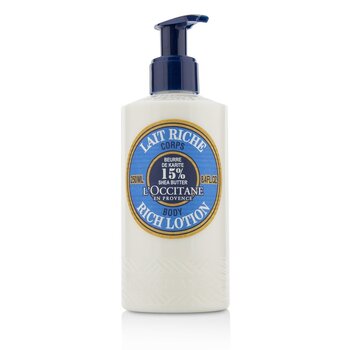


L'OccitaneShea Butter Rich Body Lotion(Random Packaging) 250ml/8.4oz
Analysis updated August 2026 · How Scout scores
At a glance
Summary
This body lotion contains beneficial ingredients like shea butter, sunflower seed oil, and calendula extract, which are known for their moisturizing and soothing properties. However, the presence of alcohol, synthetic fragrance, and several fragrance allergens such as linalool and limonene can cause skin irritation and allergic reactions. The product's processing level and inclusion of these potentially irritating ingredients prevent it from achieving a higher score.
Key ingredients 33
Butyrospermum Parkii (Shea) ButterVery Good
Shea butter is a natural fat extracted from the nuts of the shea tree, known for its moisturizing properties. It is rich in vitamins and fatty acids, making it an excellent emollient.
Risks
Rarely, individuals may experience allergic reactions.
Benefits
Deeply moisturizes and nourishes the skin, improving elasticity and reducing inflammation.
Helianthus Annuus (Sunflower) Seed OilVery Good
Sunflower seed oil is a non-comedogenic carrier oil that is highly absorbent and won't clog pores. It is rich in vitamins A, D, and E.
Risks
Minimal risk of allergic reactions.
Benefits
Helps retain moisture in the skin and provides antioxidant protection.
Calendula Officinalis Flower ExtractVery Good
Calendula extract is known for its anti-inflammatory and healing properties. It is often used in skincare for its soothing effects.
Risks
Rare allergic reactions in sensitive individuals.
Benefits
Reduces skin irritation and promotes healing.
Mel Extract/Honey ExtractVery Good
Honey extract is a natural humectant that attracts moisture to the skin. It also has antimicrobial properties.
Risks
Potential for allergic reactions in sensitive individuals.
Benefits
Hydrates the skin and provides antibacterial benefits.
Jojoba EstersVery Good
Jojoba esters are derived from jojoba oil and are used for their emollient properties. They mimic the skin's natural oils.
Risks
Generally safe with no significant risks.
Benefits
Moisturizes and balances the skin's oil production.
TocopherolVery Good
Tocopherol, or Vitamin E, is a powerful antioxidant that protects the skin from free radical damage. It is widely used in skincare for its protective benefits.
Risks
Generally safe with no significant risks.
Benefits
Protects the skin from oxidative stress and improves skin health.
GlycerinGood
Glycerin is a humectant that attracts moisture to the skin, keeping it hydrated. It is a common ingredient in skincare due to its effectiveness and safety.
Risks
Generally safe with no significant risks.
Benefits
Improves skin hydration and barrier function.
Coco-Caprylate/CaprateGood
Coco-Caprylate/Caprate is an emollient derived from coconut oil and caprylic acid. It provides a silky feel to the skin.
Risks
Low risk of irritation or allergic reaction.
Benefits
Enhances skin softness and smoothness.
Olus Oil/Vegetable OilGood
Vegetable oil is a generic term for oils derived from plants. It is used for its emollient properties.
Risks
Potential for oxidation if not stored properly.
Benefits
Moisturizes and nourishes the skin.
Linum Usitatissimum (Linseed) Seed ExtractGood
Linseed extract is rich in omega-3 fatty acids and antioxidants. It is used for its moisturizing and anti-inflammatory properties.
Risks
Minimal risk of allergic reactions.
Benefits
Improves skin hydration and reduces inflammation.
Althaea Officinalis Root ExtractGood
Marshmallow root extract is known for its soothing and anti-inflammatory properties. It is often used to calm irritated skin.
Risks
Low risk of allergic reactions.
Benefits
Soothes and calms irritated skin.
Prunus Amygdalus Dulcis (Sweet Almond) Fruit ExtractGood
Sweet almond extract is rich in vitamins and fatty acids, providing nourishing and moisturizing benefits to the skin.
Risks
Rare allergic reactions in individuals with nut allergies.
Benefits
Nourishes and softens the skin.
Polyglyceryl-3 BeeswaxGood
Polyglyceryl-3 Beeswax is an emulsifier derived from beeswax. It helps stabilize formulations and provides a creamy texture.
Risks
Minimal risk of allergic reactions.
Benefits
Enhances product texture and stability.
UreaGood
Urea is a humectant that helps retain moisture in the skin. It also has keratolytic properties, aiding in exfoliation.
Risks
Low risk of irritation in sensitive individuals.
Benefits
Hydrates the skin and improves texture by promoting exfoliation.
Aqua/WaterNeutral
Water is a common solvent used in cosmetics to dissolve other ingredients. It does not provide direct benefits or risks in skincare products.
Benefits
Acts as a base for the formulation, allowing other ingredients to be evenly distributed.
Polyglyceryl-6 DistearateNeutral
Polyglyceryl-6 Distearate is an emulsifier that helps blend oil and water-based ingredients. It is considered safe for use in cosmetics.
Benefits
Stabilizes formulations and improves texture.
Cetyl PalmitateNeutral
Cetyl Palmitate is an ester of cetyl alcohol and palmitic acid, used as an emollient and thickening agent. It is generally considered safe.
Risks
Low risk of skin irritation.
Benefits
Provides a smooth, soft feel to the skin.
Caprylyl GlycolNeutral
Caprylyl glycol is a skin-conditioning agent that also acts as a preservative. It is considered safe for use in cosmetics.
Risks
Low risk of skin irritation.
Benefits
Improves skin texture and extends product shelf life.
Cetyl AlcoholNeutral
Cetyl alcohol is a fatty alcohol used as an emollient and thickener. It is not drying like other alcohols.
Risks
Low risk of skin irritation.
Benefits
Softens and smooths the skin.
Xanthan GumNeutral
Xanthan gum is a natural thickening agent used to stabilize emulsions. It is widely used in cosmetics and food products.
Benefits
Improves product consistency and texture.
Sodium Stearoyl GlutamateNeutral
Sodium stearoyl glutamate is an emulsifier derived from plant sources. It is considered safe for use in cosmetics.
Risks
Low risk of skin irritation.
Benefits
Stabilizes emulsions and improves product texture.
Sodium PolyacrylateNeutral
Sodium polyacrylate is a thickening agent and film-former. It is used to enhance the texture and stability of products.
Risks
Potential for microplastic pollution.
Benefits
Improves product texture and provides a smooth application.
Butylene GlycolNeutral
Butylene glycol is a solvent and conditioning agent. It helps improve the texture and spreadability of products.
Risks
Low risk of skin irritation.
Benefits
Enhances product absorption and texture.
Citric AcidNeutral
Citric acid is used to adjust the pH of formulations. It is also an alpha hydroxy acid that can provide mild exfoliation.
Risks
Potential for irritation if used in high concentrations.
Benefits
Balances product pH and can improve skin texture.
AlcoholNeutral
Standard formulation ingredient — neither beneficial nor harmful at typical use.
Risks
Can cause dryness and irritation, particularly for sensitive skin.
Benefits
Acts as a preservative and enhances product penetration.
ChlorphenesinBad
Chlorphenesin is a preservative used to prevent microbial growth. It can cause irritation and allergic reactions in some individuals.
Risks
Potential for skin irritation and allergic reactions.
Benefits
Prevents microbial contamination, extending product shelf life.
LinaloolBad
Linalool is a fragrance component that can cause allergic reactions and skin irritation. It is a common allergen in cosmetics.
Risks
Potential for skin irritation and allergic reactions.
Benefits
Contributes to the fragrance profile of the product.
CoumarinBad
Coumarin is a fragrance ingredient that can cause allergic reactions. It is a known sensitizer in cosmetics.
Risks
High risk of skin sensitization and allergic reactions.
Benefits
Adds a sweet scent to the product.
CitronellolBad
Citronellol is a fragrance ingredient that can cause allergic reactions and skin irritation. It is a common allergen in cosmetics.
Risks
Potential for skin irritation and allergic reactions.
Benefits
Provides a floral scent to the product.
Alpha-Isomethyl IononeBad
Alpha-Isomethyl Ionone is a fragrance ingredient that can cause allergic reactions. It is a known sensitizer in cosmetics.
Risks
High risk of skin sensitization and allergic reactions.
Benefits
Contributes to the fragrance profile of the product.
LimoneneBad
Limonene is a fragrance component that can oxidize and cause skin irritation and allergic reactions. It is a common allergen in cosmetics.
Risks
Potential for skin irritation and allergic reactions.
Benefits
Adds a citrus scent to the product.
GeraniolBad
Geraniol is a fragrance ingredient that can cause allergic reactions and skin irritation. It is a known sensitizer in cosmetics.
Risks
High risk of skin sensitization and allergic reactions.
Benefits
Provides a rose-like scent to the product.
Parfum/FragranceVery Bad
Fragrance is a common cause of allergic reactions and skin irritation. It is often a mixture of various chemicals, some of which can be sensitizing.
Risks
High risk of skin irritation and allergic reactions.
Benefits
Provides a pleasant scent to the product.
Get the full breakdown in the Scout appTake Scout shopping
Scan any product to see lab results, healthy alternatives, and your personalized analysis.
Download on theApp Store GET IT ONGoogle Play