
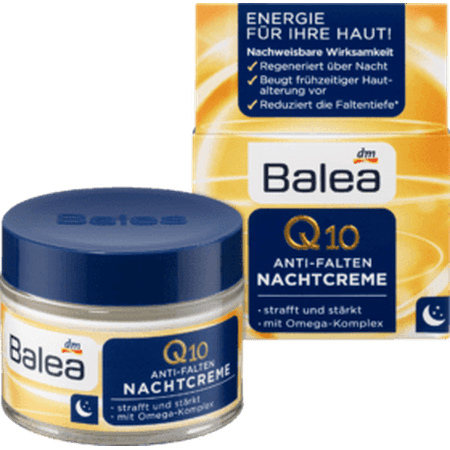

Balea Night cream Q10 anti-wrinkle, 50 ml, German Product
Analysis updated September 2026 · How Scout scores
At a glance
Summary
This moisturizer contains beneficial ingredients like natural oils and antioxidants, which provide nourishment and hydration to the skin. However, the presence of phenoxyethanol and parfum, which can cause irritation and sensitivity, slightly detracts from its overall safety profile. The product is moderately processed, with a mix of natural and synthetic components, resulting in a balanced score.
Key ingredients 35
Caprylic/Capric TriglycerideVery Good
This ingredient is derived from coconut oil and glycerin, providing excellent skin conditioning properties. It is lightweight and non-greasy, making it suitable for all skin types. It helps to replenish the skin's surface and resist moisture loss.
Risks
Rarely, it may cause mild irritation in sensitive individuals.
Benefits
It enhances the skin's barrier function and provides a silky feel.
Sesamum Indicum Seed OilVery Good
Sesame seed oil is rich in antioxidants and essential fatty acids, providing nourishment and hydration to the skin. It has anti-inflammatory properties and can help soothe irritated skin. It is a natural oil that is well-tolerated by most skin types.
Risks
Rarely, it may cause allergic reactions in sensitive individuals.
Benefits
It nourishes the skin and provides antioxidant protection.
Carthamus Tinctorius Seed OilVery Good
Safflower seed oil is rich in linoleic acid, which helps to maintain the skin's barrier and prevent moisture loss. It is a natural oil that provides nourishment and hydration. It is suitable for all skin types and is non-comedogenic.
Risks
Rarely, it may cause allergic reactions in sensitive individuals.
Benefits
It hydrates and nourishes the skin, improving its texture.
Cera AlbaVery Good
Beeswax is a natural wax that provides a protective barrier on the skin, helping to lock in moisture. It has emollient properties and can soothe and soften the skin. It is well-tolerated by most skin types.
Risks
It may cause allergic reactions in individuals sensitive to bee products.
Benefits
It provides a protective barrier and enhances skin hydration.
PanthenolVery Good
Panthenol, also known as provitamin B5, is a humectant that attracts moisture to the skin. It has soothing and anti-inflammatory properties, making it beneficial for sensitive skin. It helps to improve skin hydration and elasticity.
Risks
There are minimal risks associated with panthenol.
Benefits
It hydrates and soothes the skin, improving its texture.
Ascorbyl TetraisopalmitateVery Good
Ascorbyl Tetraisopalmitate is a stable form of Vitamin C, known for its antioxidant properties. It helps to brighten the skin and reduce signs of aging. It is well-tolerated by most skin types and provides long-lasting benefits.
Risks
There are minimal risks associated with this ingredient.
Benefits
It brightens the skin and provides antioxidant protection.
UbiquinoneVery Good
Ubiquinone, also known as Coenzyme Q10, is an antioxidant that helps protect the skin from free radical damage. It can improve skin elasticity and reduce the appearance of fine lines. It is well-tolerated by most skin types.
Risks
There are minimal risks associated with this ingredient.
Benefits
It provides antioxidant protection and improves skin elasticity.
TocopherolVery Good
Tocopherol, or Vitamin E, is a powerful antioxidant that helps protect the skin from free radical damage. It has moisturizing properties and can improve skin texture. It is widely used in skincare for its protective benefits.
Risks
In rare cases, it may cause skin irritation.
Benefits
It provides antioxidant protection and improves skin hydration.
GlycerinGood
Glycerin is a humectant that attracts moisture to the skin, helping to keep it hydrated. It is widely used in skincare for its moisturizing properties. It can improve skin smoothness and suppleness.
Risks
In very high concentrations, it may cause irritation.
Benefits
It effectively hydrates the skin and improves its resilience.
Tocopheryl AcetateGood
Tocopheryl Acetate is a form of Vitamin E, an antioxidant that helps protect the skin from free radical damage. It has moisturizing properties and can improve skin texture. It is widely used in skincare for its protective benefits.
Risks
In rare cases, it may cause skin irritation.
Benefits
It provides antioxidant protection and improves skin hydration.
UreaGood
Urea is a humectant that helps to attract moisture to the skin, improving hydration. It has keratolytic properties, helping to exfoliate and soften the skin. It is well-tolerated by most skin types.
Risks
In high concentrations, it may cause irritation.
Benefits
It hydrates and exfoliates the skin, improving its texture.
Ascorbyl PalmitateGood
Ascorbyl Palmitate is a stable form of Vitamin C, known for its antioxidant properties. It helps to protect the skin from free radical damage and improve skin texture. It is well-tolerated by most skin types.
Risks
There are minimal risks associated with this ingredient.
Benefits
It provides antioxidant protection and improves skin texture.
AquaNeutral
Aqua is commonly used as a solvent in cosmetic formulations. It helps dissolve other ingredients and provides a base for the cream. It is generally considered safe and non-irritating.
Risks
There are no significant risks associated with water in cosmetics.
Benefits
It acts as a carrier for other ingredients, ensuring even distribution.
Cetearyl IsononanoateNeutral
Cetearyl Isononanoate is an emollient that provides a smooth application and a soft feel. It is used to improve the texture of cosmetic products. It is generally considered safe for use in cosmetics.
Risks
There are minimal risks associated with this ingredient.
Benefits
It enhances the spreadability and feel of the product.
OctyldodecanolNeutral
Octyldodecanol is a fatty alcohol used as an emollient and emulsifier. It helps to improve the texture and stability of cosmetic formulations. It is considered safe for use in cosmetics.
Risks
It may cause mild irritation in sensitive skin types.
Benefits
It provides a smooth application and helps to retain moisture.
Polyglyceryl-2 DipolyhydroxystearateNeutral
This ingredient is an emulsifier that helps to blend oil and water-based components. It is derived from natural sources and is biodegradable. It is generally considered safe for use in cosmetics.
Risks
There are no significant risks associated with this ingredient.
Benefits
It stabilizes formulations and improves texture.
Hydrogenated Castor OilNeutral
Standard formulation ingredient — neither beneficial nor harmful at typical use.
Risks
It may cause mild irritation in some individuals.
Benefits
It enhances skin hydration and provides a smooth texture.
Glyceryl OleateNeutral
Glyceryl Oleate is an emulsifier and emollient derived from natural oils. It helps to stabilize formulations and improve texture. It is generally considered safe for use in cosmetics.
Risks
There are minimal risks associated with this ingredient.
Benefits
It enhances the texture and stability of the product.
Hexylene GlycolNeutral
Hexylene Glycol is used as a solvent and viscosity agent in cosmetics. It helps to improve the texture and spreadability of formulations. It is generally considered safe for use in cosmetics.
Risks
It may cause mild irritation in sensitive individuals.
Benefits
It enhances the texture and application of the product.
Magnesium SulfateNeutral
Magnesium Sulfate, also known as Epsom salt, is used as a thickening agent in cosmetics. It can help to improve the texture and stability of formulations. It is generally considered safe for use in cosmetics.
Risks
There are minimal risks associated with this ingredient.
Benefits
It enhances the texture and stability of the product.
Caprylhydroxamic AcidNeutral
Caprylhydroxamic Acid is a preservative used to prevent microbial growth in cosmetics. It is effective at low concentrations and is considered a safer alternative to parabens. It is generally considered safe for use in cosmetics.
Risks
There are minimal risks associated with this ingredient.
Benefits
It helps to preserve the product and extend its shelf life.
MethylpropanediolNeutral
Methylpropanediol is used as a solvent and penetration enhancer in cosmetics. It helps to improve the texture and absorption of formulations. It is generally considered safe for use in cosmetics.
Risks
It may cause mild irritation in sensitive individuals.
Benefits
It enhances the texture and absorption of the product.
DextrinNeutral
Dextrin is used as a binding agent in cosmetics. It helps to improve the texture and stability of formulations. It is generally considered safe for use in cosmetics.
Risks
There are minimal risks associated with this ingredient.
Benefits
It enhances the texture and stability of the product.
SucroseNeutral
Sucrose is a sugar used as a humectant in cosmetics. It helps to attract moisture to the skin, improving hydration. It is generally considered safe for use in cosmetics.
Risks
There are minimal risks associated with this ingredient.
Benefits
It helps to hydrate the skin and improve its texture.
AlanineNeutral
Alanine is an amino acid used as a conditioning agent in cosmetics. It helps to improve the texture and feel of formulations. It is generally considered safe for use in cosmetics.
Risks
There are minimal risks associated with this ingredient.
Benefits
It enhances the texture and feel of the product.
Aspartic AcidNeutral
Aspartic Acid is an amino acid used as a conditioning agent in cosmetics. It helps to improve the texture and feel of formulations. It is generally considered safe for use in cosmetics.
Risks
There are minimal risks associated with this ingredient.
Benefits
It enhances the texture and feel of the product.
Glutamic AcidNeutral
Glutamic Acid is an amino acid used as a conditioning agent in cosmetics. It helps to improve the texture and feel of formulations. It is generally considered safe for use in cosmetics.
Risks
There are minimal risks associated with this ingredient.
Benefits
It enhances the texture and feel of the product.
Hexyl NicotinateNeutral
Hexyl Nicotinate is used as a skin-conditioning agent in cosmetics. It can improve blood circulation and provide a warming sensation. It is generally considered safe for use in cosmetics.
Risks
It may cause mild irritation or redness in sensitive individuals.
Benefits
It enhances skin conditioning and provides a warming effect.
Hydrogenated Palm Glycerides CitrateNeutral
This ingredient is used as an emulsifier and stabilizer in cosmetics. It helps to improve the texture and stability of formulations. It is generally considered safe for use in cosmetics.
Risks
There are minimal risks associated with this ingredient.
Benefits
It enhances the texture and stability of the product.
PhenoxyethanolBad
Phenoxyethanol is a preservative used to prevent microbial growth in cosmetics. It is effective at low concentrations but can cause irritation in some individuals. It is considered safe in concentrations up to 1% in cosmetics.
Risks
It may cause skin irritation and allergic reactions in sensitive individuals.
Benefits
It helps to preserve the product and extend its shelf life.
ParfumBad
Parfum, or fragrance, is used to impart scent to cosmetic products. It can contain a mixture of various chemicals, some of which may cause irritation or allergic reactions. It is often criticized for its potential to cause skin sensitivity.
Risks
It may cause skin irritation, allergic reactions, and sensitivity.
Benefits
It provides a pleasant scent to the product.
FructoseBad
Processed additive flagged under Scout's ingredient doctrine.
Risks
There are minimal risks associated with this ingredient.
Benefits
It helps to hydrate the skin and improve its texture.
GlucoseBad
Processed additive flagged under Scout's ingredient doctrine.
Risks
There are minimal risks associated with this ingredient.
Benefits
It helps to hydrate the skin and improve its texture.
LecithinBad
Processed additive flagged under Scout's ingredient doctrine.
Risks
There are minimal risks associated with this ingredient.
Benefits
It enhances the texture and stability of the product while providing moisture.
LinaloolBad
Processed additive flagged under Scout's ingredient doctrine.
Risks
It may cause skin irritation or allergic reactions in sensitive individuals.
Benefits
It provides a pleasant scent to the product.
Get the full breakdown in the Scout appTake Scout shopping
Scan any product to see lab results, healthy alternatives, and your personalized analysis.
Download on theApp Store GET IT ONGoogle PlayAmazon pricing & content
Amazon price as of . Product prices and availability are accurate as of the date/time indicated and are subject to change. Any price and availability information displayed on Amazon.com at the time of purchase will apply to the purchase of this product.
CERTAIN CONTENT THAT APPEARS ON THIS SITE COMES FROM AMAZON. THIS CONTENT IS PROVIDED “AS IS” AND IS SUBJECT TO CHANGE OR REMOVAL AT ANY TIME.