
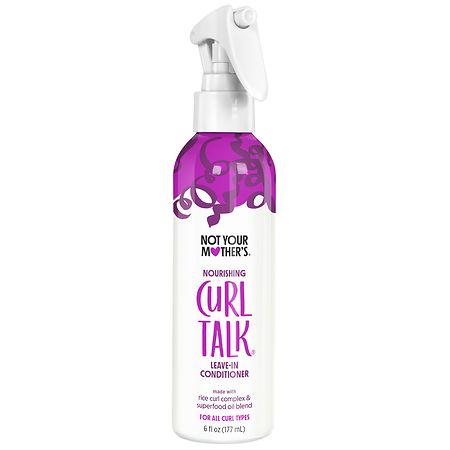
Not Your Mother's Curl Talk Leave-In Conditioner - 6 fl oz: Paraben-Free, Sulfate-Free, Citrus and Jasmine Scent, Liquid
Analysis updated August 2026 · How Scout scores
At a glance
Summary
This leave-in conditioner is free from sulfates and parabens, which is beneficial for hair health. It contains nourishing oils like avocado and marula, as well as conditioning agents like behentrimonium chloride, which help improve hair texture and moisture. However, the presence of synthetic fragrance and benzyl alcohol, which can cause irritation and dryness, slightly detracts from its overall safety and effectiveness.
Key ingredients 34
Persea Gratissima OilVery Good
Persea Gratissima Oil, also known as avocado oil, is rich in vitamins and fatty acids that nourish and condition the hair. It helps to improve hair elasticity and shine. It is considered a beneficial natural ingredient in hair care.
Risks
There are minimal risks associated with avocado oil, though it may cause mild irritation in rare cases.
Benefits
It deeply nourishes and conditions the hair, enhancing its softness and shine.
Sclerocarya Birrea Seed OilVery Good
Sclerocarya Birrea Seed Oil, commonly known as marula oil, is rich in antioxidants and fatty acids. It helps to moisturize and protect the hair from environmental damage. It is considered a highly beneficial ingredient in hair care.
Risks
There are minimal risks associated with marula oil, though it may cause mild irritation in rare cases.
Benefits
It provides deep hydration and protection, enhancing hair's overall health and appearance.
Mauritia Flexuosa Fruit OilVery Good
Mauritia Flexuosa Fruit Oil, also known as buriti oil, is rich in vitamins and fatty acids that nourish and protect the hair. It helps to improve hair elasticity and shine. It is considered a beneficial natural ingredient in hair care.
Risks
There are minimal risks associated with buriti oil, though it may cause mild irritation in rare cases.
Benefits
It deeply nourishes and conditions the hair, enhancing its softness and shine.
Behentrimonium ChlorideGood
Behentrimonium Chloride is a conditioning agent that helps to detangle hair and reduce static. It is effective in improving the feel and appearance of hair. It is considered safe for use in hair care products.
Risks
In rare cases, it may cause mild irritation to sensitive scalps.
Benefits
It enhances hair softness and manageability, making it easier to comb and style.
GlycerinGood
Glycerin is a humectant that attracts moisture to the hair, helping to keep it hydrated. It is derived from natural sources and is widely used in hair care products. It is considered safe and beneficial for maintaining hair moisture balance.
Risks
Overuse can lead to a sticky feel, but it is generally well-tolerated.
Benefits
It helps to maintain moisture levels in the hair, preventing dryness and frizz.
Oryza Sativa (Rice) ExtractGood
Oryza Sativa (Rice) Extract is known for its strengthening and conditioning properties. It helps to improve hair elasticity and reduce breakage. It is considered a beneficial ingredient in hair care products.
Risks
There are minimal risks associated with rice extract, though it may cause mild irritation in rare cases.
Benefits
It strengthens the hair and enhances its resilience, reducing the likelihood of breakage.
Keratin Amino AcidsGood
Keratin Amino Acids are derived from the protein keratin and help to strengthen and repair damaged hair. They improve hair elasticity and reduce breakage. They are considered beneficial for maintaining healthy hair structure.
Risks
There are minimal risks associated with keratin amino acids, though they may cause mild irritation in rare cases.
Benefits
They strengthen and repair the hair, enhancing its resilience and reducing breakage.
Lactobacillus/Tomato Fruit Ferment ExtractGood
Lactobacillus/Tomato Fruit Ferment Extract is used for its conditioning and antioxidant properties. It helps to protect the hair from environmental damage and improve its overall health. It is considered a beneficial ingredient in hair care.
Risks
There are minimal risks associated with this extract, though it may cause mild irritation in rare cases.
Benefits
It provides antioxidant protection and enhances the overall health of the hair.
Leuconostoc/Radish Root Ferment FiltrateGood
Leuconostoc/Radish Root Ferment Filtrate is used for its antimicrobial and conditioning properties. It helps to protect the hair and scalp from microbial growth and improve hair health. It is considered a beneficial ingredient in hair care.
Risks
There are minimal risks associated with this filtrate, though it may cause mild irritation in rare cases.
Benefits
It provides antimicrobial protection and enhances the overall health of the hair and scalp.
Salvia Hispanica Seed ExtractGood
Salvia Hispanica Seed Extract, also known as chia seed extract, is rich in omega-3 fatty acids and antioxidants. It helps to nourish and protect the hair from environmental damage. It is considered a beneficial ingredient in hair care.
Risks
There are minimal risks associated with chia seed extract, though it may cause mild irritation in rare cases.
Benefits
It nourishes and protects the hair, enhancing its overall health and appearance.
TocopherolGood
Tocopherol, also known as Vitamin E, is an antioxidant that helps to protect the hair from environmental damage. It nourishes and conditions the hair, improving its overall health. It is considered a beneficial ingredient in hair care.
Risks
There are minimal risks associated with tocopherol, though it may cause mild irritation in rare cases.
Benefits
It provides antioxidant protection and enhances the overall health of the hair.
Water (Aqua) (Eau)Neutral
Water is a universal solvent and is used as a base in many cosmetic formulations. It helps to dissolve other ingredients and provides hydration. It is generally considered safe and non-reactive.
Risks
There are no significant risks associated with water in cosmetic formulations.
Benefits
Water helps to hydrate the hair and acts as a carrier for other beneficial ingredients.
Cetearyl AlcoholNeutral
Standard formulation ingredient — neither beneficial nor harmful at typical use.
Risks
There are minimal risks associated with Cetearyl Alcohol, though some individuals may experience mild irritation.
Benefits
It provides conditioning benefits and helps to improve the texture and manageability of hair.
PPG-3 Benzyl Ether EthylhexanoateNeutral
PPG-3 Benzyl Ether Ethylhexanoate is used as an emollient and skin conditioning agent. It helps to improve the texture of the product and provides a smooth feel. It is generally considered safe for use in cosmetics.
Risks
There are no significant risks associated with this ingredient in cosmetic formulations.
Benefits
It provides a silky feel to the hair and helps to enhance the overall sensory experience of the product.
Distearyldimonium ChlorideNeutral
Distearyldimonium Chloride is a conditioning agent that helps to improve the texture and manageability of hair. It is effective in reducing static and enhancing softness. It is generally considered safe for use in hair care products.
Risks
May cause mild irritation in sensitive individuals.
Benefits
It provides conditioning benefits, making hair easier to comb and style.
Quaternium-80Neutral
Quaternium-80 is a conditioning agent that helps to improve the texture and manageability of hair. It is effective in reducing static and enhancing softness. It is generally considered safe for use in hair care products.
Risks
May cause mild irritation in sensitive individuals.
Benefits
It provides conditioning benefits, making hair easier to comb and style.
Acyl Coenzyme A DesaturaseNeutral
Acyl Coenzyme A Desaturase is an enzyme involved in lipid metabolism. Its specific role in hair care products is not well-documented, but it may contribute to the overall formulation stability. It is generally considered safe for use.
Risks
There are no significant risks associated with this ingredient in cosmetic formulations.
Benefits
It may contribute to the stability and efficacy of the product formulation.
TrehaloseNeutral
Trehalose is a sugar used for its moisturizing and protective properties. It helps to retain moisture in the hair and protect it from environmental stress. It is generally considered safe for use in hair care products.
Risks
There are no significant risks associated with trehalose in cosmetic formulations.
Benefits
It helps to retain moisture in the hair, preventing dryness and damage.
XylitolNeutral
Xylitol is a sugar alcohol used for its moisturizing properties. It helps to retain moisture in the hair and improve its overall texture. It is generally considered safe for use in hair care products.
Risks
There are no significant risks associated with xylitol in cosmetic formulations.
Benefits
It helps to retain moisture in the hair, enhancing its softness and manageability.
Caprylyl/Capryl GlucosideNeutral
Caprylyl/Capryl Glucoside is a mild surfactant used for its cleansing and foaming properties. It helps to remove dirt and oil from the hair without causing irritation. It is generally considered safe for use in hair care products.
Risks
There are no significant risks associated with this surfactant in cosmetic formulations.
Benefits
It provides gentle cleansing, helping to maintain a healthy scalp and hair.
Ethyl LinoleateNeutral
Ethyl Linoleate is an ester of linoleic acid used for its emollient properties. It helps to improve the texture and feel of the hair. It is generally considered safe for use in hair care products.
Risks
There are no significant risks associated with ethyl linoleate in cosmetic formulations.
Benefits
It provides a smooth feel to the hair and enhances the overall sensory experience of the product.
Ethyl OleateNeutral
Ethyl Oleate is an ester of oleic acid used for its emollient properties. It helps to improve the texture and feel of the hair. It is generally considered safe for use in hair care products.
Risks
There are no significant risks associated with ethyl oleate in cosmetic formulations.
Benefits
It provides a smooth feel to the hair and enhances the overall sensory experience of the product.
Sorbitan OleateNeutral
Sorbitan Oleate is an emulsifier used to stabilize formulations. It helps to blend oil and water-based ingredients, improving product consistency. It is generally considered safe for use in hair care products.
Risks
There are no significant risks associated with sorbitan oleate in cosmetic formulations.
Benefits
It helps to stabilize the product formulation, ensuring consistent performance.
Polyquaternium-37Neutral
Polyquaternium-37 is a conditioning polymer used to improve hair texture and manageability. It helps to reduce static and enhance softness. It is generally considered safe for use in hair care products.
Risks
There are no significant risks associated with polyquaternium-37 in cosmetic formulations.
Benefits
It provides conditioning benefits, making hair easier to comb and style.
Caprylic AcidNeutral
Caprylic Acid is a fatty acid used for its emollient and antimicrobial properties. It helps to improve the texture and feel of the hair. It is generally considered safe for use in hair care products.
Risks
There are no significant risks associated with caprylic acid in cosmetic formulations.
Benefits
It provides a smooth feel to the hair and enhances the overall sensory experience of the product.
Citric AcidNeutral
Citric Acid is used to adjust the pH of cosmetic formulations. It helps to maintain the stability and efficacy of the product. It is generally considered safe for use in hair care products.
Risks
There are no significant risks associated with citric acid in cosmetic formulations.
Benefits
It helps to maintain the stability and efficacy of the product formulation.
EthylhexylglycerinNeutral
Ethylhexylglycerin is used as a preservative and skin conditioning agent in cosmetic formulations. It helps to enhance the efficacy of other preservatives and improve product texture. It is generally considered safe for use in hair care products.
Risks
There are no significant risks associated with ethylhexylglycerin in cosmetic formulations.
Benefits
It acts as a preservative and enhances the overall sensory experience of the product.
CitronellolNeutral
Citronellol is a fragrance component used to impart a floral scent to cosmetic products. It is derived from natural sources and is generally considered safe for use. It is used in small concentrations to enhance the overall fragrance profile.
Risks
It may cause irritation and allergic reactions in sensitive individuals.
Benefits
It provides a pleasant floral scent to the product, enhancing the user experience.
HydroxycitronellalNeutral
Hydroxycitronellal is a fragrance component used to impart a floral scent to cosmetic products. It is derived from natural sources and is generally considered safe for use. It is used in small concentrations to enhance the overall fragrance profile.
Risks
It may cause irritation and allergic reactions in sensitive individuals.
Benefits
It provides a pleasant floral scent to the product, enhancing the user experience.
Sodium PhosphateBad
Processed additive flagged under Scout's ingredient doctrine.
Risks
There are no significant risks associated with sodium phosphate in cosmetic formulations.
Benefits
It helps to maintain the stability and efficacy of the product formulation.
Benzyl AlcoholBad
Benzyl Alcohol is used as a preservative and solvent in cosmetic formulations. It can cause dryness and irritation, especially in sensitive individuals. It is considered a drying alcohol and is generally avoided in high concentrations.
Risks
It may cause dryness and irritation, particularly in sensitive scalps.
Benefits
It acts as a preservative, helping to extend the shelf life of the product.
Propylene GlycolBad
Processed additive flagged under Scout's ingredient doctrine.
Risks
There are no significant risks associated with propylene glycol in cosmetic formulations.
Benefits
It helps to retain moisture in the hair, enhancing its softness and manageability.
PhenoxyethanolBad
Processed additive flagged under Scout's ingredient doctrine.
Risks
There are no significant risks associated with phenoxyethanol in cosmetic formulations.
Benefits
It acts as a preservative, helping to extend the shelf life of the product.
Fragrance (Parfum)Very Bad
Fragrance is used to impart a pleasant scent to cosmetic products. It can cause irritation and allergic reactions, especially in sensitive individuals. It is considered a synthetic ingredient and is generally avoided in high concentrations.
Risks
It may cause irritation and allergic reactions, particularly in sensitive individuals.
Benefits
It provides a pleasant scent to the product, enhancing the user experience.
Get the full breakdown in the Scout appTake Scout shopping
Scan any product to see lab results, healthy alternatives, and your personalized analysis.
Download on theApp Store GET IT ONGoogle PlayAmazon pricing & content
Amazon price as of . Product prices and availability are accurate as of the date/time indicated and are subject to change. Any price and availability information displayed on Amazon.com at the time of purchase will apply to the purchase of this product.
CERTAIN CONTENT THAT APPEARS ON THIS SITE COMES FROM AMAZON. THIS CONTENT IS PROVIDED “AS IS” AND IS SUBJECT TO CHANGE OR REMOVAL AT ANY TIME.