
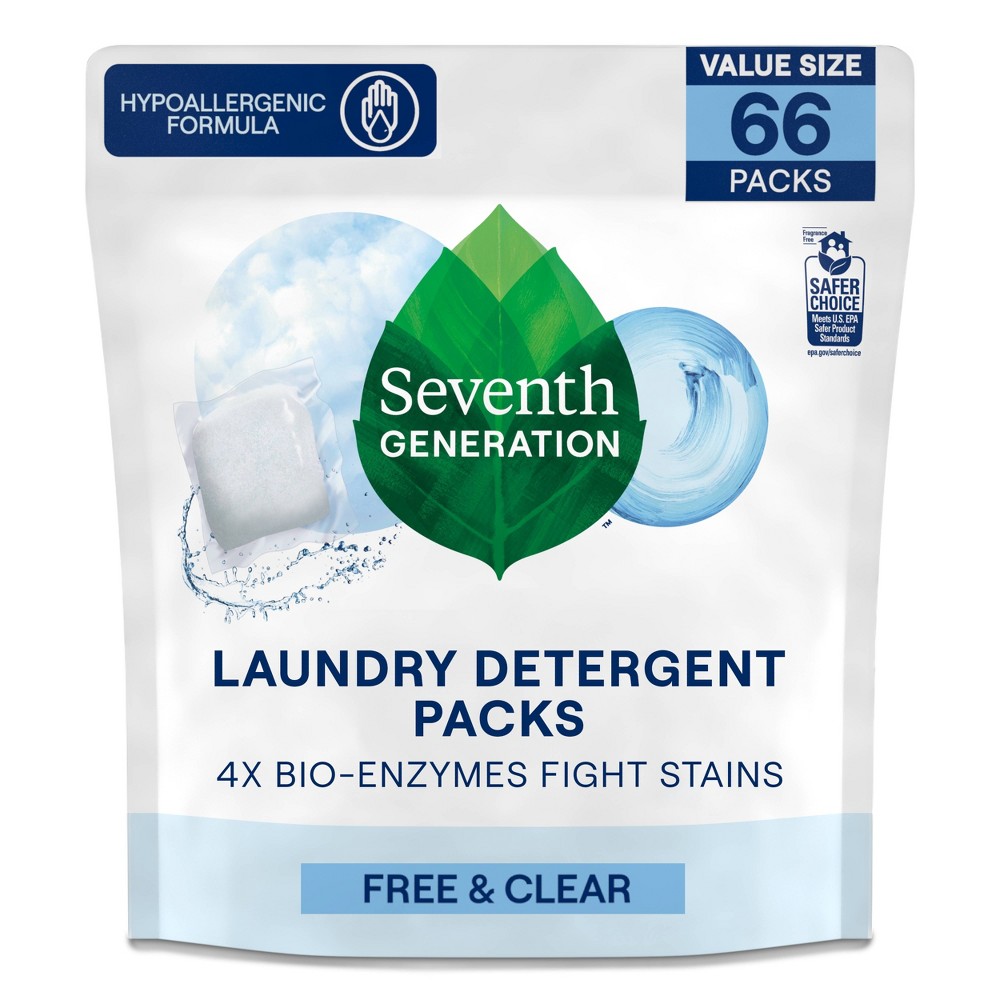
Seventh Generation Laundry Packs - Free & Clear - 66ct: Hypoallergenic, Concentrated Capsules, Resealable Bag
Analysis updated August 2026 · How Scout scores
At a glance
Summary
This product contains several beneficial ingredients such as sodium citrate, sodium bicarbonate, and plant-derived enzymes, which are biodegradable and environmentally friendly. However, the presence of Laureth-6, a surfactant with potential contamination risks, slightly detracts from its overall safety profile. Despite this, the product remains largely plant-based and free from synthetic fragrances, making it a relatively safe choice for indoor use.
Key ingredients 12
Cocos nucifera oilGood
Cocos nucifera oil, or coconut oil, is used as a natural surfactant. It helps to clean and condition fabrics. It is plant-derived and considered safe and environmentally friendly.
Risks
There are minimal risks associated with coconut oil in cleaning products.
Benefits
It is a natural surfactant that cleans and conditions fabrics.
ProteaseGood
Protease is an enzyme that breaks down protein-based stains. It enhances the cleaning power of detergents. It is biodegradable and considered safe for use in cleaning products.
Risks
There are minimal risks associated with protease in cleaning products.
Benefits
It breaks down protein-based stains, enhancing cleaning power.
AmylaseGood
Amylase is an enzyme that breaks down starch-based stains. It improves the effectiveness of detergents. It is biodegradable and considered safe for use in cleaning products.
Risks
There are minimal risks associated with amylase in cleaning products.
Benefits
It breaks down starch-based stains, improving cleaning effectiveness.
MannanaseGood
Mannanase is an enzyme that breaks down mannan-based stains. It enhances the cleaning power of detergents. It is biodegradable and considered safe for use in cleaning products.
Risks
There are minimal risks associated with mannanase in cleaning products.
Benefits
It breaks down mannan-based stains, enhancing cleaning power.
CellulaseGood
Cellulase is an enzyme that breaks down cellulose-based stains. It helps to maintain fabric quality and enhance cleaning. It is biodegradable and considered safe for use in cleaning products.
Risks
There are minimal risks associated with cellulase in cleaning products.
Benefits
It breaks down cellulose-based stains and helps maintain fabric quality.
Sodium carbonateNeutral
Sodium carbonate is a common water softener and cleaning agent. It helps to remove stains and improve the effectiveness of detergents. It is generally considered safe for use in cleaning products.
Risks
There are minimal risks associated with sodium carbonate in cleaning products.
Benefits
It enhances the cleaning power of detergents by softening water and removing stains.
Sodium citrateNeutral
Standard formulation ingredient — neither beneficial nor harmful at typical use.
Risks
There are minimal risks associated with sodium citrate in cleaning products.
Benefits
It is biodegradable and enhances the cleaning power of detergents by softening water.
Sodium bicarbonateNeutral
Standard formulation ingredient — neither beneficial nor harmful at typical use.
Risks
There are minimal risks associated with sodium bicarbonate in cleaning products.
Benefits
It neutralizes odors and enhances the cleaning power of detergents.
Sodium sulfateNeutral
Sodium sulfate is used as a filler in powdered detergents. It helps to evenly distribute the active ingredients. It is generally considered safe for use in cleaning products.
Risks
There are minimal risks associated with sodium sulfate in cleaning products.
Benefits
It helps to evenly distribute active ingredients in detergents.
Polyvinyl alcoholNeutral
Polyvinyl alcohol is used as a film-forming agent in detergent pods. It dissolves in water, releasing the detergent. It is generally considered safe for use in cleaning products.
Risks
There are minimal risks associated with polyvinyl alcohol in cleaning products.
Benefits
It helps to form the pod structure and dissolves easily in water.
Hydrated silicaNeutral
Hydrated silica is used as an abrasive and thickening agent. It helps to improve the texture and stability of the product. It is generally considered safe for use in cleaning products.
Risks
There are minimal risks associated with hydrated silica in cleaning products.
Benefits
It improves the texture and stability of the product.
Laureth-6Bad
Laureth-6 is a surfactant that can be contaminated with 1,4-dioxane, a potential carcinogen. It is used to help mix oil and water in cleaning products. Despite its effectiveness, the contamination risk makes it less desirable.
Risks
Potential contamination with 1,4-dioxane, which is a possible carcinogen.
Benefits
It is effective in mixing oil and water, enhancing the cleaning power of the product.
Get the full breakdown in the Scout appTake Scout shopping
Scan any product to see lab results, healthy alternatives, and your personalized analysis.
Download on theApp Store GET IT ONGoogle Play