
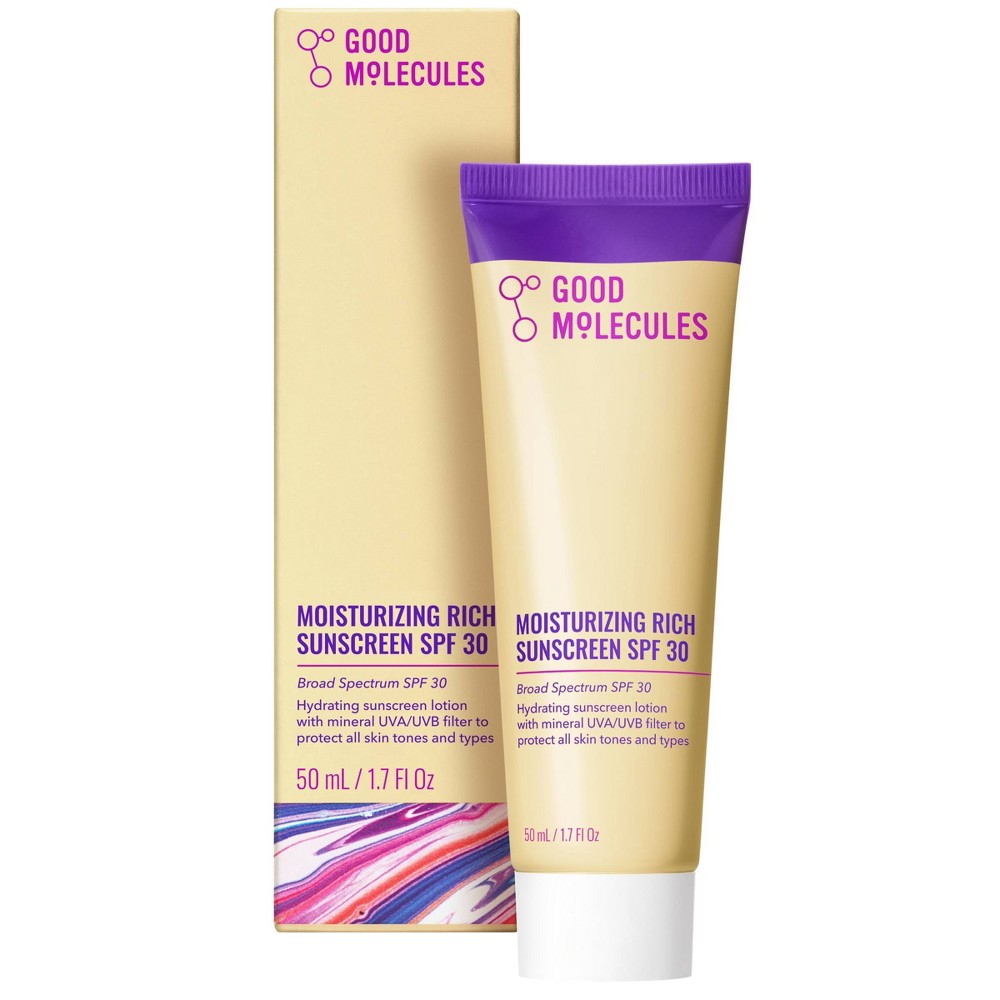
Good Molecules Moisturizing Rich Sunscreen Face Moisturizer - SPF 30 - 50ml: Vegan, Lotion, Normal to Acne-Prone Skin, Unscented
Analysis updated August 2026 · How Scout scores
At a glance
Summary
This sunscreen moisturizer contains beneficial ingredients like shea butter, grape seed oil, and sodium hyaluronate, which provide hydration and skin protection. However, it includes a chemical UV filter, ethylhexyl methoxycrylene, which may raise concerns for some users. The product avoids synthetic fragrances and other harsh chemicals, contributing to a relatively clean formulation.
Key ingredients 30
Butyrospermum Parkii (Shea) ButterVery Good
Shea Butter is a natural fat extracted from the nuts of the shea tree. It is highly moisturizing and nourishing for the skin. It is rich in vitamins and fatty acids, making it beneficial for dry skin.
Risks
There are minimal risks, though it may cause allergic reactions in individuals with nut allergies.
Benefits
It deeply moisturizes and nourishes the skin, improving elasticity.
Caprylic/Capric TriglycerideGood
This ingredient is an emollient derived from coconut oil and glycerin. It helps to moisturize and replenish the skin. It is well-tolerated by most skin types.
Risks
There are minimal risks, though very sensitive skin may experience mild irritation.
Benefits
It provides a lightweight, non-greasy moisturizing effect.
AllantoinGood
Allantoin is a skin-soothing agent that helps to calm irritation and promote healing. It is beneficial for sensitive and irritated skin. It is widely used for its skin-protective properties.
Risks
There are no significant risks associated with allantoin.
Benefits
It soothes and protects the skin, promoting healing.
Vitis Vinifera (Grape) Seed OilGood
Grape Seed Oil is a natural oil rich in antioxidants and fatty acids. It helps to moisturize and protect the skin from environmental damage. It is lightweight and easily absorbed.
Risks
There are minimal risks, though it may cause irritation in very sensitive skin.
Benefits
It provides antioxidant protection and moisturizes the skin.
BisabololGood
Bisabolol is a natural compound known for its soothing and anti-inflammatory properties. It helps to calm irritated skin and reduce redness. It is beneficial for sensitive and reactive skin types.
Risks
There are no significant risks associated with bisabolol.
Benefits
It soothes and calms the skin, reducing irritation and redness.
TocopherolGood
Tocopherol, also known as Vitamin E, is a powerful antioxidant. It helps to protect the skin from free radical damage and supports skin health. It is widely used for its skin-conditioning properties.
Risks
There are minimal risks, though it may cause irritation in very sensitive skin.
Benefits
It provides antioxidant protection and supports skin health.
Sodium HyaluronateGood
Sodium Hyaluronate is a form of hyaluronic acid known for its excellent moisture-retaining properties. It helps to hydrate and plump the skin, reducing the appearance of fine lines. It is highly beneficial for all skin types.
Risks
There are no significant risks associated with sodium hyaluronate.
Benefits
It provides deep hydration and plumps the skin, reducing fine lines.
Linoleic AcidGood
Linoleic Acid is an essential fatty acid that helps to maintain the skin's barrier function. It is beneficial for dry and sensitive skin, providing nourishment and hydration. It is widely used for its skin-conditioning properties.
Risks
There are no significant risks associated with linoleic acid.
Benefits
It nourishes and hydrates the skin, supporting barrier function.
PhospholipidsGood
Phospholipids are natural compounds that help to maintain the skin's barrier and retain moisture. They are beneficial for dry and dehydrated skin. They are widely used for their moisturizing and skin-conditioning properties.
Risks
There are no significant risks associated with phospholipids.
Benefits
They help to retain moisture and support the skin's barrier function.
PhytosterolsGood
Phytosterols are plant-derived compounds that help to soothe and protect the skin. They are beneficial for sensitive and irritated skin, providing anti-inflammatory effects. They are widely used for their skin-conditioning properties.
Risks
There are no significant risks associated with phytosterols.
Benefits
They soothe and protect the skin, providing anti-inflammatory effects.
GlycerinGood
Glycerin is a humectant that helps to draw moisture into the skin. It is beneficial for all skin types, providing hydration and improving skin texture. It is widely used for its moisturizing properties.
Risks
There are no significant risks associated with glycerin.
Benefits
It hydrates the skin and improves texture, providing a smooth feel.
WaterNeutral
Water is a common solvent used in cosmetics to dissolve other ingredients. It helps in the application and absorption of the product. It does not provide direct benefits or risks.
Risks
There are no significant risks associated with water in cosmetics.
Benefits
Water helps in the even distribution of other ingredients.
Heptyl UndecylenateNeutral
Heptyl Undecylenate is an ester used as an emollient and skin conditioning agent. It provides a silky feel to the skin. It is generally considered safe for use in cosmetics.
Risks
There are no significant risks associated with this ingredient.
Benefits
It enhances the texture and feel of the product on the skin.
PropanediolNeutral
Propanediol is a glycol used as a solvent and humectant in cosmetics. It helps to improve the texture and moisture retention of the product. It is generally safe for use in skincare.
Risks
There are minimal risks, though it may cause irritation in very sensitive skin.
Benefits
It aids in moisture retention and improves product texture.
Cetyl AlcoholNeutral
Cetyl Alcohol is a fatty alcohol used as an emollient and thickener. It helps to stabilize and thicken formulations. It is generally non-irritating and safe for use.
Risks
There are minimal risks, though it may cause irritation in very sensitive skin.
Benefits
It provides a creamy texture and helps to soften the skin.
Ethylhexyl MethoxycryleneNeutral
Ethylhexyl Methoxycrylene is a photostabilizer used in sunscreens to enhance UV filter stability. It helps to maintain the effectiveness of the sunscreen. It is generally considered safe for use.
Risks
There are no significant risks associated with this ingredient.
Benefits
It enhances the stability and effectiveness of UV filters.
C18-21 AlkaneNeutral
C18-21 Alkane is used as an emollient and solvent in cosmetics. It provides a smooth application and helps to improve the texture of the product. It is generally considered safe for use.
Risks
There are no significant risks associated with this ingredient.
Benefits
It improves the texture and application of the product.
Cetearyl AlcoholNeutral
Cetearyl Alcohol is a fatty alcohol used as an emollient and emulsifier. It helps to stabilize and thicken formulations. It is generally non-irritating and safe for use.
Risks
There are minimal risks, though it may cause irritation in very sensitive skin.
Benefits
It provides a creamy texture and helps to soften the skin.
Glyceryl StearateNeutral
Glyceryl Stearate is an emulsifier that helps to blend water and oils. It provides a smooth texture and helps to moisturize the skin. It is generally considered safe for use.
Risks
There are minimal risks, though it may cause irritation in very sensitive skin.
Benefits
It helps to stabilize emulsions and provides a smooth texture.
Sodium Lauroyl GlutamateNeutral
Sodium Lauroyl Glutamate is a mild surfactant used for cleansing and foaming. It is derived from natural sources and is gentle on the skin. It is generally considered safe for use.
Risks
There are minimal risks, though it may cause irritation in very sensitive skin.
Benefits
It provides gentle cleansing without stripping natural oils.
Stearic AcidNeutral
Stearic Acid is a fatty acid used as an emulsifier and thickener. It helps to stabilize formulations and improve texture. It is generally considered safe for use.
Risks
There are minimal risks, though it may cause irritation in very sensitive skin.
Benefits
It stabilizes emulsions and provides a creamy texture.
Polyester-8Neutral
Polyester-8 is a film-forming agent used in sunscreens to enhance water resistance. It helps to maintain the effectiveness of the sunscreen. It is generally considered safe for use.
Risks
There are no significant risks associated with this ingredient.
Benefits
It enhances water resistance and effectiveness of sunscreens.
Caprylyl GlycolNeutral
Caprylyl Glycol is a humectant and skin conditioning agent. It helps to retain moisture and improve the texture of the product. It is generally considered safe for use.
Risks
There are minimal risks, though it may cause irritation in very sensitive skin.
Benefits
It helps to retain moisture and improve product texture.
Lauroyl LysineNeutral
Lauroyl Lysine is an amino acid derivative used as a skin conditioning agent. It provides a silky feel and improves the texture of the product. It is generally considered safe for use.
Risks
There are no significant risks associated with this ingredient.
Benefits
It enhances the texture and feel of the product on the skin.
Polyhydroxystearic AcidNeutral
Polyhydroxystearic Acid is used as a thickener and emulsifier in cosmetics. It helps to stabilize formulations and improve texture. It is generally considered safe for use.
Risks
There are no significant risks associated with this ingredient.
Benefits
It stabilizes emulsions and provides a smooth texture.
Acacia Senegal GumNeutral
Acacia Senegal Gum is a natural gum used as a thickener and stabilizer. It helps to improve the texture and consistency of the product. It is generally considered safe for use.
Risks
There are no significant risks associated with this ingredient.
Benefits
It enhances the texture and stability of the product.
Xanthan GumNeutral
Xanthan Gum is a polysaccharide used as a thickener and stabilizer. It helps to improve the texture and consistency of the product. It is generally considered safe for use.
Risks
There are no significant risks associated with this ingredient.
Benefits
It enhances the texture and stability of the product.
Pongamia Pinnata Seed ExtractNeutral
Pongamia Pinnata Seed Extract is used for its emollient and conditioning properties. It helps to moisturize and protect the skin. It is generally considered safe for use.
Risks
There are no significant risks associated with this ingredient.
Benefits
It moisturizes and conditions the skin.
Sodium GluconateNeutral
Sodium Gluconate is a chelating agent used to improve product stability. It helps to prevent the degradation of other ingredients. It is generally considered safe for use.
Risks
There are no significant risks associated with this ingredient.
Benefits
It enhances product stability and prevents ingredient degradation.
Caprylhydroxamic AcidNeutral
Caprylhydroxamic Acid is a preservative used to prevent microbial growth. It helps to extend the shelf life of the product. It is generally considered safe for use.
Risks
There are no significant risks associated with this ingredient.
Benefits
It prevents microbial growth and extends product shelf life.
Processing
Processed Foods
Get the full breakdown in the Scout appTake Scout shopping
Scan any product to see lab results, healthy alternatives, and your personalized analysis.
Download on theApp Store GET IT ONGoogle PlayAmazon pricing & content
Amazon price as of . Product prices and availability are accurate as of the date/time indicated and are subject to change. Any price and availability information displayed on Amazon.com at the time of purchase will apply to the purchase of this product.
CERTAIN CONTENT THAT APPEARS ON THIS SITE COMES FROM AMAZON. THIS CONTENT IS PROVIDED “AS IS” AND IS SUBJECT TO CHANGE OR REMOVAL AT ANY TIME.