
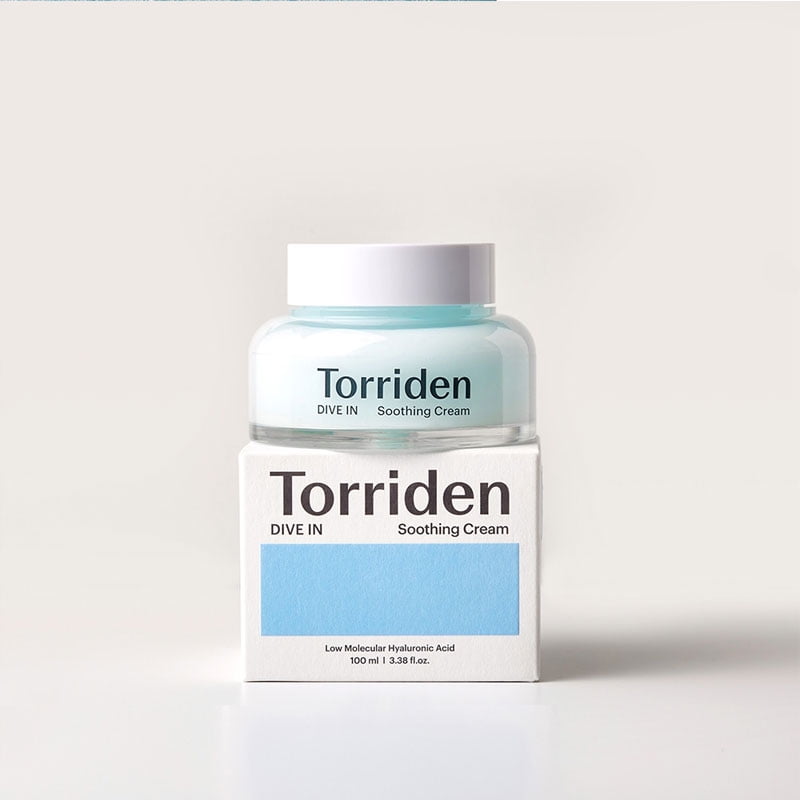



Torriden Dive-In Low Molecular Hyaluronic Acid Soothing Cream 100ml 100ml
Analysis updated August 2026 · How Scout scores
At a glance
Summary
This moisturizer contains a variety of beneficial ingredients such as glycerin, panthenol, and multiple forms of hyaluronic acid, which are known for their hydrating and skin-soothing properties. The inclusion of natural extracts like witch hazel and chamomile further enhances its appeal. However, the presence of synthetic polymers and the processed nature of the product slightly reduce its overall score.
Key ingredients 44
PanthenolVery Good
Panthenol, also known as provitamin B5, is a powerful moisturizer and skin conditioner. It helps improve skin hydration and elasticity.
Risks
There are minimal risks, though it may cause mild irritation in rare cases.
Benefits
It enhances skin hydration and promotes a healthy skin barrier.
Hydrolyzed Hyaluronic AcidVery Good
Hydrolyzed Hyaluronic Acid is a smaller molecule form of hyaluronic acid that penetrates deeper into the skin. It provides intense hydration and plumps the skin.
Risks
There are no significant risks associated with this ingredient.
Benefits
It offers deep hydration and helps reduce the appearance of fine lines.
Sodium Hyaluronate CrosspolymerVery Good
Sodium Hyaluronate Crosspolymer is a cross-linked form of hyaluronic acid that provides long-lasting hydration. It forms a protective film on the skin.
Risks
There are no significant risks associated with this ingredient.
Benefits
It offers prolonged hydration and enhances skin smoothness.
Sodium Acetylated HyaluronateVery Good
Sodium Acetylated Hyaluronate is a modified form of hyaluronic acid that provides enhanced moisture retention. It is known for its superior hydrating properties.
Risks
There are no significant risks associated with this ingredient.
Benefits
It delivers intense hydration and improves skin texture.
Hydrolyzed Sodium HyaluronateVery Good
Hydrolyzed Sodium Hyaluronate is a low molecular weight form of hyaluronic acid that penetrates deeply into the skin. It provides deep hydration and plumping effects.
Risks
There are no significant risks associated with this ingredient.
Benefits
It offers deep hydration and helps reduce the appearance of wrinkles.
GlutathioneVery Good
Glutathione is a powerful antioxidant that helps protect the skin from oxidative stress. It is known for its skin-brightening and anti-aging properties.
Risks
There are no significant risks associated with this ingredient.
Benefits
It provides antioxidant protection and helps improve skin radiance.
GlycerinGood
Glycerin is a well-known humectant that attracts moisture to the skin. It is widely used for its hydrating properties and skin barrier support.
Risks
There are minimal risks associated with glycerin, though it can be sticky in high concentrations.
Benefits
It significantly improves skin hydration and helps maintain a healthy skin barrier.
AllantoinGood
Allantoin is known for its soothing and skin-conditioning properties. It helps to calm irritated skin and promotes healing.
Risks
There are minimal risks, though it may cause mild irritation in rare cases.
Benefits
It soothes the skin and supports the healing of minor skin irritations.
TrehaloseGood
Trehalose is a sugar that acts as a humectant and antioxidant. It helps retain moisture and protects the skin from environmental stress.
Risks
There are no significant risks associated with trehalose.
Benefits
It provides hydration and antioxidant protection to the skin.
Sodium HyaluronateGood
Sodium Hyaluronate is a salt form of hyaluronic acid that is highly effective in retaining moisture. It is known for its ability to hydrate and plump the skin.
Risks
There are no significant risks associated with sodium hyaluronate.
Benefits
It provides excellent hydration and helps maintain skin elasticity.
Caprylic/Capric TriglycerideGood
Caprylic/Capric Triglyceride is an emollient derived from coconut oil and glycerin. It helps moisturize and condition the skin.
Risks
There are no significant risks associated with this ingredient.
Benefits
It provides a lightweight, non-greasy feel and enhances skin hydration.
Curcuma Longa (Turmeric) Root ExtractGood
Turmeric Root Extract is known for its powerful antioxidant and anti-inflammatory properties. It helps protect the skin from environmental damage and soothes irritation.
Risks
There are no significant risks associated with this ingredient.
Benefits
It provides strong antioxidant protection and helps calm irritated skin.
Chamomilla Recutita (Matricaria) Flower ExtractGood
Chamomile Flower Extract is known for its soothing and anti-inflammatory properties. It helps calm irritated skin and reduce redness.
Risks
There are no significant risks associated with this ingredient.
Benefits
It provides soothing benefits and helps reduce skin inflammation.
WaterNeutral
Water is a common solvent used in cosmetics. It helps dissolve other ingredients and provides a base for the formulation.
Risks
There are no significant risks associated with water in cosmetics.
Benefits
Water hydrates the skin and helps in the absorption of other ingredients.
Butylene GlycolNeutral
Butylene Glycol is a common humectant that helps retain moisture in the skin. It also acts as a solvent and improves the texture of the product.
Risks
In rare cases, it may cause irritation or allergic reactions in sensitive individuals.
Benefits
It enhances skin hydration and improves the spreadability of the product.
1, 2-HexanediolNeutral
1, 2-Hexanediol is used as a preservative and emollient in cosmetics. It helps stabilize the formulation and provides a smooth texture.
Risks
It may cause mild irritation in very sensitive skin types.
Benefits
It enhances the shelf life of the product and provides a silky feel.
Hydrogenated DideceneNeutral
Hydrogenated Didecene is an emollient that provides a smooth and silky texture to the skin. It is used to improve the spreadability of the product.
Risks
There are no significant risks associated with this ingredient.
Benefits
It helps in moisturizing the skin and enhances the product's texture.
Hamamelis Virginiana (Witch Hazel) ExtractNeutral
Witch Hazel Extract is known for its astringent and anti-inflammatory properties. It is often used to soothe and tone the skin.
Risks
It may cause dryness or irritation in sensitive skin types.
Benefits
It helps reduce inflammation and tightens the skin.
Glyceryl Acrylate/Acrylic Acid CopolymerNeutral
This copolymer is used as a film-forming agent and thickener in cosmetics. It helps improve the texture and stability of the product.
Risks
There are no significant risks associated with this ingredient.
Benefits
It enhances the product's texture and provides a smooth application.
PVM/MA CopolymerNeutral
PVM/MA Copolymer is used as a film-forming agent and adhesive in cosmetics. It helps improve the product's texture and adherence to the skin.
Risks
There are no significant risks associated with this ingredient.
Benefits
It enhances the product's texture and provides a smooth application.
Hydroxyethyl Acrylate/Sodium Acryloyldimethyl Taurate CopolymerNeutral
This copolymer is used as a thickener and stabilizer in cosmetics. It helps improve the texture and stability of the product.
Risks
There are no significant risks associated with this ingredient.
Benefits
It enhances the product's texture and provides a smooth application.
2, 3-ButanediolNeutral
2, 3-Butanediol is used as a solvent and humectant in cosmetics. It helps retain moisture and improve the texture of the product.
Risks
There are no significant risks associated with this ingredient.
Benefits
It enhances skin hydration and improves the product's texture.
Cetearyl AlcoholNeutral
Cetearyl Alcohol is a fatty alcohol used as an emollient and thickener in cosmetics. It helps improve the texture and stability of the product.
Risks
There are no significant risks associated with this ingredient.
Benefits
It provides a creamy texture and helps moisturize the skin.
C14-22 AlcoholsNeutral
C14-22 Alcohols are fatty alcohols used as emollients and thickeners in cosmetics. They help improve the texture and stability of the product.
Risks
There are no significant risks associated with these ingredients.
Benefits
They provide a creamy texture and help moisturize the skin.
C12-20 Alkyl GlucosideNeutral
C12-20 Alkyl Glucoside is used as an emulsifier and surfactant in cosmetics. It helps blend oil and water-based ingredients.
Risks
There are no significant risks associated with this ingredient.
Benefits
It improves the texture and stability of the product.
Pentylene GlycolNeutral
Pentylene Glycol is a humectant and solvent used in cosmetics. It helps retain moisture and improve the texture of the product.
Risks
There are no significant risks associated with this ingredient.
Benefits
It enhances skin hydration and improves the product's texture.
Sorbitan IsostearateNeutral
Sorbitan Isostearate is used as an emulsifier in cosmetics. It helps blend oil and water-based ingredients.
Risks
There are no significant risks associated with this ingredient.
Benefits
It improves the texture and stability of the product.
Melia Azadirachta Leaf ExtractNeutral
Melia Azadirachta Leaf Extract is known for its antibacterial and anti-inflammatory properties. It is used to soothe and protect the skin.
Risks
There are no significant risks associated with this ingredient.
Benefits
It helps soothe irritated skin and provides antibacterial protection.
Melia Azadirachta Flower ExtractNeutral
Melia Azadirachta Flower Extract is used for its soothing and protective properties. It helps calm and condition the skin.
Risks
There are no significant risks associated with this ingredient.
Benefits
It provides soothing and protective benefits to the skin.
Coccinia Indica Fruit ExtractNeutral
Coccinia Indica Fruit Extract is used for its antioxidant properties. It helps protect the skin from environmental stress.
Risks
There are no significant risks associated with this ingredient.
Benefits
It provides antioxidant protection and helps maintain skin health.
Solanum Melongena (Eggplant) Fruit ExtractNeutral
Eggplant Fruit Extract is known for its antioxidant and anti-inflammatory properties. It helps protect and soothe the skin.
Risks
There are no significant risks associated with this ingredient.
Benefits
It provides antioxidant protection and helps soothe irritated skin.
Ocimum Sanctum Leaf ExtractNeutral
Ocimum Sanctum Leaf Extract, also known as Holy Basil, is known for its antioxidant and anti-inflammatory properties. It helps protect and soothe the skin.
Risks
There are no significant risks associated with this ingredient.
Benefits
It provides antioxidant protection and helps soothe irritated skin.
Corallina Officinalis ExtractNeutral
Corallina Officinalis Extract is known for its mineral-rich content and skin-conditioning properties. It helps nourish and protect the skin.
Risks
There are no significant risks associated with this ingredient.
Benefits
It provides mineral nourishment and helps maintain skin health.
Salvia Sclarea (Clary) ExtractNeutral
Clary Extract is known for its soothing and anti-inflammatory properties. It helps calm and condition the skin.
Risks
There are no significant risks associated with this ingredient.
Benefits
It provides soothing benefits and helps reduce skin inflammation.
Lavandula Angustifolia (Lavender) Flower ExtractNeutral
Lavender Flower Extract is known for its calming and soothing properties. It helps relax and condition the skin.
Risks
There are no significant risks associated with this ingredient.
Benefits
It provides calming benefits and helps soothe irritated skin.
Hyacinthus Orientalis (Hyacinth) ExtractNeutral
Hyacinth Extract is used for its soothing and conditioning properties. It helps calm and protect the skin.
Risks
There are no significant risks associated with this ingredient.
Benefits
It provides soothing benefits and helps maintain skin health.
Centaurea Cyanus Flower ExtractNeutral
Centaurea Cyanus Flower Extract is known for its soothing and conditioning properties. It helps calm and protect the skin.
Risks
There are no significant risks associated with this ingredient.
Benefits
It provides soothing benefits and helps maintain skin health.
Borago Officinalis ExtractNeutral
Borago Officinalis Extract is known for its skin-conditioning properties. It helps nourish and protect the skin.
Risks
There are no significant risks associated with this ingredient.
Benefits
It provides nourishment and helps maintain skin health.
CarbomerNeutral
Carbomer is used as a thickening agent in cosmetics. It helps improve the texture and stability of the product.
Risks
There are no significant risks associated with this ingredient.
Benefits
It provides a smooth texture and enhances the product's stability.
TromethamineNeutral
Tromethamine is used as a pH adjuster in cosmetics. It helps maintain the stability and effectiveness of the formulation.
Risks
There are no significant risks associated with this ingredient.
Benefits
It helps maintain the product's pH balance and stability.
Xanthan GumNeutral
Xanthan Gum is used as a thickening and stabilizing agent in cosmetics. It helps improve the texture and stability of the product.
Risks
There are no significant risks associated with this ingredient.
Benefits
It provides a smooth texture and enhances the product's stability.
Malachite ExtractNeutral
Malachite Extract is known for its antioxidant and skin-conditioning properties. It helps protect and nourish the skin.
Risks
There are no significant risks associated with this ingredient.
Benefits
It provides antioxidant protection and helps maintain skin health.
EthylhexylglycerinNeutral
Ethylhexylglycerin is used as a preservative and skin-conditioning agent in cosmetics. It helps enhance the product's shelf life and skin feel.
Risks
There are no significant risks associated with this ingredient.
Benefits
It provides antimicrobial protection and improves skin texture.
Disodium EDTABad
Processed additive flagged under Scout's ingredient doctrine.
Risks
There are no significant risks associated with this ingredient.
Benefits
It enhances the stability and shelf life of the product.
Processing
Processed Foods
Get the full breakdown in the Scout appTake Scout shopping
Scan any product to see lab results, healthy alternatives, and your personalized analysis.
Download on theApp Store GET IT ONGoogle PlayAmazon pricing & content
Amazon price as of . Product prices and availability are accurate as of the date/time indicated and are subject to change. Any price and availability information displayed on Amazon.com at the time of purchase will apply to the purchase of this product.
CERTAIN CONTENT THAT APPEARS ON THIS SITE COMES FROM AMAZON. THIS CONTENT IS PROVIDED “AS IS” AND IS SUBJECT TO CHANGE OR REMOVAL AT ANY TIME.