
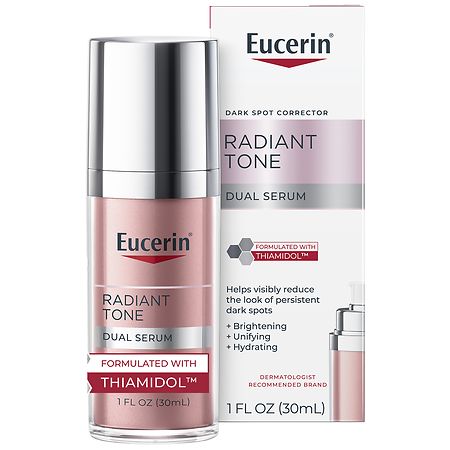


Eucerin Face Radiant Tone Dual Serum, Dark Spot Corrector with Thiamidol and Hyaluronic Acid - 1.0 fl oz
EucerinAnalysis updated August 2026 · How Scout scores
At a glance
Summary
This serum contains beneficial ingredients like glycerin, sodium hyaluronate, and tocopherol, which provide moisturizing and antioxidant benefits. However, the presence of denatured alcohol as a top ingredient can be drying and potentially irritating to the skin, and the inclusion of fragrance adds a risk of skin sensitivity. The product's formulation is a mix of beneficial and potentially harmful components, leading to a moderate processing level.
Key ingredients 31
TocopherolVery Good
Tocopherol, or Vitamin E, is an antioxidant that helps to protect the skin from free radical damage. It also has moisturizing properties and supports skin barrier function. It is widely used in skincare for its protective benefits.
Risks
Generally considered safe with minimal risk of irritation.
Benefits
Protects skin from oxidative stress and supports skin health.
Sodium Ascorbyl PhosphateVery Good
Sodium Ascorbyl Phosphate is a stable form of Vitamin C used in skincare for its antioxidant properties. It helps to brighten the skin and reduce signs of aging. It is valued for its ability to improve skin tone and texture.
Risks
Generally considered safe with minimal risk of irritation.
Benefits
Brightens skin and provides antioxidant protection.
GlycerinGood
Glycerin is a well-known humectant that attracts moisture to the skin. It helps to keep the skin hydrated and improve its barrier function. It is widely used in skincare for its moisturizing properties.
Risks
Generally considered safe with minimal risk of irritation.
Benefits
Excellent for skin hydration and improving skin barrier function.
Sodium HyaluronateGood
Sodium Hyaluronate is a form of hyaluronic acid, a powerful humectant that attracts moisture to the skin. It helps to keep the skin hydrated and plump. It is highly valued in skincare for its moisturizing properties.
Risks
Generally considered safe with minimal risk of irritation.
Benefits
Excellent for skin hydration and plumping.
Glycyrrhiza Inflata Root ExtractGood
Glycyrrhiza Inflata Root Extract is derived from licorice and is known for its anti-inflammatory and skin-brightening properties. It helps to soothe irritated skin and reduce hyperpigmentation. It is valued in skincare for its calming and brightening effects.
Risks
Generally considered safe with minimal risk of irritation.
Benefits
Soothes skin and helps to reduce pigmentation.
Glycine Soja (Soybean) OilGood
Glycine Soja Oil is a natural oil rich in fatty acids and antioxidants. It helps to moisturize the skin and improve its barrier function. It is valued in skincare for its nourishing and protective properties.
Risks
Generally considered safe with minimal risk of irritation.
Benefits
Moisturizes and nourishes the skin, supporting barrier function.
WaterNeutral
Water is a common solvent used in cosmetic formulations. It helps dissolve other ingredients and provides a base for the serum. It does not have any direct benefits or risks associated with its use in cosmetics.
Risks
There are no significant risks associated with water in cosmetics.
Benefits
Water acts as a solvent and hydrates the skin when used in formulations.
Butylene GlycolNeutral
Butylene Glycol is a common humectant and solvent in cosmetics. It helps to retain moisture and improve the texture of the product. It is generally considered safe for use in cosmetics.
Risks
May cause irritation in very sensitive skin types.
Benefits
Helps to maintain skin hydration and improve product spreadability.
Isopropyl PalmitateNeutral
Isopropyl Palmitate is an emollient that helps to soften and smooth the skin. It is used to enhance the texture and spreadability of cosmetic products. It is generally well-tolerated by most skin types.
Risks
May cause acne in very acne-prone skin due to its occlusive nature.
Benefits
Improves skin texture and provides a smooth application.
Cetearyl IsononanoateNeutral
Cetearyl Isononanoate is an emollient that provides a silky feel to the skin. It helps to improve the spreadability of the product. It is generally considered safe for use in cosmetics.
Risks
Minimal risk of irritation or allergic reaction.
Benefits
Enhances product texture and provides a smooth application.
Diisopropyl AdipateNeutral
Diisopropyl Adipate is used as an emollient and solvent in cosmetics. It helps to improve the texture and spreadability of the product. It is generally considered safe for use in cosmetics.
Risks
Low risk of irritation or allergic reaction.
Benefits
Improves product texture and provides a smooth application.
Propylheptyl CaprylateNeutral
Propylheptyl Caprylate is an emollient that provides a light, non-greasy feel to the skin. It helps to improve the spreadability of the product. It is generally considered safe for use in cosmetics.
Risks
Minimal risk of irritation or allergic reaction.
Benefits
Enhances product texture and provides a smooth application.
Cetearyl AlcoholNeutral
Cetearyl Alcohol is a fatty alcohol used as an emollient and thickener in cosmetics. It helps to stabilize emulsions and improve the texture of the product. It is generally considered safe and non-irritating.
Risks
Low risk of irritation or allergic reaction.
Benefits
Improves product texture and stability.
Distarch PhosphateNeutral
Distarch Phosphate is used as a thickening agent in cosmetics. It helps to improve the texture and stability of the product. It is generally considered safe for use in cosmetics.
Risks
Minimal risk of irritation or allergic reaction.
Benefits
Enhances product texture and stability.
Isobutylamido Thiazolyl ResorcinolNeutral
Isobutylamido Thiazolyl Resorcinol is used in cosmetics for its skin-brightening properties. It helps to reduce the appearance of dark spots and improve skin tone. It is generally considered safe for use in cosmetics.
Risks
Minimal risk of irritation or allergic reaction.
Benefits
Helps to brighten skin and reduce dark spots.
GlucosylrutinNeutral
Glucosylrutin is an antioxidant used in cosmetics to protect the skin from oxidative stress. It helps to improve skin resilience and reduce signs of aging. It is generally considered safe for use in cosmetics.
Risks
Minimal risk of irritation or allergic reaction.
Benefits
Provides antioxidant protection and supports skin health.
IsoquercitrinNeutral
Isoquercitrin is a flavonoid with antioxidant properties used in cosmetics. It helps to protect the skin from free radical damage and improve skin health. It is generally considered safe for use in cosmetics.
Risks
Minimal risk of irritation or allergic reaction.
Benefits
Provides antioxidant protection and supports skin health.
Glyceryl StearateNeutral
Glyceryl Stearate is an emulsifier used to stabilize cosmetic formulations. It helps to improve the texture and spreadability of the product. It is generally considered safe for use in cosmetics.
Risks
Minimal risk of irritation or allergic reaction.
Benefits
Stabilizes formulations and improves product texture.
Hydroxypropyl Starch PhosphateNeutral
Hydroxypropyl Starch Phosphate is used as a thickening agent in cosmetics. It helps to improve the texture and stability of the product. It is generally considered safe for use in cosmetics.
Risks
Minimal risk of irritation or allergic reaction.
Benefits
Enhances product texture and stability.
Dehydroxanthan GumNeutral
Dehydroxanthan Gum is used as a thickening and stabilizing agent in cosmetics. It helps to improve the texture and stability of the product. It is generally considered safe for use in cosmetics.
Risks
Minimal risk of irritation or allergic reaction.
Benefits
Enhances product texture and stability.
Sodium Stearoyl GlutamateNeutral
Sodium Stearoyl Glutamate is an emulsifier used to stabilize cosmetic formulations. It helps to improve the texture and spreadability of the product. It is generally considered safe for use in cosmetics.
Risks
Minimal risk of irritation or allergic reaction.
Benefits
Stabilizes formulations and improves product texture.
Xanthan GumNeutral
Xanthan Gum is used as a thickening and stabilizing agent in cosmetics. It helps to improve the texture and stability of the product. It is generally considered safe for use in cosmetics.
Risks
Minimal risk of irritation or allergic reaction.
Benefits
Enhances product texture and stability.
Gellan GumNeutral
Gellan Gum is used as a thickening and stabilizing agent in cosmetics. It helps to improve the texture and stability of the product. It is generally considered safe for use in cosmetics.
Risks
Minimal risk of irritation or allergic reaction.
Benefits
Enhances product texture and stability.
Sodium ChlorideNeutral
Sodium Chloride is used as a thickening agent and stabilizer in cosmetics. It helps to improve the texture and stability of the product. It is generally considered safe for use in cosmetics.
Risks
Minimal risk of irritation or allergic reaction.
Benefits
Enhances product texture and stability.
EthylhexylglycerinNeutral
Ethylhexylglycerin is used as a preservative and skin conditioning agent in cosmetics. It helps to enhance the efficacy of other preservatives and improve skin feel. It is generally considered safe for use in cosmetics.
Risks
Minimal risk of irritation or allergic reaction.
Benefits
Enhances preservative efficacy and improves skin feel.
Trisodium EDTANeutral
Trisodium EDTA is a chelating agent used to improve the stability of cosmetic formulations. It helps to bind metal ions and prevent product degradation. It is generally considered safe for use in cosmetics.
Risks
Minimal risk of irritation or allergic reaction.
Benefits
Improves product stability and prevents degradation.
Citric AcidNeutral
Citric Acid is used to adjust the pH of cosmetic formulations. It helps to maintain the stability and efficacy of the product. It is generally considered safe for use in cosmetics.
Risks
May cause irritation in very sensitive skin types.
Benefits
Helps to maintain product stability and efficacy.
DimethiconeBad
Occlusive silicone film-former — flagged under clean-beauty doctrine.
Risks
May cause breakouts in very acne-prone skin due to its occlusive nature.
Benefits
Smooths skin and improves product texture.
PhenoxyethanolBad
Processed additive flagged under Scout's ingredient doctrine.
Risks
May cause irritation in very sensitive skin types.
Benefits
Prevents microbial growth and extends product shelf life.
Alcohol Denat.Very Bad
Alcohol Denat. is used as a solvent and astringent in cosmetics. It can be drying and irritating to the skin, especially in high concentrations. It may disrupt the skin's natural barrier function.
Risks
Can cause skin dryness and irritation, especially for sensitive skin types.
Benefits
Helps in quick drying of the product and enhances penetration of other ingredients.
FragranceVery Bad
Fragrance is used to impart a pleasant scent to cosmetic products. It can be irritating to the skin and is a common allergen. It is often criticized for its potential to cause skin sensitivity.
Risks
Can cause skin irritation and allergic reactions.
Benefits
Provides a pleasant scent to the product.
Get the full breakdown in the Scout appTake Scout shopping
Scan any product to see lab results, healthy alternatives, and your personalized analysis.
Download on theApp Store GET IT ONGoogle PlayAmazon pricing & content
Amazon price as of . Product prices and availability are accurate as of the date/time indicated and are subject to change. Any price and availability information displayed on Amazon.com at the time of purchase will apply to the purchase of this product.
CERTAIN CONTENT THAT APPEARS ON THIS SITE COMES FROM AMAZON. THIS CONTENT IS PROVIDED “AS IS” AND IS SUBJECT TO CHANGE OR REMOVAL AT ANY TIME.