
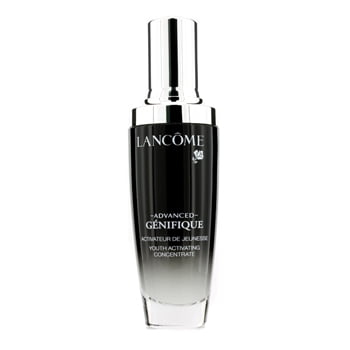


Lancome Advanced Genifique Youth Activating Concentrate Serum, 1.69 Oz
Analysis updated September 2026 · How Scout scores
At a glance
Summary
This serum contains beneficial ingredients like Bifida Ferment Lysate, Glycerin, and Sodium Hyaluronate, which provide hydration and support skin health. However, the presence of Alcohol Denat as a top ingredient can be drying and potentially damaging to the skin barrier. Additionally, the inclusion of fragrance components like Limonene and Citronellol, which can cause irritation, further impacts the product's safety profile.
Key ingredients 34
Bifida Ferment LysateVery Good
Bifida Ferment Lysate is a probiotic ingredient that helps strengthen the skin's barrier. It is known for its soothing and repairing properties. It can improve skin resilience and reduce sensitivity.
Risks
There are minimal risks associated with this ingredient, though individual reactions can vary.
Benefits
It enhances skin barrier function and provides anti-aging benefits by reducing skin sensitivity.
Ascorbyl GlucosideVery Good
Ascorbyl Glucoside is a stable form of Vitamin C that provides antioxidant benefits. It helps brighten the skin and reduce signs of aging. It is known for its ability to improve skin tone and texture.
Risks
It is generally safe, but some individuals may experience mild irritation.
Benefits
It provides antioxidant protection and helps brighten and even out skin tone.
TocopherolVery Good
Tocopherol, or Vitamin E, is a powerful antioxidant that protects the skin from free radical damage. It helps moisturize and strengthen the skin barrier. It is widely used for its anti-aging and skin-conditioning properties.
Risks
It is generally safe, but high concentrations can cause irritation in sensitive individuals.
Benefits
It provides antioxidant protection and helps maintain skin health.
GlycerinGood
Glycerin is a humectant that attracts moisture to the skin, keeping it hydrated. It is widely used in skincare for its moisturizing properties. It helps maintain the skin's water balance on an intercellular level.
Risks
Glycerin is generally safe, but in very high concentrations, it can cause irritation.
Benefits
It provides excellent hydration and helps maintain skin moisture levels.
LactobacillusGood
Lactobacillus is a probiotic that can help balance the skin's microbiome. It has soothing and anti-inflammatory properties. It can enhance the skin's natural defense mechanisms.
Risks
There are minimal risks, though individual reactions can vary.
Benefits
It supports a healthy skin microbiome and reduces inflammation.
Sodium HyaluronateGood
Sodium Hyaluronate is a form of hyaluronic acid that provides intense hydration. It can hold up to 1000 times its weight in water, making it an excellent moisturizer. It helps plump the skin and reduce the appearance of fine lines.
Risks
There are minimal risks associated with this ingredient.
Benefits
It provides deep hydration and helps maintain skin elasticity.
AdenosineGood
Adenosine is a beneficial ingredient known for its anti-wrinkle and skin-soothing properties. It helps improve the appearance of fine lines and promotes smoother skin. It is well-tolerated and effective in anti-aging formulations.
Risks
There are minimal risks associated with this ingredient.
Benefits
It helps reduce the appearance of wrinkles and improves skin texture.
Salicyloyl PhytosphingosineGood
This ingredient is a derivative of salicylic acid and sphingosine, known for its anti-inflammatory properties. It helps improve skin barrier function and reduce redness. It is beneficial for sensitive and acne-prone skin.
Risks
There are minimal risks, though individual reactions can vary.
Benefits
It helps soothe inflammation and improve skin barrier function.
Rosa Gallica Flower ExtractGood
Rosa Gallica Flower Extract is a botanical ingredient known for its soothing and antioxidant properties. It helps calm the skin and reduce redness. It is beneficial for sensitive and irritated skin.
Risks
There are minimal risks, though individual reactions can vary.
Benefits
It provides soothing and antioxidant benefits, supporting skin health.
Aqua/WaterNeutral
Aqua, or water, is a common solvent used in cosmetic formulations. It helps dissolve other ingredients and provides a base for the product. It is generally considered safe and non-reactive.
Risks
There are no significant risks associated with water in cosmetic products.
Benefits
Water acts as a carrier for active ingredients, allowing them to be absorbed by the skin.
Hydroxyethylpiperazine Ethane Sulfonic AcidNeutral
This ingredient is used to adjust the pH of cosmetic formulations. It helps maintain the stability and efficacy of the product. It is generally considered safe for use in cosmetics.
Risks
There are no significant risks associated with this ingredient in cosmetic formulations.
Benefits
It helps maintain the product's pH balance, ensuring stability and effectiveness.
Sodium HydroxideNeutral
Sodium Hydroxide is used to adjust the pH of cosmetic products. It is a strong base that helps maintain the stability of formulations. It is used in very small amounts to ensure product safety.
Risks
In high concentrations, it can be irritating, but it is used in safe amounts in cosmetics.
Benefits
It helps maintain the product's pH balance, ensuring stability and effectiveness.
PEG-20 Methyl Glucose SesquistearateNeutral
This ingredient is an emulsifier that helps blend oil and water-based components. It is derived from natural glucose and is considered safe for use in cosmetics. It helps improve the texture and stability of formulations.
Risks
There are minimal risks associated with this ingredient.
Benefits
It helps stabilize formulations and improve product texture.
PEG-60 Hydrogenated Castor OilNeutral
This ingredient is an emulsifier and surfactant used to stabilize cosmetic formulations. It is derived from castor oil and is generally considered safe. It helps improve the texture and spreadability of products.
Risks
There are minimal risks, though it can cause irritation in sensitive individuals.
Benefits
It helps stabilize formulations and improve product texture.
Polymnia Sonchifolia Root JuiceNeutral
This ingredient is derived from the yacon plant and is used for its moisturizing properties. It is rich in fructooligosaccharides, which help retain moisture in the skin. It is considered safe and beneficial for hydration.
Risks
There are minimal risks associated with this ingredient.
Benefits
It provides hydration and helps maintain skin moisture levels.
MaltodextrinNeutral
Maltodextrin is a polysaccharide used as a binding and stabilizing agent in cosmetics. It helps improve the texture and consistency of products. It is generally considered safe for use in skincare formulations.
Risks
There are minimal risks associated with this ingredient.
Benefits
It helps stabilize formulations and improve product texture.
Ammonium Polyacryloyldimethyl TaurateNeutral
This ingredient is a thickening agent used to improve the texture of cosmetic products. It helps stabilize emulsions and provides a smooth feel. It is considered safe for use in skincare formulations.
Risks
There are minimal risks associated with this ingredient.
Benefits
It helps stabilize formulations and improve product texture.
MannoseNeutral
Mannose is a sugar molecule used for its moisturizing properties in cosmetics. It helps retain moisture and improve skin hydration. It is considered safe and beneficial for skin health.
Risks
There are minimal risks associated with this ingredient.
Benefits
It provides hydration and helps maintain skin moisture levels.
Xanthan GumNeutral
Xanthan Gum is a natural thickening agent used to stabilize cosmetic formulations. It helps improve the texture and consistency of products. It is considered safe and non-irritating.
Risks
There are minimal risks associated with this ingredient.
Benefits
It helps stabilize formulations and improve product texture.
Pentylene GlycolNeutral
Pentylene Glycol is a humectant and solvent used to enhance the texture of cosmetic products. It helps retain moisture and improve skin hydration. It is considered safe and effective in skincare formulations.
Risks
There are minimal risks associated with this ingredient.
Benefits
It provides hydration and helps improve product texture.
Caprylyl GlycolNeutral
Caprylyl Glycol is a skin-conditioning agent that provides moisturizing benefits. It helps improve the texture and feel of cosmetic products. It is considered safe and effective in skincare formulations.
Risks
There are minimal risks associated with this ingredient.
Benefits
It provides hydration and helps improve product texture.
Alpha-Glucan OligosaccharideNeutral
This ingredient is a prebiotic that helps support the skin's natural microbiome. It is used for its moisturizing and skin-conditioning properties. It is considered safe and beneficial for skin health.
Risks
There are minimal risks associated with this ingredient.
Benefits
It supports a healthy skin microbiome and provides hydration.
SorbitolNeutral
Sorbitol is a sugar alcohol used as a humectant in cosmetics. It helps retain moisture and improve skin hydration. It is considered safe and effective in skincare formulations.
Risks
There are minimal risks associated with this ingredient.
Benefits
It provides hydration and helps maintain skin moisture levels.
OctyldodecanolNeutral
Octyldodecanol is an emollient used to improve the texture and feel of cosmetic products. It helps provide a smooth and silky finish. It is considered safe and effective in skincare formulations.
Risks
There are minimal risks associated with this ingredient.
Benefits
It provides a smooth texture and helps improve product spreadability.
DimethiconeBad
Occlusive silicone film-former — flagged under clean-beauty doctrine.
Risks
It can potentially trap dirt and bacteria if not properly cleansed from the skin.
Benefits
It provides a silky texture and helps to smooth the skin's surface.
Sodium BenzoateBad
Synthetic preservative that can form benzene in the presence of vitamin C.
Risks
There are minimal risks, though it can cause irritation in sensitive individuals.
Benefits
It prevents microbial growth, ensuring product safety and longevity.
PhenoxyethanolBad
Processed additive flagged under Scout's ingredient doctrine.
Risks
In high concentrations, it can cause irritation, but it is used in safe amounts in cosmetics.
Benefits
It helps preserve the product by preventing bacterial contamination.
Faex Extract/Yeast ExtractBad
Processed additive flagged under Scout's ingredient doctrine.
Risks
There are minimal risks, though individual reactions can vary.
Benefits
It provides nutrients and antioxidants, supporting skin health and hydration.
LimoneneBad
Limonene is a fragrance component that can cause skin irritation and sensitization. It is derived from citrus oils and is used for its pleasant scent. It can oxidize and become more irritating over time.
Risks
It can cause skin irritation and allergic reactions, especially in sensitive individuals.
Benefits
It provides a pleasant citrus scent to cosmetic products.
Propylene GlycolBad
Processed additive flagged under Scout's ingredient doctrine.
Risks
It can cause irritation in sensitive skin types.
Benefits
It provides hydration and helps improve product texture.
Disodium EDTABad
Processed additive flagged under Scout's ingredient doctrine.
Risks
There are minimal risks associated with this ingredient.
Benefits
It helps stabilize formulations and improve product longevity.
CitronellolBad
Citronellol is a fragrance component that can cause skin irritation and sensitization. It is derived from essential oils and is used for its floral scent. It can oxidize and become more irritating over time.
Risks
It can cause skin irritation and allergic reactions, especially in sensitive individuals.
Benefits
It provides a pleasant floral scent to cosmetic products.
Alcohol DenatVery Bad
Alcohol Denat is used as a solvent and can help other ingredients penetrate the skin. However, it can be drying and irritating, especially for sensitive skin. It may disrupt the skin's natural barrier over time.
Risks
It can cause dryness and irritation, particularly in sensitive skin types.
Benefits
It helps other ingredients penetrate the skin more effectively.
Parfum/FragranceVery Bad
Fragrance is a common cause of skin irritation and allergic reactions in cosmetics. It is used to provide a pleasant scent but can be problematic for sensitive skin. It is often a mixture of various chemicals, some of which may be irritating.
Risks
It can cause skin irritation and allergic reactions, especially in sensitive individuals.
Benefits
It provides a pleasant scent to cosmetic products.
Get the full breakdown in the Scout appTake Scout shopping
Scan any product to see lab results, healthy alternatives, and your personalized analysis.
Download on theApp Store GET IT ONGoogle Play