
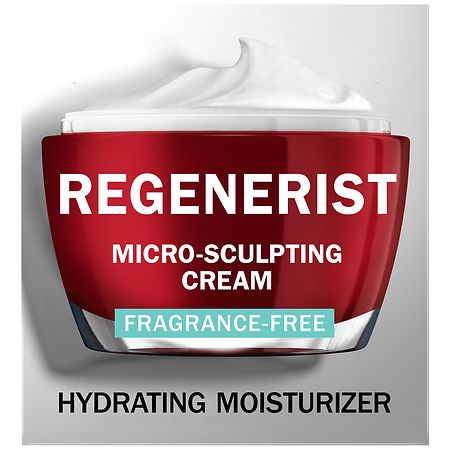

Olay Regenerist Face Moisturizer Micro-Sculpting Cream - Fragrance Free - 1.7oz: Anti-Aging, Peptide & Hyaluronic Acid Formula
Analysis updated August 2026 · How Scout scores
At a glance
Summary
This moisturizer contains beneficial ingredients like niacinamide, hyaluronic acid, and peptides, which are known for their hydrating and anti-aging properties. However, the presence of ethylparaben, a controversial preservative linked to potential endocrine disruption, slightly lowers its safety profile. The product is processed, which also impacts its overall rating, but the absence of fragrance and inclusion of natural extracts like aloe vera and green tea are positive aspects.
Key ingredients 37
PanthenolVery Good
Panthenol is a provitamin of B5 that acts as a moisturizer and skin conditioner. It helps to improve skin hydration and elasticity. It is well-tolerated by most skin types and is known for its soothing properties.
Risks
Rarely, it may cause mild irritation or redness.
Benefits
Improves skin hydration and soothes irritated skin.
Palmitoyl Pentapeptide-4Very Good
Palmitoyl Pentapeptide-4 is a peptide that helps to stimulate collagen production and improve skin firmness. It is known for its anti-aging benefits and ability to reduce the appearance of fine lines and wrinkles. It is generally considered safe and effective for most skin types.
Risks
Rarely, it may cause mild irritation or redness.
Benefits
Stimulates collagen production and reduces signs of aging.
Camellia Sinensis Leaf ExtractVery Good
Camellia Sinensis Leaf Extract, also known as Green Tea Extract, is rich in antioxidants and has anti-inflammatory properties. It helps to protect the skin from environmental damage and soothe irritation. It is well-tolerated by most skin types.
Risks
Rarely, it may cause mild irritation or redness.
Benefits
Protects skin from environmental damage and soothes irritation.
Aloe Barbadensis Leaf JuiceVery Good
Aloe Barbadensis Leaf Juice, commonly known as Aloe Vera, is known for its soothing and hydrating properties. It helps to calm irritated skin and improve skin hydration. It is well-tolerated by most skin types.
Risks
Rarely, it may cause mild irritation or redness.
Benefits
Soothes irritated skin and improves hydration.
GlycerinGood
Glycerin is a humectant that attracts moisture to the skin, helping to keep it hydrated. It is widely used in skincare for its moisturizing properties. It is generally considered safe and beneficial for most skin types.
Risks
Rarely, it may cause irritation in very sensitive skin.
Benefits
Helps to maintain skin hydration and improve skin barrier function.
NiacinamideGood
Niacinamide is a form of Vitamin B3 that offers multiple skin benefits, including improving skin tone and texture. It is known for its anti-inflammatory properties and ability to reduce redness and blotchiness. It is well-tolerated by most skin types.
Risks
Rarely, it may cause mild irritation or redness.
Benefits
Improves skin texture, reduces inflammation, and enhances skin barrier function.
Tocopheryl AcetateGood
Tocopheryl Acetate is a form of Vitamin E that acts as an antioxidant. It helps to protect the skin from free radical damage and improve skin health. It is generally considered safe and beneficial for most skin types.
Risks
May cause mild irritation in very sensitive skin.
Benefits
Protects skin from oxidative stress and improves skin health.
Sodium HyaluronateGood
Sodium Hyaluronate is a salt form of Hyaluronic Acid that helps to retain moisture in the skin. It is known for its excellent hydrating properties and ability to improve skin elasticity. It is well-tolerated by most skin types.
Risks
Rarely, it may cause mild irritation or redness.
Benefits
Deeply hydrates the skin and improves skin elasticity.
AllantoinGood
Allantoin is a skin conditioning agent known for its soothing and healing properties. It helps to calm irritated skin and promote skin repair. It is generally considered safe and beneficial for most skin types.
Risks
Rarely, it may cause mild irritation or redness.
Benefits
Soothes and heals irritated skin.
Caprylic/Capric TriglycerideGood
Caprylic/Capric Triglyceride is an emollient derived from coconut oil and glycerin. It helps to moisturize and condition the skin. It is well-tolerated by most skin types and is known for its lightweight texture.
Risks
Rarely, it may cause mild irritation or redness.
Benefits
Moisturizes and conditions the skin.
WaterNeutral
Water is a common solvent used in cosmetics to dissolve other ingredients. It helps in the application and absorption of the product. It does not have any direct benefits or risks.
Benefits
Acts as a solvent and helps in the application of the product.
IsohexadecaneNeutral
Isohexadecane is an emollient that provides a silky texture to the product. It helps in spreading the product evenly on the skin. It is generally considered safe for use in cosmetics.
Risks
May cause mild irritation if used in high concentrations.
Benefits
Improves product texture and application.
Isopropyl IsostearateNeutral
Isopropyl Isostearate is an emollient that helps to soften and smooth the skin. It is used to enhance the texture of the product. It is generally considered safe for use in cosmetics.
Risks
May cause mild irritation in sensitive skin.
Benefits
Improves skin smoothness and product texture.
Aluminum Starch OctenylsuccinateNeutral
Aluminum Starch Octenylsuccinate is used as a thickening agent and to absorb excess oil. It helps in improving the texture and feel of the product. It is generally considered safe for use in cosmetics.
Risks
May cause mild irritation if inhaled in powder form.
Benefits
Improves product texture and reduces oiliness.
Nylon-12Neutral
Nylon-12 is used to improve the texture and feel of cosmetic products. It provides a smooth, silky finish and helps in oil absorption. It is generally considered safe for use in cosmetics.
Risks
May cause mild irritation if inhaled in powder form.
Benefits
Improves product texture and provides a matte finish.
Stearyl AlcoholNeutral
Stearyl Alcohol is a fatty alcohol used as an emollient and thickening agent. It helps to improve the texture and stability of the product. It is generally considered safe for use in cosmetics.
Risks
May cause mild irritation in sensitive skin.
Benefits
Improves product texture and stability.
Cetyl AlcoholNeutral
Cetyl Alcohol is a fatty alcohol used as an emollient and thickening agent. It helps to improve the texture and stability of the product. It is generally considered safe for use in cosmetics.
Risks
May cause mild irritation in sensitive skin.
Benefits
Improves product texture and stability.
Sodium Acrylates CopolymerNeutral
Sodium Acrylates Copolymer is used as a thickening agent and film-forming agent in cosmetics. It helps to improve the texture and application of the product. It is generally considered safe for use in cosmetics.
Risks
May cause mild irritation in sensitive skin.
Benefits
Improves product texture and application.
Behenyl AlcoholNeutral
Behenyl Alcohol is a fatty alcohol used as an emollient and thickening agent. It helps to improve the texture and stability of the product. It is generally considered safe for use in cosmetics.
Risks
May cause mild irritation in sensitive skin.
Benefits
Improves product texture and stability.
Acrylamide/Sodium Acryloyldimethyltaurate CopolymerNeutral
Acrylamide/Sodium Acryloyldimethyltaurate Copolymer is used as a thickening agent and film-forming agent in cosmetics. It helps to improve the texture and application of the product. It is generally considered safe for use in cosmetics.
Risks
May cause mild irritation in sensitive skin.
Benefits
Improves product texture and application.
DimethiconolNeutral
Dimethiconol is a silicone-based polymer used as an emollient and skin protectant. It provides a smooth application and helps to lock in moisture. It is generally considered safe for use in cosmetics.
Risks
May cause mild irritation in sensitive skin.
Benefits
Improves skin smoothness and locks in moisture.
Sodium Peg-7 Olive Oil CarboxylateNeutral
Sodium Peg-7 Olive Oil Carboxylate is used as an emulsifier and surfactant in cosmetics. It helps to improve the texture and stability of the product. It is generally considered safe for use in cosmetics.
Risks
May cause mild irritation in sensitive skin.
Benefits
Improves product texture and stability.
Peucedanum Graveolens ExtractNeutral
Peucedanum Graveolens Extract is used for its potential antioxidant and skin-soothing properties. It helps to protect the skin from environmental damage. It is generally considered safe for use in cosmetics.
Risks
May cause mild irritation in sensitive skin.
Benefits
Provides antioxidant protection and soothes the skin.
Peg-100 StearateNeutral
Peg-100 Stearate is used as an emulsifier and surfactant in cosmetics. It helps to improve the texture and stability of the product. It is generally considered safe for use in cosmetics.
Risks
May cause mild irritation in sensitive skin.
Benefits
Improves product texture and stability.
Stearic AcidNeutral
Stearic Acid is a fatty acid used as an emulsifier and thickening agent. It helps to improve the texture and stability of the product. It is generally considered safe for use in cosmetics.
Risks
May cause mild irritation in sensitive skin.
Benefits
Improves product texture and stability.
Cetearyl GlucosideNeutral
Cetearyl Glucoside is used as an emulsifier and surfactant in cosmetics. It helps to improve the texture and stability of the product. It is generally considered safe for use in cosmetics.
Risks
May cause mild irritation in sensitive skin.
Benefits
Improves product texture and stability.
Cetearyl AlcoholNeutral
Cetearyl Alcohol is a fatty alcohol used as an emollient and thickening agent. It helps to improve the texture and stability of the product. It is generally considered safe for use in cosmetics.
Risks
May cause mild irritation in sensitive skin.
Benefits
Improves product texture and stability.
Citric AcidNeutral
Citric Acid is used to adjust the pH of cosmetic products. It helps to maintain product stability and efficacy. It is generally considered safe for use in cosmetics.
Risks
May cause mild irritation in sensitive skin.
Benefits
Maintains product stability and efficacy.
C12-13 Pareth-3Neutral
C12-13 Pareth-3 is used as an emulsifier and surfactant in cosmetics. It helps to improve the texture and stability of the product. It is generally considered safe for use in cosmetics.
Risks
May cause mild irritation in sensitive skin.
Benefits
Improves product texture and stability.
Laureth-7Neutral
Laureth-7 is used as an emulsifier and surfactant in cosmetics. It helps to improve the texture and stability of the product. It is generally considered safe for use in cosmetics.
Risks
May cause mild irritation in sensitive skin.
Benefits
Improves product texture and stability.
C13-14 IsoparaffinNeutral
C13-14 Isoparaffin is used as an emollient and solvent in cosmetics. It helps to improve the texture and application of the product. It is generally considered safe for use in cosmetics.
Risks
May cause mild irritation in sensitive skin.
Benefits
Improves product texture and application.
Sodium HydroxideNeutral
Sodium Hydroxide is used to adjust the pH of cosmetic products. It helps to maintain product stability and efficacy. It is generally considered safe for use in cosmetics when used in low concentrations.
Risks
May cause irritation if used in high concentrations.
Benefits
Maintains product stability and efficacy.
DimethiconeBad
Occlusive silicone film-former — flagged under clean-beauty doctrine.
Risks
May cause mild irritation in sensitive skin.
Benefits
Improves skin smoothness and locks in moisture.
Benzyl AlcoholBad
Processed additive flagged under Scout's ingredient doctrine.
Risks
May cause mild irritation or allergic reactions in sensitive skin.
Benefits
Prevents microbial growth and improves product stability.
Disodium EdtaBad
Processed additive flagged under Scout's ingredient doctrine.
Risks
May cause mild irritation in sensitive skin.
Benefits
Improves product stability and efficacy.
PolyethyleneVery Bad
Heavily flagged ingredient class under Scout's doctrine.
Risks
Concerns about microplastic pollution in the environment.
Benefits
Improves product texture and application.
EthylparabenVery Bad
Ethylparaben is a paraben used as a preservative in cosmetics. It helps to prevent microbial growth and extend product shelf life. However, parabens have been associated with potential endocrine disruption and are considered controversial.
Risks
Potential endocrine disruption and allergic reactions.
Benefits
Prevents microbial growth and extends product shelf life.
Processing
Processed Foods
Get the full breakdown in the Scout appTake Scout shopping
Scan any product to see lab results, healthy alternatives, and your personalized analysis.
Download on theApp Store GET IT ONGoogle PlayAmazon pricing & content
Amazon price as of . Product prices and availability are accurate as of the date/time indicated and are subject to change. Any price and availability information displayed on Amazon.com at the time of purchase will apply to the purchase of this product.
CERTAIN CONTENT THAT APPEARS ON THIS SITE COMES FROM AMAZON. THIS CONTENT IS PROVIDED “AS IS” AND IS SUBJECT TO CHANGE OR REMOVAL AT ANY TIME.