
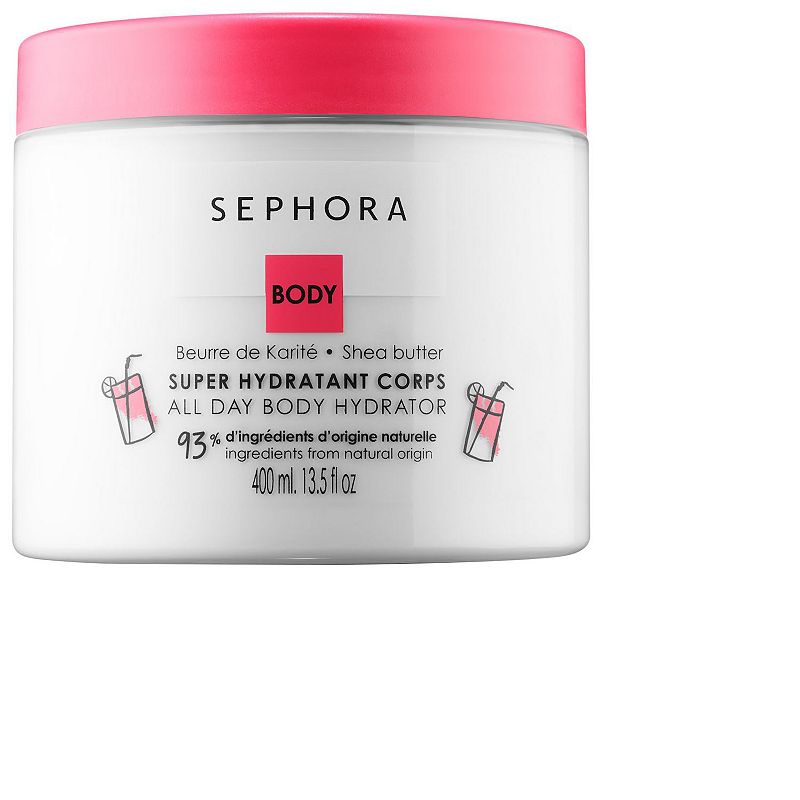

SEPHORA COLLECTION All Day Body Hydrator, Size: 13.5 FL Oz, None
Analysis updated July 2026 · How Scout scores
At a glance
Summary
This body hydrator contains beneficial ingredients like shea butter, mango seed butter, and squalane, which are known for their moisturizing properties. However, the presence of synthetic fragrance and several emulsifiers and stabilizers indicates a moderate level of processing. While it lacks harsh surfactants or known endocrine disruptors, the inclusion of fragrance results in a deduction due to potential skin irritation concerns.
Key ingredients 27
Butyrospermum Parkii Butter (Shea Butter)Very Good
Shea Butter is a natural fat extracted from the nuts of the shea tree. It is rich in vitamins and fatty acids, making it highly moisturizing and nourishing for the skin.
Risks
There is a low risk of allergic reactions, especially for those with nut allergies.
Benefits
Shea Butter provides deep hydration and has anti-inflammatory properties.
Mangifera Indica (Mango) Seed ButterVery Good
Mango Seed Butter is a rich emollient that provides moisture and nourishment to the skin. It is high in fatty acids and antioxidants.
Risks
There is a minimal risk of allergic reactions.
Benefits
It helps to soften the skin and protect it from environmental stressors.
SqualaneVery Good
Squalane is a highly effective emollient and natural antioxidant. It mimics the skin's natural oils, providing deep hydration and improving skin elasticity.
Risks
There are minimal risks, as squalane is generally well-tolerated.
Benefits
It provides long-lasting moisture and helps protect the skin barrier.
C10-18 TriglyceridesGood
C10-18 Triglycerides are emollients that help to moisturize and soften the skin. They are derived from natural oils and are generally well-tolerated by the skin.
Risks
There are minimal risks associated with C10-18 Triglycerides, though some individuals may experience mild irritation.
Benefits
They provide a smooth texture and help to lock in moisture, improving skin hydration.
GlycerinGood
Glycerin is a humectant that attracts moisture to the skin, making it an excellent hydrating agent. It is widely used in skincare for its ability to improve skin barrier function.
Risks
Glycerin is generally safe, but in very high concentrations, it may cause irritation.
Benefits
It helps maintain skin hydration and improves skin texture.
Aqua (Water)Neutral
Water is a common solvent used in cosmetic formulations. It helps dissolve other ingredients and provides a base for the product. It does not have any direct benefits or risks.
Risks
There are no significant risks associated with water in cosmetics.
Benefits
Water helps in the application and absorption of the product.
Isocetyl StearateNeutral
Isocetyl Stearate is an ester used as an emollient and thickening agent in cosmetics. It helps improve the texture and spreadability of products.
Risks
It may cause mild irritation in sensitive individuals.
Benefits
It enhances the smoothness and application of the product.
Glyceryl StearateNeutral
Glyceryl Stearate is an emulsifier that helps blend water and oil components in formulations. It also acts as a skin conditioning agent.
Risks
Generally considered safe, but may cause mild irritation in sensitive skin.
Benefits
It helps stabilize formulations and provides a smooth feel.
Neopentyl Glycol DiheptanoateNeutral
This ingredient is used as an emollient and skin conditioning agent. It provides a silky feel and enhances the spreadability of products.
Risks
There are minimal risks associated with this ingredient.
Benefits
It improves the texture and feel of the product on the skin.
Isopropyl MyristateNeutral
Isopropyl Myristate is used to enhance the absorption of products into the skin. It acts as an emollient and helps improve the texture of formulations.
Risks
It may cause pore-clogging in acne-prone skin.
Benefits
It improves the spreadability and absorption of the product.
Butylene GlycolNeutral
Butylene Glycol is a solvent and conditioning agent that helps improve the texture and spreadability of products. It also acts as a humectant.
Risks
There is a low risk of irritation, especially in sensitive skin.
Benefits
It helps maintain moisture and enhances product application.
Glyceryl Stearate CitrateNeutral
This ingredient is an emulsifier that helps blend oil and water components in formulations. It also acts as a skin conditioning agent.
Risks
Generally safe, but may cause mild irritation in sensitive individuals.
Benefits
It stabilizes formulations and provides a smooth texture.
Hydroxyethyl Acrylate/Sodium Acryloyldimethyl Taurate CopolymerNeutral
This copolymer is used as a thickening agent and stabilizer in cosmetic formulations. It helps improve the texture and consistency of products.
Risks
There are minimal risks associated with this ingredient.
Benefits
It enhances the viscosity and stability of the product.
HydroxyacetophenoneNeutral
Hydroxyacetophenone is used as an antioxidant and preservative in cosmetic formulations. It helps protect the product from degradation.
Risks
There are minimal risks associated with this ingredient.
Benefits
It helps maintain the stability and efficacy of the product.
Acacia Senegal GumNeutral
Acacia Senegal Gum is a natural thickening agent and film-former. It helps improve the texture and stability of cosmetic formulations.
Risks
There are minimal risks associated with this ingredient.
Benefits
It enhances the viscosity and application of the product.
MaltodextrinNeutral
Maltodextrin is used as a binding and stabilizing agent in cosmetics. It helps improve the texture and consistency of products.
Risks
There are minimal risks associated with this ingredient.
Benefits
It helps stabilize formulations and improve texture.
O-Cymen-5-OlNeutral
O-Cymen-5-Ol is used as a preservative and antimicrobial agent in cosmetics. It helps protect the product from microbial contamination.
Risks
There are minimal risks associated with this ingredient.
Benefits
It helps maintain the safety and efficacy of the product.
Sodium Acrylates CopolymerNeutral
This copolymer is used as a thickening and stabilizing agent in cosmetic formulations. It helps improve the texture and consistency of products.
Risks
There are minimal risks associated with this ingredient.
Benefits
It enhances the viscosity and stability of the product.
Xanthan GumNeutral
Xanthan Gum is a natural thickening agent used to stabilize and improve the texture of cosmetic formulations. It is derived from fermented sugars.
Risks
There are minimal risks associated with this ingredient.
Benefits
It helps stabilize formulations and improve texture.
Diethylhexyl SyringylidenemalonateNeutral
This ingredient is used as a UV absorber and stabilizer in cosmetic formulations. It helps protect the product from degradation due to light exposure.
Risks
There are minimal risks associated with this ingredient.
Benefits
It helps maintain the stability and efficacy of the product.
Sorbitan IsostearateNeutral
Sorbitan Isostearate is an emulsifier that helps blend oil and water components in formulations. It also acts as a surfactant.
Risks
There are minimal risks, though it may cause mild irritation in sensitive skin.
Benefits
It stabilizes formulations and improves texture.
Biosaccharide Gum-1Neutral
Biosaccharide Gum-1 is a moisturizing and soothing agent derived from plant sugars. It helps improve skin hydration and texture.
Risks
There are minimal risks associated with this ingredient.
Benefits
It provides hydration and a soothing effect on the skin.
Caprylic/Capric TriglycerideNeutral
Caprylic/Capric Triglyceride is an emollient derived from coconut oil and glycerin. It helps moisturize and condition the skin.
Risks
There are minimal risks associated with this ingredient.
Benefits
It provides a lightweight, non-greasy feel and enhances skin hydration.
Citric AcidNeutral
Citric Acid is used as a pH adjuster and exfoliant in cosmetic formulations. It helps maintain the stability and efficacy of the product.
Risks
In high concentrations, it may cause irritation, especially in sensitive skin.
Benefits
It helps balance the product's pH and can provide mild exfoliation.
Polysorbate 60Bad
Processed additive flagged under Scout's ingredient doctrine.
Risks
There are minimal risks, though it may cause mild irritation in sensitive skin.
Benefits
It stabilizes formulations and improves texture.
LecithinBad
Processed additive flagged under Scout's ingredient doctrine.
Risks
There are minimal risks associated with this ingredient.
Benefits
It helps stabilize formulations and improve skin feel.
Parfum (Fragrance)Very Bad
Fragrance is often used to enhance the sensory experience of a product. However, it can be a common irritant and allergen, especially for sensitive skin.
Risks
Fragrance can cause allergic reactions and skin irritation.
Benefits
It provides a pleasant scent to the product.
Get the full breakdown in the Scout appTake Scout shopping
Scan any product to see lab results, healthy alternatives, and your personalized analysis.
Download on theApp Store GET IT ONGoogle Play