
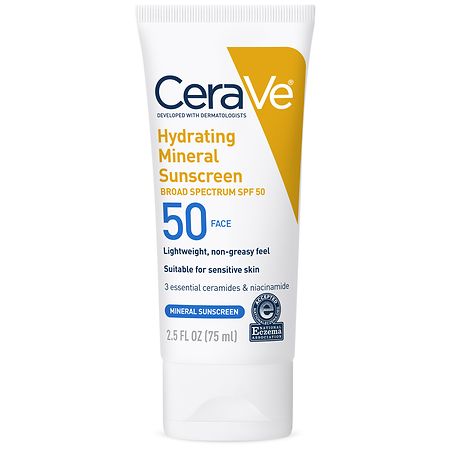
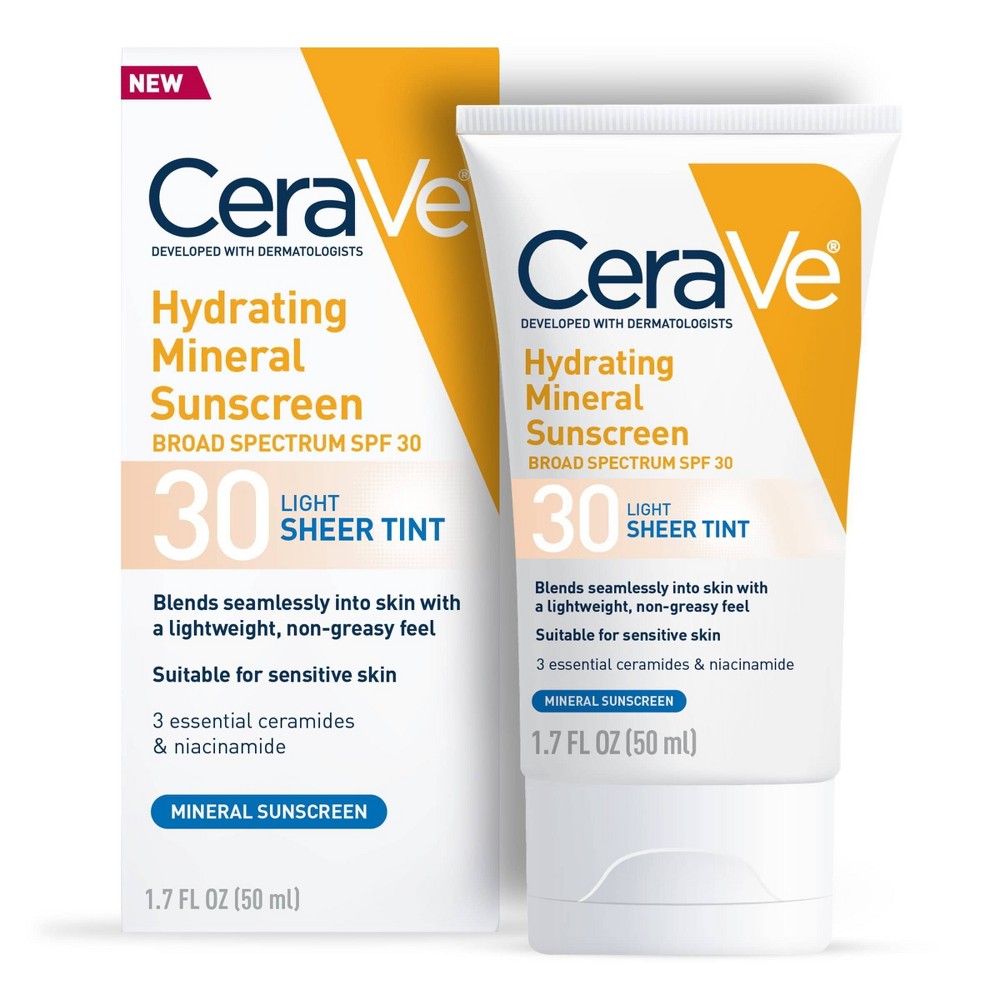

CeraVe Hydrating 100% Mineral Sunscreen for Face - SPF 50 - 2.5 fl oz
Analysis updated August 2026 · How Scout scores
At a glance
Summary
This mineral sunscreen contains beneficial ingredients like zinc oxide, niacinamide, and ceramides, which support skin health and provide effective UV protection. However, the presence of phenoxyethanol, a preservative that can cause irritation, slightly lowers its safety profile. The product is processed, but it maintains a relatively clean ingredient list with a focus on skin-friendly components.
Key ingredients 46
Ceramide APVery Good
Ceramide AP is a lipid that supports the skin barrier and improves hydration. It is beneficial for maintaining healthy skin.
Benefits
Supports skin barrier and improves hydration.
Ceramide EOPVery Good
Ceramide EOP is a lipid that enhances the skin's natural barrier and retains moisture. It is beneficial for dry and sensitive skin.
Benefits
Enhances skin barrier and retains moisture.
TocopherolVery Good
Tocopherol, or Vitamin E, is an antioxidant that helps protect the skin from free radical damage. It is beneficial for maintaining healthy skin.
Benefits
Protects skin from free radical damage and supports skin health.
PanthenolVery Good
Panthenol, or Provitamin B5, is a humectant that helps retain moisture and improve skin barrier function. It is well-tolerated by most skin types.
Benefits
Retains moisture and improves skin barrier function.
GlycerinGood
Glycerin is a humectant that attracts moisture to the skin, helping to keep it hydrated. It is well-tolerated by most skin types and enhances the skin's natural barrier function.
Risks
Rarely, glycerin can cause irritation in very sensitive skin.
Benefits
Helps maintain skin hydration and improves barrier function.
NiacinamideGood
Niacinamide is a form of Vitamin B3 that improves skin barrier function, reduces inflammation, and brightens skin tone. It is well-tolerated by most skin types.
Risks
Rarely, it can cause mild irritation or redness.
Benefits
Improves skin barrier, reduces inflammation, and brightens skin.
Ceramide NPGood
Ceramide NP is a lipid that helps restore the skin barrier and retain moisture. It is beneficial for dry and sensitive skin types.
Benefits
Restores skin barrier and retains moisture.
Sodium HyaluronateGood
Sodium Hyaluronate is a form of hyaluronic acid that helps retain moisture in the skin, improving hydration and plumpness. It is well-tolerated by most skin types.
Benefits
Improves skin hydration and plumpness.
Zinc OxideGood
Zinc Oxide is a mineral sunscreen agent that provides broad-spectrum UV protection. It is generally considered safe and effective for use in sunscreens.
Risks
May cause mild irritation in sensitive skin.
Benefits
Provides broad-spectrum UV protection.
WaterNeutral
Water is a common solvent used in cosmetic formulations. It helps dissolve other ingredients and provides a base for the product. It does not have any direct benefits or risks.
Benefits
Provides a base for other ingredients to be dissolved and applied.
C12-15 Alkyl BenzoateNeutral
C12-15 Alkyl Benzoate is an emollient that helps to improve the texture and feel of the product. It is generally considered safe for use in cosmetics.
Risks
May cause mild irritation in sensitive individuals.
Benefits
Improves product spreadability and skin feel.
IsododecaneNeutral
Isododecane is a lightweight, volatile solvent that helps products dry quickly and feel weightless on the skin. It is commonly used in long-wear formulations.
Risks
May cause dryness if used excessively.
Benefits
Contributes to a lightweight, non-greasy feel.
Glyceryl StearateNeutral
Glyceryl Stearate is an emulsifier that helps blend water and oil components in formulations. It is generally safe and well-tolerated.
Risks
Rarely, it can cause mild irritation in sensitive skin.
Benefits
Helps stabilize emulsions and improve product texture.
Dicaprylyl CarbonateNeutral
Dicaprylyl Carbonate is an emollient that provides a silky feel and enhances the spreadability of products. It is generally safe for use in cosmetics.
Risks
May cause mild irritation in sensitive skin.
Benefits
Improves product texture and application.
PropanediolNeutral
Propanediol is a glycol used as a solvent and skin-conditioning agent. It is generally considered safe and non-irritating.
Risks
Rarely, it can cause mild irritation in sensitive skin.
Benefits
Acts as a solvent and improves skin hydration.
Stearic AcidNeutral
Stearic Acid is a fatty acid used as an emulsifier and thickener in cosmetics. It is generally safe and well-tolerated.
Risks
May cause mild irritation in sensitive individuals.
Benefits
Stabilizes emulsions and improves product texture.
Aluminum HydroxideNeutral
Aluminum Hydroxide is used as a thickening agent and to improve the opacity of products. It is generally considered safe for use in cosmetics.
Risks
May cause mild irritation in sensitive skin.
Benefits
Improves product texture and opacity.
PEG-100 StearateNeutral
PEG-100 Stearate is an emulsifier that helps blend water and oil components. It is generally considered safe for use in cosmetics.
Risks
May cause irritation in sensitive skin due to ethoxylation byproducts.
Benefits
Stabilizes emulsions and improves product texture.
Sorbitan StearateNeutral
Sorbitan Stearate is an emulsifier that helps blend water and oil components in formulations. It is generally safe and well-tolerated.
Risks
May cause mild irritation in sensitive skin.
Benefits
Helps stabilize emulsions and improve product texture.
PEG-8 LaurateNeutral
PEG-8 Laurate is an emulsifier and surfactant used to blend ingredients. It is generally considered safe for use in cosmetics.
Risks
May cause irritation in sensitive skin due to ethoxylation byproducts.
Benefits
Helps blend ingredients and stabilize formulations.
Sorbitan IsostearateNeutral
Sorbitan Isostearate is an emulsifier that helps blend water and oil components. It is generally safe and well-tolerated.
Risks
May cause mild irritation in sensitive skin.
Benefits
Helps stabilize emulsions and improve product texture.
CarbomerNeutral
Carbomer is a thickening agent used to stabilize and thicken formulations. It is generally considered safe for use in cosmetics.
Risks
May cause mild irritation in sensitive skin.
Benefits
Stabilizes and thickens formulations.
Cetearyl AlcoholNeutral
Cetearyl Alcohol is a fatty alcohol used as an emollient and emulsifier. It is generally safe and well-tolerated.
Risks
May cause mild irritation in sensitive skin.
Benefits
Acts as an emollient and stabilizes emulsions.
Ceteareth-20Neutral
Ceteareth-20 is an emulsifier that helps blend water and oil components. It is generally considered safe for use in cosmetics.
Risks
May cause irritation in sensitive skin due to ethoxylation byproducts.
Benefits
Stabilizes emulsions and improves product texture.
TriethoxycaprylylsilaneNeutral
Triethoxycaprylylsilane is a silicone-based compound used to improve the spreadability and feel of products. It is generally considered safe for use in cosmetics.
Risks
May cause mild irritation in sensitive skin.
Benefits
Improves product spreadability and feel.
DimethiconolNeutral
Dimethiconol is a silicone-based polymer used to provide a smooth application and form a protective barrier on the skin. It is non-comedogenic and widely used in skincare.
Risks
Can potentially trap dirt and bacteria if not properly cleansed from the skin.
Benefits
Provides a smooth application and helps protect the skin barrier.
Sodium CitrateNeutral
Sodium Citrate is used as a buffering agent to maintain the pH of formulations. It is generally considered safe for use in cosmetics.
Risks
May cause mild irritation in sensitive skin.
Benefits
Helps maintain product pH stability.
Sodium Lauroyl LactylateNeutral
Sodium Lauroyl Lactylate is a mild surfactant and emulsifier used in cosmetics. It is generally considered safe and well-tolerated.
Risks
May cause mild irritation in sensitive skin.
Benefits
Acts as a mild surfactant and emulsifier.
Myristic AcidNeutral
Myristic Acid is a fatty acid used as an emulsifier and surfactant in cosmetics. It is generally considered safe for use.
Risks
May cause mild irritation in sensitive skin.
Benefits
Acts as an emulsifier and surfactant.
CholesterolNeutral
Cholesterol is a lipid that helps maintain the skin barrier and improve hydration. It is generally safe and beneficial for dry skin.
Benefits
Helps maintain skin barrier and improve hydration.
Palmitic AcidNeutral
Palmitic Acid is a fatty acid used as an emollient and surfactant in cosmetics. It is generally considered safe for use.
Risks
May cause mild irritation in sensitive skin.
Benefits
Acts as an emollient and surfactant.
ChlorphenesinNeutral
Chlorphenesin is a preservative used to prevent microbial growth in cosmetics. It is generally considered safe for use.
Risks
May cause mild irritation in sensitive skin.
Benefits
Prevents microbial growth and extends product shelf life.
Hydroxyethyl Acrylate/Sodium Acryloyldimethyl Taurate CopolymerNeutral
This copolymer is used as a thickening and stabilizing agent in formulations. It is generally considered safe for use in cosmetics.
Risks
May cause mild irritation in sensitive skin.
Benefits
Stabilizes and thickens formulations.
Caprylyl GlycolNeutral
Caprylyl Glycol is a skin-conditioning agent and preservative booster. It is generally considered safe for use in cosmetics.
Risks
May cause mild irritation in sensitive skin.
Benefits
Enhances skin conditioning and preservative efficacy.
Citric AcidNeutral
Citric Acid is used as a pH adjuster and exfoliant in cosmetics. It is generally considered safe for use.
Risks
May cause irritation in sensitive skin if used in high concentrations.
Benefits
Adjusts pH and provides mild exfoliation.
Xanthan GumNeutral
Xanthan Gum is a thickening agent used to stabilize formulations. It is generally considered safe for use in cosmetics.
Risks
May cause mild irritation in sensitive skin.
Benefits
Stabilizes and thickens formulations.
PhytosphingosineNeutral
Phytosphingosine is a lipid that helps maintain the skin barrier and has anti-inflammatory properties. It is generally considered safe for use in cosmetics.
Benefits
Maintains skin barrier and reduces inflammation.
Polyhydroxystearic AcidNeutral
Polyhydroxystearic Acid is used as a thickening and stabilizing agent in formulations. It is generally considered safe for use in cosmetics.
Risks
May cause mild irritation in sensitive skin.
Benefits
Stabilizes and thickens formulations.
EthylhexylglycerinNeutral
Ethylhexylglycerin is a preservative and skin-conditioning agent. It is generally considered safe for use in cosmetics.
Risks
May cause mild irritation in sensitive skin.
Benefits
Enhances preservative efficacy and conditions the skin.
Titanium DioxideNeutral
Standard formulation ingredient — neither beneficial nor harmful at typical use.
Risks
May cause mild irritation in sensitive skin.
Benefits
Provides broad-spectrum UV protection.
DimethiconeBad
Occlusive silicone film-former — flagged under clean-beauty doctrine.
Risks
Can potentially trap dirt and bacteria if not properly cleansed from the skin.
Benefits
Provides a smooth application and helps protect the skin barrier.
Styrene/Acrylates CopolymerBad
Processed additive flagged under Scout's ingredient doctrine.
Risks
May cause irritation if used in high concentrations.
Benefits
Improves product adherence and longevity.
Butyloctyl SalicylateBad
Processed additive flagged under Scout's ingredient doctrine.
Risks
May cause mild irritation in sensitive individuals.
Benefits
Improves sunscreen efficacy and product feel.
Sodium DodecylbenzenesulfonateBad
Sodium Dodecylbenzenesulfonate is a surfactant that can be harsh on the skin and cause irritation. It is generally avoided in sensitive skin formulations.
Risks
Can cause skin irritation and dryness, especially in sensitive skin.
Benefits
Effective as a cleansing and foaming agent.
PhenoxyethanolBad
Phenoxyethanol is a preservative that can cause irritation and allergic reactions in some individuals. It is often used as an alternative to parabens.
Risks
Can cause skin irritation and allergic reactions, especially in sensitive individuals.
Benefits
Effective as a preservative to prevent microbial growth.
Polysorbate 60Bad
Processed additive flagged under Scout's ingredient doctrine.
Risks
May cause irritation in sensitive skin due to ethoxylation byproducts.
Benefits
Stabilizes emulsions and improves product texture.
Processing
Processed Foods
Get the full breakdown in the Scout appTake Scout shopping
Scan any product to see lab results, healthy alternatives, and your personalized analysis.
Download on theApp Store GET IT ONGoogle PlayAmazon pricing & content
Amazon price as of . Product prices and availability are accurate as of the date/time indicated and are subject to change. Any price and availability information displayed on Amazon.com at the time of purchase will apply to the purchase of this product.
CERTAIN CONTENT THAT APPEARS ON THIS SITE COMES FROM AMAZON. THIS CONTENT IS PROVIDED “AS IS” AND IS SUBJECT TO CHANGE OR REMOVAL AT ANY TIME.