
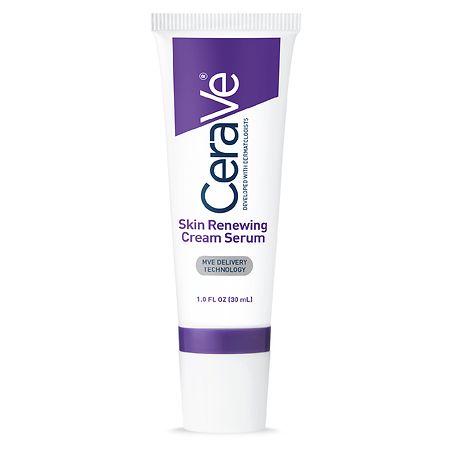
CeraVe Skin Renewing Retinol Face Serum for Fine Lines and Wrinkles - 1oz: Paraben-Free, Aluminum-Free, Contains Ceramides
Analysis updated August 2026 · How Scout scores
At a glance
Summary
This serum contains beneficial ingredients like glycerin, ceramides, and niacinamide, which support skin hydration and barrier function. However, the presence of triethanolamine, which can cause skin irritation and is associated with potential carcinogens, lowers its safety profile. Additionally, the inclusion of PEG compounds and the processed nature of the product further impact its overall rating.
Key ingredients 37
Ceramide APVery Good
Ceramide AP is a type of ceramide that supports skin barrier function. It helps to lock in moisture and protect the skin from environmental stressors. It is beneficial for maintaining healthy skin.
Risks
There are no significant risks associated with ceramides.
Benefits
It enhances skin hydration and barrier protection.
Ceramide EOPVery Good
Ceramide EOP is a crucial component of the skin's lipid barrier. It helps to maintain skin hydration and resilience. It is effective in improving skin texture and reducing dryness.
Risks
There are no significant risks associated with ceramides.
Benefits
It supports the skin's natural barrier and improves moisture retention.
RetinolVery Good
Retinol is a form of Vitamin A that is highly effective in reducing fine lines and wrinkles. It promotes cell turnover and improves skin texture. It is a well-researched ingredient with proven anti-aging benefits.
Risks
It can cause irritation and sensitivity, especially in high concentrations.
Benefits
It helps to reduce signs of aging and improve skin texture.
Hydrolyzed Hyaluronic AcidVery Good
Hydrolyzed Hyaluronic Acid is a smaller molecule form of hyaluronic acid that penetrates the skin more effectively. It provides intense hydration and plumps the skin. It is highly beneficial for improving skin moisture and elasticity.
Risks
There are no significant risks associated with hyaluronic acid.
Benefits
It enhances skin hydration and improves elasticity.
Butyrospermum Parkii ButterVery Good
Butyrospermum Parkii Butter, also known as shea butter, is a natural emollient that provides intense moisture to the skin. It helps to soften and smooth the skin. It is well-tolerated and beneficial for all skin types.
Risks
There are no significant risks associated with shea butter.
Benefits
It provides deep hydration and improves skin texture.
GlycerinGood
Glycerin is a humectant that attracts moisture to the skin. It helps to maintain hydration and improve skin barrier function. It is well-tolerated by most skin types.
Risks
There are minimal risks, though it can be sticky in high concentrations.
Benefits
Glycerin helps to keep the skin moisturized and soft.
Caprylic/Capric TriglycerideGood
Caprylic/Capric Triglyceride is an emollient derived from coconut oil and glycerin. It helps to smooth and soften the skin. It is lightweight and non-greasy, making it suitable for various skin types.
Risks
There are minimal risks, though it may cause breakouts in very sensitive skin.
Benefits
It enhances the spreadability of the product and provides a silky feel.
Ceramide NPGood
Ceramide NP is a lipid that helps to restore the skin's natural barrier. It is essential for maintaining skin hydration and integrity. It is well-tolerated and beneficial for all skin types.
Risks
There are no significant risks associated with ceramides.
Benefits
It helps to strengthen the skin barrier and retain moisture.
NiacinamideGood
Niacinamide is a form of Vitamin B3 that offers multiple skin benefits. It helps to improve skin tone, reduce redness, and enhance barrier function. It is well-tolerated by most skin types and is highly beneficial.
Risks
There are minimal risks, though it may cause mild irritation in very sensitive skin.
Benefits
It helps to brighten the skin and improve its overall appearance.
Cichorium Intybus Root ExtractGood
Cichorium Intybus Root Extract, also known as chicory root extract, is a natural ingredient with antioxidant properties. It helps to protect the skin from environmental stressors. It is beneficial for maintaining healthy skin.
Risks
There are minimal risks, though it may cause mild irritation in very sensitive skin.
Benefits
It provides antioxidant protection and supports skin health.
CholesterolGood
Cholesterol is a lipid that helps to maintain the skin's natural barrier. It is essential for skin hydration and integrity. It is beneficial for improving skin texture and reducing dryness.
Risks
There are no significant risks associated with cholesterol.
Benefits
It supports the skin's natural barrier and improves moisture retention.
TocopherolGood
Tocopherol, also known as Vitamin E, is an antioxidant that helps to protect the skin from free radical damage. It supports skin health and improves hydration. It is well-tolerated and beneficial for all skin types.
Risks
There are no significant risks associated with tocopherol.
Benefits
It provides antioxidant protection and enhances skin hydration.
PhytosphingosineGood
Phytosphingosine is a lipid that helps to restore the skin's natural barrier. It has anti-inflammatory and antimicrobial properties. It is beneficial for maintaining healthy skin.
Risks
There are no significant risks associated with phytosphingosine.
Benefits
It supports the skin's natural barrier and reduces inflammation.
WaterNeutral
Water is a common solvent used in cosmetic formulations. It helps dissolve other ingredients and provides a base for the serum. It is generally considered safe and non-irritating.
Risks
There are no significant risks associated with water in cosmetics.
Benefits
Water helps to hydrate the skin and improve the texture of the product.
Potassium Cetyl PhosphateNeutral
Potassium Cetyl Phosphate is an emulsifying agent that helps to stabilize formulations. It allows oil and water components to mix effectively. It is generally considered safe for use in cosmetics.
Risks
There are no significant risks associated with this ingredient.
Benefits
It helps to maintain the consistency and stability of the product.
Hydrogenated Palm GlyceridesNeutral
Hydrogenated Palm Glycerides are used as emollients and thickeners in cosmetic formulations. They help to improve the texture and feel of the product. They are generally considered safe for use.
Risks
There are environmental concerns related to palm oil production.
Benefits
They provide a smooth texture and enhance the moisturizing properties of the product.
Polysorbate 20Neutral
Polysorbate 20 is a surfactant and emulsifier used to stabilize formulations. It helps to mix oil and water components effectively. It is generally considered safe for use in cosmetics.
Risks
There is a potential for mild skin irritation in sensitive individuals.
Benefits
It helps to improve the texture and stability of the product.
PEG-40 StearateNeutral
PEG-40 Stearate is an emulsifier that helps to blend ingredients in formulations. It is derived from stearic acid and polyethylene glycol. It is generally considered safe for use in cosmetics.
Risks
There is a potential for contamination with ethylene oxide and 1,4-dioxane.
Benefits
It helps to stabilize the product and improve its texture.
CyclopentasiloxaneNeutral
Cyclopentasiloxane is a silicone-based compound used to improve the texture and spreadability of products. It provides a silky, smooth feel on the skin. It is generally considered safe for use in cosmetics.
Risks
There are concerns about bioaccumulation in the environment.
Benefits
It helps to enhance the application and feel of the product on the skin.
HydroxyethylcelluloseNeutral
Hydroxyethylcellulose is a thickening agent used to improve the texture of formulations. It is derived from cellulose and is generally considered safe for use. It helps to stabilize and thicken the product.
Risks
There are no significant risks associated with this ingredient.
Benefits
It helps to improve the consistency and application of the product.
Potassium PhosphateNeutral
Potassium Phosphate is used as a buffering agent in cosmetic formulations. It helps to maintain the pH balance of the product. It is generally considered safe for use.
Risks
There are no significant risks associated with this ingredient.
Benefits
It helps to stabilize the pH of the product, ensuring its effectiveness.
CarbomerNeutral
Carbomer is a thickening agent used to stabilize and thicken cosmetic formulations. It helps to create a smooth and consistent texture. It is generally considered safe for use in cosmetics.
Risks
There are no significant risks associated with carbomer.
Benefits
It helps to improve the texture and stability of the product.
Isoceteth-10Neutral
Isoceteth-10 is an emulsifier used to blend oil and water components in formulations. It helps to stabilize the product and improve its texture. It is generally considered safe for use in cosmetics.
Risks
There is a potential for mild skin irritation in sensitive individuals.
Benefits
It helps to maintain the consistency and stability of the product.
Cetearyl AlcoholNeutral
Cetearyl Alcohol is a fatty alcohol used as an emollient and thickener in formulations. It helps to improve the texture and feel of the product. It is generally considered safe and non-irritating.
Risks
There are no significant risks associated with cetearyl alcohol.
Benefits
It provides a smooth texture and enhances the moisturizing properties of the product.
SilicaNeutral
Silica is used as a thickening agent and absorbent in cosmetic formulations. It helps to improve the texture and mattify the skin. It is generally considered safe for use.
Risks
There are no significant risks associated with silica.
Benefits
It helps to improve the texture and finish of the product.
Sodium Lauroyl LactylateNeutral
Sodium Lauroyl Lactylate is a mild surfactant and emulsifier used in cosmetics. It helps to stabilize formulations and improve texture. It is generally considered safe for use.
Risks
There are no significant risks associated with this ingredient.
Benefits
It helps to maintain the consistency and stability of the product.
AlcoholNeutral
Alcohol is used as a solvent and preservative in cosmetic formulations. It helps to dissolve other ingredients and improve product texture. It can be drying to the skin in high concentrations.
Risks
It can cause dryness and irritation, especially in sensitive skin.
Benefits
It helps to improve the texture and stability of the product.
HydroxyacetophenoneNeutral
Hydroxyacetophenone is an antioxidant and preservative used in cosmetics. It helps to protect the product from oxidation and extend its shelf life. It is generally considered safe for use.
Risks
There are no significant risks associated with this ingredient.
Benefits
It provides antioxidant protection and helps to preserve the product.
Citric AcidNeutral
Citric Acid is used as a pH adjuster and exfoliant in cosmetic formulations. It helps to maintain the acidity of the product and improve skin texture. It is generally considered safe for use.
Risks
It can cause irritation in sensitive skin, especially in high concentrations.
Benefits
It helps to balance the pH and improve skin texture.
Pentylene GlycolNeutral
Pentylene Glycol is a humectant and solvent used in cosmetic formulations. It helps to improve skin hydration and enhance the texture of the product. It is generally considered safe for use.
Risks
There are no significant risks associated with pentylene glycol.
Benefits
It helps to improve skin hydration and product texture.
Xanthan GumNeutral
Xanthan Gum is a thickening agent used to stabilize and thicken cosmetic formulations. It helps to create a smooth and consistent texture. It is generally considered safe for use.
Risks
There are no significant risks associated with xanthan gum.
Benefits
It helps to improve the texture and stability of the product.
EthylhexylglycerinNeutral
Ethylhexylglycerin is a preservative and skin-conditioning agent used in cosmetics. It helps to enhance the efficacy of other preservatives and improve skin feel. It is generally considered safe for use.
Risks
There are no significant risks associated with ethylhexylglycerin.
Benefits
It helps to preserve the product and improve skin texture.
Dimethicone/Vinyl Dimethicone CrosspolymerBad
Processed additive flagged under Scout's ingredient doctrine.
Risks
There are concerns about bioaccumulation in the environment.
Benefits
It enhances the application and feel of the product on the skin.
TriethanolamineBad
Triethanolamine is used as a pH balancer and emulsifier in cosmetics. It can cause skin irritation and allergic reactions in some individuals. It is also associated with the formation of nitrosamines, which are potential carcinogens.
Risks
It can cause skin irritation and may form harmful nitrosamines.
Benefits
It helps to stabilize the pH and consistency of the product.
Behentrimonium MethosulfateBad
Processed additive flagged under Scout's ingredient doctrine.
Risks
There are no significant risks associated with this ingredient.
Benefits
It helps to improve the texture and manageability of the product.
LecithinBad
Processed additive flagged under Scout's ingredient doctrine.
Risks
There are no significant risks associated with lecithin.
Benefits
It enhances skin hydration and improves the texture of the product.
PhenoxyethanolBad
Processed additive flagged under Scout's ingredient doctrine.
Risks
It can cause irritation in sensitive skin and is a potential allergen.
Benefits
It helps to preserve the product and prevent contamination.
Processing
Processed Foods
Get the full breakdown in the Scout appTake Scout shopping
Scan any product to see lab results, healthy alternatives, and your personalized analysis.
Download on theApp Store GET IT ONGoogle PlayAmazon pricing & content
Amazon price as of . Product prices and availability are accurate as of the date/time indicated and are subject to change. Any price and availability information displayed on Amazon.com at the time of purchase will apply to the purchase of this product.
CERTAIN CONTENT THAT APPEARS ON THIS SITE COMES FROM AMAZON. THIS CONTENT IS PROVIDED “AS IS” AND IS SUBJECT TO CHANGE OR REMOVAL AT ANY TIME.