
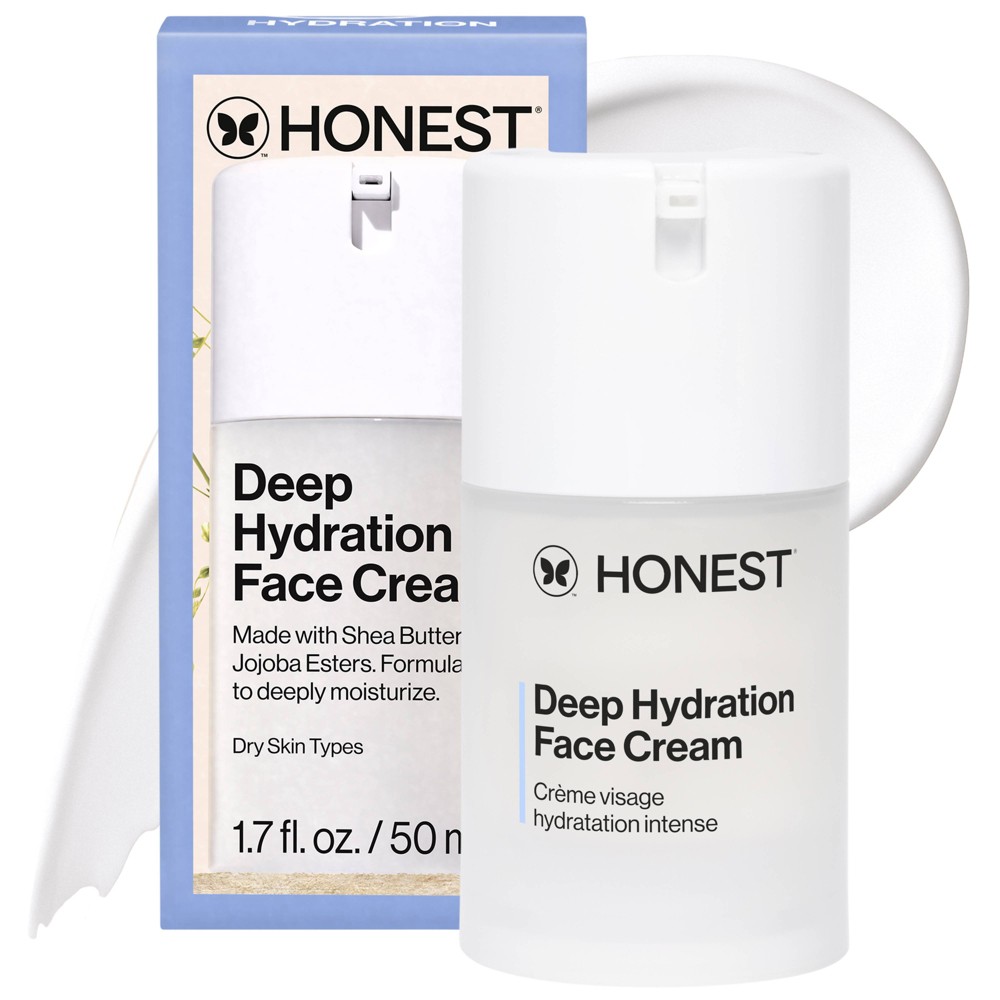

Honest Beauty Deep Hydration Face Cream with Shea Butter - 1.7 fl oz: Unscented, Anti-Aging, Sensitive Skin
Analysis updated August 2026 · How Scout scores
At a glance
Summary
This moisturizer contains several beneficial ingredients such as shea butter, jojoba esters, and hyaluronic acid, which provide excellent hydration and nourishment for the skin. However, the presence of alcohol and benzyl alcohol, which can be drying and irritating, especially for sensitive skin, slightly lowers its overall safety profile. The product is moderately processed, which also impacts its rating.
Key ingredients 48
Jojoba EstersVery Good
Jojoba Esters are derived from jojoba oil and are used for their moisturizing properties. They mimic the skin's natural oils, making them excellent for hydration. They are non-comedogenic and suitable for all skin types.
Risks
Generally considered safe with minimal risk of irritation.
Benefits
Provides excellent moisturizing properties and mimics natural skin oils.
Butyrospermum Parkii (Shea) ButterVery Good
Shea Butter is a natural fat extracted from the nuts of the shea tree, known for its moisturizing and anti-inflammatory properties. It is highly beneficial for dry and sensitive skin. It is widely used in skincare for its nourishing effects.
Risks
Rarely, it may cause allergic reactions in individuals with nut allergies.
Benefits
Deeply moisturizes and nourishes the skin, reducing inflammation.
Beeswax (Cera Alba)Very Good
Beeswax is a natural wax produced by honey bees, used for its emollient and protective properties. It helps to lock in moisture and protect the skin barrier. It is beneficial for dry and sensitive skin.
Risks
May cause allergic reactions in individuals allergic to bee products.
Benefits
Locks in moisture and protects the skin barrier.
Hydrolyzed Hyaluronic AcidVery Good
Hydrolyzed Hyaluronic Acid is a smaller molecule form of hyaluronic acid that penetrates the skin more easily. It provides intense hydration and helps to plump the skin. It is highly beneficial for maintaining skin moisture.
Risks
Generally considered safe with minimal risk of irritation.
Benefits
Provides intense hydration and helps plump the skin.
Calendula Officinalis Flower ExtractVery Good
Calendula Extract is known for its soothing and anti-inflammatory properties. It helps to calm irritated skin and promote healing. It is beneficial for sensitive and inflamed skin.
Risks
Generally considered safe with minimal risk of irritation.
Benefits
Soothes and calms irritated skin, promoting healing.
Chamomilla Recutita (Matricaria) Flower ExtractVery Good
Chamomile Extract is known for its calming and anti-inflammatory properties. It helps to soothe and reduce redness in the skin. It is beneficial for sensitive and irritated skin.
Risks
Generally considered safe with minimal risk of irritation.
Benefits
Calms and soothes the skin, reducing redness.
GlycerinGood
Glycerin is a humectant that attracts moisture to the skin, helping to keep it hydrated. It is widely used in skincare for its moisturizing properties. It is considered safe and beneficial for most skin types.
Risks
Rarely, it may cause irritation in very sensitive skin.
Benefits
Helps maintain skin hydration by attracting moisture.
Raphanus Sativus (Radish) Seed ExtractGood
Radish Seed Extract is used for its antioxidant properties, helping to protect the skin from environmental stressors. It also provides moisturizing benefits. It is generally safe for use in cosmetics.
Risks
May cause mild irritation in sensitive skin.
Benefits
Offers antioxidant protection and moisturizing benefits.
Caprylic/Capric TriglycerideGood
Caprylic/Capric Triglyceride is derived from coconut oil and glycerin, used for its emollient properties. It helps to moisturize and replenish the skin. It is lightweight and non-greasy, making it suitable for all skin types.
Risks
Generally considered safe with minimal risk of irritation.
Benefits
Moisturizes and replenishes the skin without a greasy feel.
Adansonia Digitata Seed OilGood
Adansonia Digitata Seed Oil, also known as Baobab oil, is rich in vitamins and antioxidants. It provides excellent moisturizing and nourishing properties. It is beneficial for dry and aging skin.
Risks
Generally considered safe with minimal risk of irritation.
Benefits
Moisturizes and nourishes the skin, rich in antioxidants.
Malpighia Glabra (Acerola) Fruit ExtractGood
Acerola Fruit Extract is rich in vitamin C and antioxidants, providing skin brightening and anti-aging benefits. It helps to protect the skin from environmental damage. It is beneficial for improving skin tone and texture.
Risks
May cause mild irritation in sensitive skin.
Benefits
Brightens skin and provides antioxidant protection.
Helianthus Annuus (Sunflower) Seed OilGood
Sunflower Seed Oil is rich in vitamins and fatty acids, providing excellent moisturizing and nourishing properties. It helps to maintain the skin's barrier and prevent moisture loss. It is beneficial for all skin types.
Risks
Generally considered safe with minimal risk of irritation.
Benefits
Moisturizes and nourishes the skin, maintaining the skin barrier.
Rosmarinus Officinalis (Rosemary) Leaf ExtractGood
Rosemary Leaf Extract is known for its antioxidant and antimicrobial properties. It helps to protect the skin from environmental damage and improve circulation. It is beneficial for maintaining healthy skin.
Risks
May cause mild irritation in sensitive skin.
Benefits
Provides antioxidant protection and improves skin health.
TocopherolGood
Tocopherol, also known as Vitamin E, is an antioxidant that helps to protect the skin from environmental damage. It provides moisturizing and anti-aging benefits. It is beneficial for maintaining healthy skin.
Risks
Generally considered safe with minimal risk of irritation.
Benefits
Provides antioxidant protection and moisturizes the skin.
Water (Aqua/Eau)Neutral
Water is a common solvent used in cosmetics to dissolve other ingredients. It helps in the application and absorption of the product. It does not provide direct benefits or risks.
Risks
There are no direct risks associated with water in cosmetics.
Benefits
Water helps in the application and absorption of the product.
Ethylhexyl StearateNeutral
Ethylhexyl Stearate is an emollient that helps to soften and smooth the skin. It is commonly used in cosmetics for its ability to improve texture. It is generally considered safe for use.
Risks
May cause mild irritation in sensitive individuals.
Benefits
Improves skin texture by providing a smooth and soft feel.
SorbitolNeutral
Sorbitol is a sugar alcohol used as a humectant in cosmetics to retain moisture. It helps to keep the skin hydrated. It is generally considered safe for use.
Risks
May cause mild irritation if used in high concentrations.
Benefits
Helps retain moisture in the skin, keeping it hydrated.
Glyceryl Stearate SENeutral
Glyceryl Stearate SE is an emulsifier that helps blend water and oil components in cosmetics. It also acts as a lubricant on the skin's surface. It is generally considered safe for use.
Risks
May cause mild irritation in sensitive individuals.
Benefits
Helps blend ingredients and provides a smooth application.
Cetyl AlcoholNeutral
Cetyl Alcohol is a fatty alcohol used as an emollient and thickener in cosmetics. It helps to soften and smooth the skin. It is generally safe and non-irritating.
Risks
Rarely, it may cause irritation in very sensitive skin.
Benefits
Softens and smooths the skin, improving texture.
Glyceryl StearateNeutral
Glyceryl Stearate is an emulsifier that helps to stabilize and thicken cosmetic formulations. It also acts as a lubricant on the skin's surface. It is generally considered safe for use.
Risks
May cause mild irritation in sensitive individuals.
Benefits
Stabilizes formulations and provides a smooth application.
Candelilla/Jojoba/Rice Bran Polyglyceryl-3 EstersNeutral
This ingredient is a blend of esters used as an emulsifier and skin conditioning agent. It helps to improve the texture and feel of the product. It is generally considered safe for use.
Risks
May cause mild irritation in sensitive individuals.
Benefits
Improves texture and conditions the skin.
MaltodextrinNeutral
Maltodextrin is a polysaccharide used as a binding agent in cosmetics. It helps to improve the texture and stability of the product. It is generally considered safe for use.
Risks
May cause mild irritation in sensitive individuals.
Benefits
Improves texture and stability of the product.
Lavandula Hybrida OilNeutral
Lavandula Hybrida Oil is used for its fragrance and potential calming effects. It is often included in cosmetics for its aromatic properties. It is generally safe but can cause irritation in sensitive skin.
Risks
May cause irritation or allergic reactions in sensitive individuals.
Benefits
Provides a calming fragrance and potential soothing effects.
Lavandula Angustifolia (Lavender) OilNeutral
Lavender Oil is used for its fragrance and potential calming effects. It is often included in cosmetics for its aromatic properties. It is generally safe but can cause irritation in sensitive skin.
Risks
May cause irritation or allergic reactions in sensitive individuals.
Benefits
Provides a calming fragrance and potential soothing effects.
Abies Sibirica OilNeutral
Abies Sibirica Oil, also known as Siberian Fir Oil, is used for its fragrance and potential antimicrobial properties. It is included in cosmetics for its aromatic benefits. It is generally safe but can cause irritation in sensitive skin.
Risks
May cause irritation or allergic reactions in sensitive individuals.
Benefits
Provides a fresh fragrance and potential antimicrobial effects.
Pogostemon Cablin Leaf OilNeutral
Pogostemon Cablin Leaf Oil, also known as Patchouli Oil, is used for its fragrance and potential skin benefits. It is included in cosmetics for its aromatic properties. It is generally safe but can cause irritation in sensitive skin.
Risks
May cause irritation or allergic reactions in sensitive individuals.
Benefits
Provides a distinctive fragrance and potential skin benefits.
Cymbopogon Martini OilNeutral
Cymbopogon Martini Oil, also known as Palmarosa Oil, is used for its fragrance and potential skin conditioning properties. It is included in cosmetics for its aromatic benefits. It is generally safe but can cause irritation in sensitive skin.
Risks
May cause irritation or allergic reactions in sensitive individuals.
Benefits
Provides a floral fragrance and potential skin conditioning effects.
Pelargonium Graveolens Flower OilNeutral
Pelargonium Graveolens Flower Oil, also known as Geranium Oil, is used for its fragrance and potential skin benefits. It is included in cosmetics for its aromatic properties. It is generally safe but can cause irritation in sensitive skin.
Risks
May cause irritation or allergic reactions in sensitive individuals.
Benefits
Provides a floral fragrance and potential skin benefits.
Anthemis Nobilis Flower OilNeutral
Anthemis Nobilis Flower Oil, also known as Roman Chamomile Oil, is used for its calming fragrance and potential soothing effects. It is included in cosmetics for its aromatic benefits. It is generally safe but can cause irritation in sensitive skin.
Risks
May cause irritation or allergic reactions in sensitive individuals.
Benefits
Provides a calming fragrance and potential soothing effects.
Citric AcidNeutral
Citric Acid is used to adjust the pH of cosmetics and provide mild exfoliation. It helps to maintain the stability of the product. It is generally safe but can cause irritation in sensitive skin.
Risks
May cause irritation or stinging in sensitive skin.
Benefits
Helps maintain product stability and provides mild exfoliation.
Sodium PhytateNeutral
Sodium Phytate is used as a chelating agent to stabilize cosmetic formulations. It helps to prevent the degradation of the product. It is generally considered safe for use.
Risks
May cause mild irritation in sensitive individuals.
Benefits
Stabilizes formulations and prevents degradation.
AlcoholNeutral
Standard formulation ingredient — neither beneficial nor harmful at typical use.
Risks
Can cause dryness and irritation, especially in sensitive skin.
Benefits
Acts as a solvent and preservative in formulations.
Cetearyl AlcoholNeutral
Cetearyl Alcohol is a fatty alcohol used as an emollient and thickener in cosmetics. It helps to soften and smooth the skin. It is generally safe and non-irritating.
Risks
Rarely, it may cause irritation in very sensitive skin.
Benefits
Softens and smooths the skin, improving texture.
Fagus Sylvatica Bud ExtractNeutral
Fagus Sylvatica Bud Extract is used for its potential anti-aging and skin conditioning properties. It is included in cosmetics for its botanical benefits. It is generally considered safe for use.
Risks
May cause mild irritation in sensitive skin.
Benefits
Provides potential anti-aging and skin conditioning benefits.
Alaria Esculenta ExtractNeutral
Alaria Esculenta Extract is a type of seaweed extract used for its potential antioxidant and skin conditioning properties. It is included in cosmetics for its botanical benefits. It is generally considered safe for use.
Risks
May cause mild irritation in sensitive skin.
Benefits
Provides potential antioxidant and skin conditioning benefits.
Opuntia Ficus-Indica ExtractNeutral
Opuntia Ficus-Indica Extract, also known as Prickly Pear Extract, is used for its moisturizing and skin conditioning properties. It is included in cosmetics for its botanical benefits. It is generally considered safe for use.
Risks
May cause mild irritation in sensitive skin.
Benefits
Provides moisturizing and skin conditioning benefits.
Xanthan GumNeutral
Xanthan Gum is used as a thickening agent in cosmetics to improve texture and stability. It helps to create a smooth and consistent product. It is generally considered safe for use.
Risks
May cause mild irritation in sensitive skin.
Benefits
Improves texture and stability of the product.
Benzoic AcidNeutral
Benzoic Acid is used as a preservative in cosmetics to prevent microbial growth. It helps to extend the shelf life of the product. It is generally considered safe for use.
Risks
May cause mild irritation in sensitive skin.
Benefits
Prevents microbial growth, extending product shelf life.
CitronellolNeutral
Citronellol is a fragrance component used in cosmetics for its floral scent. It is included for its aromatic properties. It is generally safe but can cause irritation in sensitive skin.
Risks
May cause irritation or allergic reactions in sensitive individuals.
Benefits
Provides a floral fragrance to the product.
GeraniolNeutral
Geraniol is a fragrance component used in cosmetics for its rose-like scent. It is included for its aromatic properties. It is generally safe but can cause irritation in sensitive skin.
Risks
May cause irritation or allergic reactions in sensitive individuals.
Benefits
Provides a rose-like fragrance to the product.
DimethiconeBad
Occlusive silicone film-former — flagged under clean-beauty doctrine.
Risks
May cause buildup on the skin, leading to clogged pores.
Benefits
Provides a smooth texture and prevents moisture loss.
Sodium Stearoyl LactylateBad
Processed additive flagged under Scout's ingredient doctrine.
Risks
May cause mild irritation in sensitive individuals.
Benefits
Improves texture and conditions the skin.
LecithinBad
Processed additive flagged under Scout's ingredient doctrine.
Risks
May cause mild irritation in sensitive individuals.
Benefits
Improves texture and conditions the skin.
Benzyl AlcoholBad
Benzyl Alcohol is used as a preservative and solvent in cosmetics, but it can be irritating to the skin. It may cause allergic reactions in sensitive individuals. It is generally not recommended for sensitive skin.
Risks
Can cause irritation and allergic reactions, especially in sensitive skin.
Benefits
Acts as a preservative and solvent in formulations.
Potassium SorbateBad
Synthetic preservative — flagged in daily-use products.
Risks
May cause mild irritation in sensitive skin.
Benefits
Prevents microbial growth, extending product shelf life.
Sodium BenzoateBad
Synthetic preservative that can form benzene in the presence of vitamin C.
Risks
May cause mild irritation in sensitive skin.
Benefits
Prevents microbial growth, extending product shelf life.
LimoneneBad
Processed additive flagged under Scout's ingredient doctrine.
Risks
May cause irritation or allergic reactions in sensitive individuals.
Benefits
Provides a citrus fragrance to the product.
LinaloolBad
Processed additive flagged under Scout's ingredient doctrine.
Risks
May cause irritation or allergic reactions in sensitive individuals.
Benefits
Provides a floral fragrance to the product.
Get the full breakdown in the Scout appTake Scout shopping
Scan any product to see lab results, healthy alternatives, and your personalized analysis.
Download on theApp Store GET IT ONGoogle PlayAmazon pricing & content
Amazon price as of . Product prices and availability are accurate as of the date/time indicated and are subject to change. Any price and availability information displayed on Amazon.com at the time of purchase will apply to the purchase of this product.
CERTAIN CONTENT THAT APPEARS ON THIS SITE COMES FROM AMAZON. THIS CONTENT IS PROVIDED “AS IS” AND IS SUBJECT TO CHANGE OR REMOVAL AT ANY TIME.