Tree To Tub Retinol Body Lotion - Hydrating Retinol Body Cream Retinol Firming Cream w/ Hyaluronic Acid & Shea Butter Body Lotion for Crepey Skin
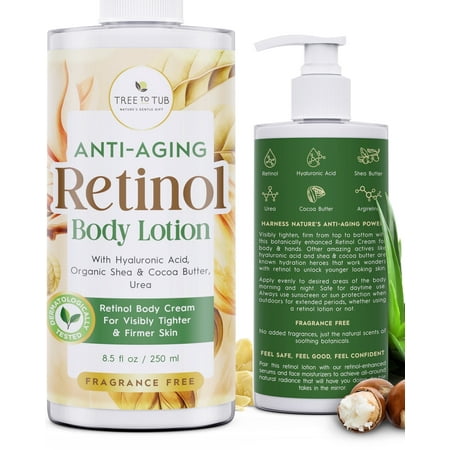
At a glance
Summary
This body lotion contains a variety of beneficial ingredients such as hyaluronic acid, shea butter, and retinol, which are known for their moisturizing and anti-aging properties. The formulation includes mostly natural and safe ingredients, with only a minor concern due to the presence of phenoxyethanol, a synthetic preservative that can cause irritation in some individuals. Overall, the product is well-formulated with a focus on skin health and minimal use of potentially harmful substances. Its plastic packaging can shed microplastics into the product and lowers its score.
Key ingredients 36
RetinolVery Good
Retinol is a form of Vitamin A known for its anti-aging properties. It helps to improve skin texture and reduce the appearance of fine lines.
Risks
Retinol can cause irritation and sensitivity, especially in high concentrations.
Benefits
It promotes cell turnover and improves skin texture.
Theobroma Cacao Seed ButterVery Good
Cocoa butter is a natural fat extracted from cocoa beans, known for its moisturizing properties. It helps to nourish and protect the skin.
Risks
There are minimal risks, though it may cause breakouts in acne-prone skin.
Benefits
It provides deep hydration and improves skin elasticity.
Butyrospermum Parkii ButterVery Good
Shea butter is a natural fat extracted from the nuts of the shea tree, known for its moisturizing and anti-inflammatory properties. It helps to soothe and nourish the skin.
Risks
There are minimal risks, though it may cause breakouts in acne-prone skin.
Benefits
It provides deep hydration and soothes irritated skin.
Simmondsia Chinensis Seed OilVery Good
Jojoba oil is a natural oil known for its moisturizing properties. It is similar to the skin's natural sebum and helps to balance oil production.
Risks
There are minimal risks associated with this ingredient.
Benefits
It provides hydration and helps to balance the skin's natural oils.
Aloe Barbadensis Leaf JuiceVery Good
Aloe vera is known for its soothing and hydrating properties. It helps to calm irritated skin and provides moisture.
Risks
There are minimal risks associated with this ingredient.
Benefits
It soothes and hydrates the skin, reducing inflammation.
Camellia Sinensis Leaf ExtractVery Good
Green tea extract is rich in antioxidants and has anti-inflammatory properties. It helps to protect the skin from environmental damage and soothe irritation.
Risks
There are minimal risks associated with this ingredient.
Benefits
It provides antioxidant protection and soothes the skin.
TocopherolVery Good
Tocopherol, or Vitamin E, is a powerful antioxidant that helps to protect the skin from environmental damage. It also has moisturizing properties.
Risks
There are minimal risks associated with this ingredient.
Benefits
It provides antioxidant protection and improves skin hydration.
GlycerinGood
Glycerin is a humectant that attracts moisture to the skin, helping to keep it hydrated. It is widely used in skincare for its moisturizing properties.
Risks
There are minimal risks associated with glycerin, though it can be sticky.
Benefits
Glycerin helps maintain skin hydration and improves skin barrier function.
Caprylic/Capric TriglycerideGood
This ingredient is an emollient derived from coconut oil and glycerin, known for its skin-softening properties. It helps to improve the spreadability of the lotion.
Risks
There are minimal risks, though it may cause breakouts in very sensitive skin.
Benefits
It provides a lightweight, non-greasy feel and helps to moisturize the skin.
Coco-Caprylate/CaprateGood
Coco-Caprylate/Caprate is an emollient that provides a silky feel to the skin. It is derived from coconut oil and is used to enhance the texture of cosmetic products.
Risks
There are minimal risks, though it may cause irritation in very sensitive skin.
Benefits
It improves the texture of the lotion and provides a smooth application.
Cetearyl OlivateGood
Cetearyl Olivate is an emulsifier derived from olive oil, used to blend oil and water in formulations. It is known for its moisturizing properties.
Risks
There are minimal risks associated with this ingredient.
Benefits
It helps to moisturize the skin and improve the texture of the lotion.
Sorbitan OlivateGood
Sorbitan Olivate is an emulsifier derived from olive oil, used to stabilize emulsions. It is gentle on the skin and helps to improve the texture of products.
Risks
There are minimal risks associated with this ingredient.
Benefits
It helps to stabilize the lotion and provides a smooth application.
UreaGood
Urea is a humectant that helps to retain moisture in the skin. It is also known for its exfoliating properties, helping to improve skin texture.
Risks
In high concentrations, urea can cause irritation.
Benefits
It helps to hydrate the skin and improve its texture.
Sodium HyaluronateGood
Sodium Hyaluronate is a form of hyaluronic acid, known for its ability to retain moisture. It helps to hydrate the skin and improve its elasticity.
Risks
There are minimal risks associated with this ingredient.
Benefits
It provides intense hydration and improves skin texture.
Acetyl Hexapeptide-8Good
Acetyl Hexapeptide-8 is a peptide known for its anti-aging properties. It helps to reduce the appearance of fine lines and wrinkles.
Risks
There are minimal risks associated with this ingredient.
Benefits
It helps to improve skin elasticity and reduce signs of aging.
Sapindus Mukorossi Peel ExtractGood
Sapindus Mukorossi Peel Extract, also known as soapberry extract, is known for its gentle cleansing properties. It is used in skincare for its natural surfactant properties.
Risks
There are minimal risks associated with this ingredient.
Benefits
It provides gentle cleansing and is suitable for sensitive skin.
Saccharum Officinarum ExtractGood
Sugarcane extract is known for its exfoliating properties due to its glycolic acid content. It helps to improve skin texture and promote cell turnover.
Risks
There are minimal risks, though it may cause irritation in very sensitive skin.
Benefits
It helps to exfoliate the skin and improve its texture.
Pyrus Malus Fruit ExtractGood
Apple extract is rich in antioxidants and vitamins, known for its skin-brightening properties. It helps to improve skin tone and texture.
Risks
There are minimal risks associated with this ingredient.
Benefits
It provides antioxidant protection and improves skin radiance.
Citrus Limon Fruit ExtractGood
Lemon extract is known for its astringent and brightening properties. It helps to improve skin tone and reduce excess oil.
Risks
There are minimal risks, though it may cause irritation in very sensitive skin.
Benefits
It helps to brighten the skin and reduce oiliness.
Citrus Aurantium Dulcis Fruit ExtractGood
Orange extract is rich in Vitamin C and antioxidants, known for its brightening properties. It helps to improve skin radiance and texture.
Risks
There are minimal risks associated with this ingredient.
Benefits
It provides antioxidant protection and improves skin brightness.
Tocopheryl AcetateGood
Tocopheryl Acetate is a form of Vitamin E, known for its antioxidant properties. It helps to protect the skin from environmental damage and improve moisture retention.
Risks
There are minimal risks associated with this ingredient.
Benefits
It provides antioxidant protection and improves skin hydration.
Helianthus Annuus Seed OilGood
Sunflower seed oil is a natural oil rich in fatty acids and Vitamin E. It helps to moisturize and nourish the skin.
Risks
There are minimal risks associated with this ingredient.
Benefits
It provides hydration and improves skin barrier function.
AquaNeutral
Aqua, or water, is commonly used as a solvent in cosmetic formulations. It helps dissolve other ingredients and provides a base for the lotion. It does not have any direct benefits or risks.
Risks
There are no significant risks associated with water in cosmetic products.
Benefits
Water acts as a solvent and helps in the application of the lotion.
Cetearyl AlcoholNeutral
Cetearyl Alcohol is a fatty alcohol used as an emollient and thickener in cosmetics. It helps to stabilize and thicken formulations.
Risks
There are minimal risks, though it may cause irritation in very sensitive skin.
Benefits
It helps to stabilize the lotion and provides a creamy texture.
1,2-HexanediolNeutral
1,2-Hexanediol is a synthetic preservative and moisture-binding agent. It helps to stabilize formulations and prevent microbial growth.
Risks
There are minimal risks, though it may cause irritation in very sensitive skin.
Benefits
It helps to preserve the product and maintain its efficacy.
Sodium Acrylates CopolymerNeutral
Sodium Acrylates Copolymer is a thickening agent used to stabilize formulations. It helps to improve the texture and consistency of products.
Risks
There are minimal risks, though it may cause irritation in very sensitive skin.
Benefits
It helps to stabilize the lotion and improve its texture.
Sodium HydroxideNeutral
Sodium Hydroxide is used to adjust the pH of cosmetic formulations. It is a strong base and is used in small amounts to ensure product stability.
Risks
In high concentrations, it can be irritating, but it is used in safe amounts in cosmetics.
Benefits
It helps to stabilize the pH of the product.
Succinic AcidNeutral
Succinic Acid is used as a pH adjuster and has antimicrobial properties. It helps to stabilize formulations and prevent microbial growth.
Risks
There are minimal risks associated with this ingredient.
Benefits
It helps to stabilize the product and maintain its efficacy.
Xanthan GumNeutral
Xanthan Gum is a natural thickening agent used to stabilize formulations. It helps to improve the texture and consistency of products.
Risks
There are minimal risks associated with this ingredient.
Benefits
It helps to stabilize the lotion and improve its texture.
Caprylyl GlycolNeutral
Caprylyl Glycol is a skin-conditioning agent and preservative. It helps to improve the texture of formulations and prevent microbial growth.
Risks
There are minimal risks associated with this ingredient.
Benefits
It helps to condition the skin and preserve the product.
HydroxyacetophenoneNeutral
Hydroxyacetophenone is an antioxidant and preservative booster. It helps to enhance the efficacy of preservatives and protect the skin from oxidative stress.
Risks
There are minimal risks associated with this ingredient.
Benefits
It provides antioxidant protection and boosts preservative efficacy.
Caprylhydroxamic AcidNeutral
Caprylhydroxamic Acid is a preservative used to prevent microbial growth in cosmetics. It is effective and considered safe for use in skincare.
Risks
There are minimal risks associated with this ingredient.
Benefits
It helps to preserve the product and maintain its efficacy.
LecithinBad
Processed additive flagged under Scout's ingredient doctrine.
Risks
There are minimal risks associated with this ingredient.
Benefits
It helps to stabilize the lotion and provides moisture to the skin.
PhenoxyethanolBad
Phenoxyethanol is a synthetic preservative used to prevent microbial growth in cosmetics. It is effective but can cause irritation in some individuals.
Risks
It can cause skin irritation and allergic reactions in sensitive individuals.
Benefits
It helps to preserve the product and extend its shelf life.
Potassium SorbateBad
Synthetic preservative — flagged in daily-use products.
Risks
It can cause irritation in sensitive individuals.
Benefits
It helps to preserve the product and extend its shelf life.
Sodium BenzoateBad
Synthetic preservative that can form benzene in the presence of vitamin C.
Risks
It can cause irritation in sensitive individuals.
Benefits
It helps to preserve the product and maintain its efficacy.
Get the full breakdown in the Scout appTake Scout shopping
Scan any product to see lab results, healthy alternatives, and your personalized analysis.
Are you Tree To Tub? Fix an error Get the badge Get tested
Amazon pricing & content
Amazon price as of . Product prices and availability are accurate as of the date/time indicated and are subject to change. Any price and availability information displayed on Amazon.com at the time of purchase will apply to the purchase of this product.
CERTAIN CONTENT THAT APPEARS ON THIS SITE COMES FROM AMAZON. THIS CONTENT IS PROVIDED “AS IS” AND IS SUBJECT TO CHANGE OR REMOVAL AT ANY TIME.