
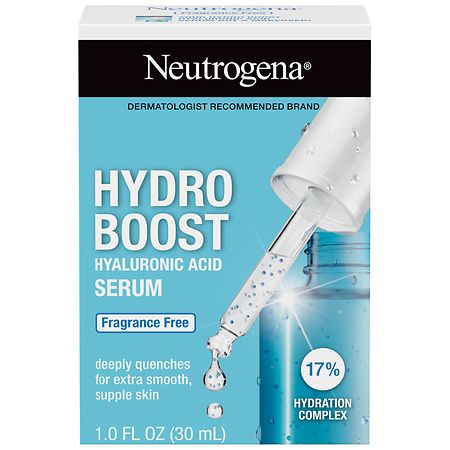


Neutrogena Hydro Boost Hyaluronic Acid Face Serum with Vitamin B5 for Dry Skin - 1 fl oz
Analysis updated August 2026 · How Scout scores
At a glance
Summary
This serum contains beneficial ingredients like glycerin, panthenol, and various forms of hyaluronic acid, which are excellent for moisturizing and improving skin hydration. However, the presence of phenoxyethanol, a preservative that can cause irritation for some individuals, slightly lowers its safety profile. Additionally, the product includes acrylates, which are synthetic polymers, contributing to its processed nature.
Key ingredients 27
PanthenolVery Good
Panthenol, also known as Vitamin B5, is a moisturizing agent that helps to improve skin hydration and elasticity. It is known for its soothing and anti-inflammatory properties. It is beneficial for dry and sensitive skin.
Risks
Very low risk of irritation or allergic reaction.
Benefits
Enhances skin hydration and has soothing properties.
Hydrolyzed Hyaluronic AcidVery Good
Hydrolyzed Hyaluronic Acid is a smaller molecule form of hyaluronic acid that penetrates the skin more easily. It provides excellent hydration and helps to improve skin elasticity. It is suitable for all skin types and is highly effective in improving skin hydration.
Risks
Very low risk of irritation or allergic reaction.
Benefits
Provides deep hydration and improves skin elasticity.
GlycerinGood
Glycerin is a humectant that attracts moisture to the skin, helping to keep it hydrated. It is widely used in skincare for its moisturizing properties. It is generally well-tolerated by most skin types.
Risks
Rarely, it can cause irritation in very sensitive skin.
Benefits
Helps to maintain skin hydration and improve skin barrier function.
Sodium HyaluronateGood
Sodium Hyaluronate is a form of hyaluronic acid known for its excellent moisturizing properties. It helps to retain moisture in the skin, making it look plump and hydrated. It is suitable for all skin types and is highly effective in improving skin hydration.
Risks
Very low risk of irritation or allergic reaction.
Benefits
Provides deep hydration and improves skin texture.
MicaGood
Beneficial ingredient — whole-food or functional value in this product class.
Risks
Inhalation of fine particles can be a concern in powdered form.
Benefits
Adds shimmer and color to cosmetic products.
WaterNeutral
Water is a common solvent used in cosmetics to dissolve other ingredients. It helps in the application and absorption of the product. It does not provide any direct benefits or risks.
Benefits
Acts as a solvent and helps in the application of the product.
Butylene GlycolNeutral
Butylene Glycol is used as a solvent and conditioning agent in cosmetics. It helps to improve the texture and spreadability of products. It is generally considered safe for use in cosmetics.
Risks
May cause irritation in sensitive skin types.
Benefits
Improves product texture and helps in moisture retention.
Pentylene GlycolNeutral
Pentylene Glycol is used as a solvent and skin-conditioning agent. It helps to improve the texture and stability of cosmetic formulations. It is generally considered safe for use in cosmetics.
Risks
May cause mild irritation in sensitive individuals.
Benefits
Improves product stability and texture.
ChlorphenesinNeutral
Chlorphenesin is a preservative used to prevent the growth of bacteria and fungi in cosmetics. It is effective in low concentrations. It is generally considered safe but can cause irritation in sensitive skin.
Risks
Possible skin irritation in sensitive individuals.
Benefits
Helps maintain product integrity by preventing microbial growth.
TrehaloseNeutral
Trehalose is a sugar used as a moisturizing agent in cosmetics. It helps to retain moisture in the skin and improve product stability. It is generally well-tolerated by most skin types.
Risks
Low risk of irritation or allergic reaction.
Benefits
Helps to retain moisture and improve skin hydration.
XylitylglucosideNeutral
Xylitylglucoside is a sugar-derived ingredient used for its moisturizing properties. It helps to improve skin hydration and barrier function. It is generally considered safe for use in cosmetics.
Risks
Low risk of irritation or allergic reaction.
Benefits
Enhances skin hydration and barrier function.
AnhydroxylitolNeutral
Anhydroxylitol is a sugar-derived ingredient used for its moisturizing properties. It helps to improve skin hydration and barrier function. It is generally considered safe for use in cosmetics.
Risks
Low risk of irritation or allergic reaction.
Benefits
Enhances skin hydration and barrier function.
Sodium HydroxideNeutral
Sodium Hydroxide is used to adjust the pH of cosmetic formulations. It is effective in small amounts but can be irritating in higher concentrations. It is generally considered safe when used appropriately.
Risks
Potential for irritation if used in high concentrations.
Benefits
Helps to maintain the desired pH of the product.
XylitolNeutral
Xylitol is a sugar alcohol used for its moisturizing properties in cosmetics. It helps to improve skin hydration and barrier function. It is generally considered safe for use in cosmetics.
Risks
Low risk of irritation or allergic reaction.
Benefits
Enhances skin hydration and barrier function.
Caprylyl GlycolNeutral
Caprylyl Glycol is used as a skin-conditioning agent and preservative booster in cosmetics. It helps to improve skin hydration and extend product shelf life. It is generally considered safe for use in cosmetics.
Risks
Low risk of irritation or allergic reaction.
Benefits
Enhances skin hydration and product preservation.
AgarNeutral
Agar is used as a thickening and gelling agent in cosmetics. It helps to improve the texture and consistency of products. It is generally considered safe for use in cosmetics.
Risks
Low risk of irritation or allergic reaction.
Benefits
Improves product texture and consistency.
Potassium ChlorideNeutral
Potassium Chloride is used as a viscosity-increasing agent in cosmetics. It helps to improve the texture and consistency of products. It is generally considered safe for use in cosmetics.
Risks
Low risk of irritation or allergic reaction.
Benefits
Improves product texture and consistency.
Xanthan GumNeutral
Xanthan Gum is used as a thickening and stabilizing agent in cosmetics. It helps to improve the texture and consistency of products. It is generally considered safe for use in cosmetics.
Risks
Low risk of irritation or allergic reaction.
Benefits
Improves product texture and stability.
Benzoic AcidNeutral
Benzoic Acid is used as a preservative in cosmetics to prevent microbial growth. It is effective in low concentrations and is generally considered safe for use in cosmetics. It can cause irritation in sensitive skin types.
Risks
Potential for skin irritation in sensitive individuals.
Benefits
Prevents microbial growth, extending product shelf life.
Dehydroacetic AcidNeutral
Dehydroacetic Acid is used as a preservative in cosmetics to prevent microbial growth. It is effective in low concentrations and is generally considered safe for use in cosmetics. It can cause irritation in sensitive skin types.
Risks
Potential for skin irritation in sensitive individuals.
Benefits
Prevents microbial growth, extending product shelf life.
UltramarinesNeutral
Ultramarines are pigments used to add color to cosmetics. They are generally considered safe for use in cosmetics. They do not provide any direct benefits or risks.
Benefits
Provides color to cosmetic products.
Titanium DioxideNeutral
Titanium Dioxide is used as a pigment and UV filter in cosmetics. It helps to provide coverage and sun protection in products. It is generally considered safe for use in cosmetics.
Risks
Inhalation of fine particles can be a concern in powdered form.
Benefits
Provides coverage and sun protection.
PhenoxyethanolBad
Phenoxyethanol is a preservative used to prevent microbial growth in cosmetics. It is effective but can cause irritation and allergic reactions in some individuals. It is a common alternative to parabens.
Risks
Potential for skin irritation and allergic reactions.
Benefits
Prevents microbial growth, extending product shelf life.
Acrylates/C10-30 Alkyl Acrylate CrosspolymerBad
Processed additive flagged under Scout's ingredient doctrine.
Risks
May cause mild irritation in sensitive skin types.
Benefits
Improves product texture and stability.
Disodium EDTABad
Processed additive flagged under Scout's ingredient doctrine.
Risks
May cause mild irritation in sensitive skin types.
Benefits
Improves product stability and prevents degradation.
Yeast ExtractBad
Concentrated glutamate source — MSG-adjacent flavor enhancer.
Risks
Low risk of irritation or allergic reaction.
Benefits
Provides moisture and antioxidant protection.
CarrageenanBad
Processed additive flagged under Scout's ingredient doctrine.
Risks
May cause mild irritation in sensitive skin types.
Benefits
Improves product texture and stability.
Get the full breakdown in the Scout appTake Scout shopping
Scan any product to see lab results, healthy alternatives, and your personalized analysis.
Download on theApp Store GET IT ONGoogle PlayAmazon pricing & content
Amazon price as of . Product prices and availability are accurate as of the date/time indicated and are subject to change. Any price and availability information displayed on Amazon.com at the time of purchase will apply to the purchase of this product.
CERTAIN CONTENT THAT APPEARS ON THIS SITE COMES FROM AMAZON. THIS CONTENT IS PROVIDED “AS IS” AND IS SUBJECT TO CHANGE OR REMOVAL AT ANY TIME.